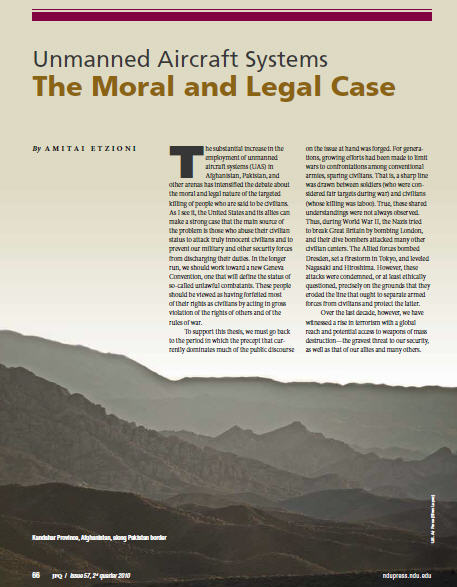
 The renowned sociologist Amitai Etzioni takes to the pages of Joint Force Quarterly to make “The Moral and Legal Case for Unmanned Aircraft Systems [PDF].” The format makes excerpting difficult but the essence of the argument is that “the main source of the problem is those who abuse their civilian status to attack truly innocent civilians and to prevent our military and other security forces from discharging their duties.”
Charli Carpenter, a professor of national security ethics, calls his case “flimsy” and finds the whole notion of “targeted killings of civilians, whatever we might suspect those civilians of doing, and particularly inside the sovereign borders of countries with whom we’re not at war” problematic. And, while she agrees with Etzioni that the Geneva Conventions should be revised to “create a multilateral consensus around what current law means in an era of asymmetric war,” she would not go nearly so far as Etzioni, who would strip them of all their rights as civilians.
As far as I understand it, there is no legal justification for this — that is, no “legal case” to be made here. If they are civilians, they lose their immunity only as long as they are directly participating in hostilities. If they might actually be considered combatants, then Etzioni’s distinction between “innocent” and “abusive” civilians doesn’t make much sense. And even if it did, he suggests no means to distinguish between the two categories for the purpose of making sure you avoid “innocent civilian” casualties — arguably one of the key moral dilemmas that would need to be addressed in order to “make the case.”
Etzioni makes a few other unconvincing statements in supporting his argument: he overestimates, in my view, the differences between today’s wars and previous wars; his claim that we must kill terrorists before they attack us hinges on the notion that terrorists cannot be deterred or rehabilitated (they can); and he seems to be arguing that the UN Charter regime is irrelevant, when he suggests that no government who wishes to target a terrorist on foreign soil should wait for the consent of the foreign government. Maybe his goal is to push us back into a world where conventional war is the norm — go ahead and undermine the territorial integrity norm, and that’s what you’ll have.
While I’m less eager than Carpenter to arrest and rehabilitate terrorists — hunting them down and killing them will do just nicely, thanks — I’m confused by the argument as well.
Terrorists, guerrillas, insurgents, and other non-state actors who are waging war are combatants, pure and simple. And combatants can be targeted for killing rather than arrested. There’s no doubt about that under existing law.
Carpenter’s right, of course, that state sovereignty throws a wrench into the works. So perhaps it would be useful to create a consensus on what to do about that. Then again, the combination of the uselessness of the UN Security Council and Article 51 of the UN Charter (“the inherent right of individual or collective self-defense if an armed attack occurs”) would seem to confer a right of pursuit. And, frankly, no militarily powerful country would observe rules that precluded response, anyway.
The primary gray area in international is what to do with enemy combatants who are captured in an asymmetric war. Are the entitled to precisely the same protection as uniformed, privileged belligerents? Can they be held for indefinite detention — or for the “duration of hostilities” in a war without end? That’s something that needs to be settled as a matter of practicality.