
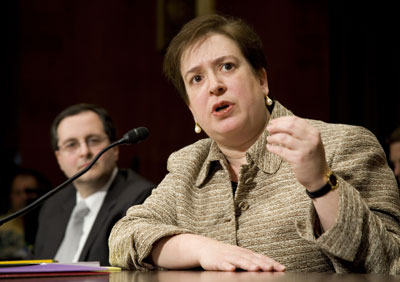
 People are having fun with reports that Elena Kagan, who argued as an advisor during the Ruth Bader Ginsburg confirmation that Supreme Court nominees should be required to give very detailed answers to policy questions, has changed her position now that the shoe is on the other foot.
Kagan wrote in 1995 that the confirmation process had become a “charade” because nominees were not answering direct questions, and said they should have to do so.
But during a briefing with reporters in the White House, Ron Klain, a top legal adviser to Vice President Joe Biden who played a key role in helping President Obama choose Kagan, said that she no longer holds this opinion. Klain pointed to Kagan’s testimony during confirmation hearings for her current job as solicitor general, the government’s top lawyer. “She was asked about it and said that both the passage of time and her perspective as a nominee had given her a new appreciation and respect for the difficulty of being a nominee, and the need to answer questions carefully,” Klain said, prompting laughter from a few reporters.
“You will see before the committee that she walks that line in a very appropriate way. She will be forthcoming with the committee. It will be a robust and engaging conversation about the law, but she will obviously also respect the conventions about how far a nominee should or shouldn’t go in answering about specific legal questions,” Klain said.
During her confirmation hearing on Feb. 10, 2009, Kagan was questioned about her 1995 law review article by Sen. Orrin Hatch, Utah Republican, who restated to Kagan the position she took about the need for answers to specific questions, and expressed concern that this would violate the judicial obligation to impartiality. “I’m not sure that, sitting here today, I would agree with that statement,” Kagan said, referring to her own opinion from 14 years prior. “I wrote that when I was in the position of sitting where the staff is now sitting, and feeling a little bit frustrated that I really wasn’t understanding completely what the judicial nominee in front of me meant and what she thought,” Kagan said, referring to her time on Biden’s staff in 1993 when he was chairman of the Senate Judiciary Committee.
Kagan helped Biden with the confirmation hearing of Justice Ruth Bader Ginsburg. In her law review article, Kagan said Ginbsurg used a “pincer movement” to evade being pinned down about her views on specific topics.
I’m reminded of an Al Franken bit on “Saturday Night Live” from 30 years or so ago. Jimmy Carter had brought back Selective Service registration and Franken said that, while he was vehemently opposed to the draft back in the 1960s, when he was eligible to be called, now that he was “older and wiser,” he had come to see the benefits.
It’s worth noting, however, that Kagan publicly stated her new position before it became clear that she was a frontrunner for an appointment to the High Court. That would seem to take charges of hypocrisy off the table.
Further, it’s a very thorny question. On the one hand, the Senate is charged by the Constitution with the duty to advise and consent on judicial nominees. And they can’t do their job properly without strong insights into how the nominee thinks about the law and how they would work through the balancing of conflicting Constitutional interests that are currently open questions. Or their willingness to ignore established precedent in favor of their own reading of the Constitution. On the other hand, the judiciary is a coordinate branch of government and forcing prospective Supreme Court justices to foreshadow their rulings makes them beholden to the Senate, compromising the independence of the Court. One could easily argue that, having signaled that they would vote a certain way in order to get confirmed, voting the other way would make them subject to impeachment. That’s untenable.
My own preference is somewhat closer to 1995 Kagan than 2009 Kagan, granting that the latter is so vaguely stated that it’s as hard to pin down as nominee Ginsburg’s judicial philosophy. Nominees don’t owe the Senate specific answers on how they would vote on specific cases. They do, however, owe the Senate — who represent the people of the several states — detailed insights into their legal philosophy.








