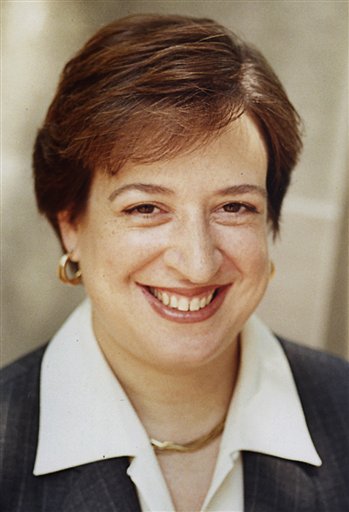
 Solicitor General Elena Kagan, considered the frontrunner to replace Justice John Paul Stevens since his retirement announcement, will be President Obama’s choice, it is being widely reported.
On paper, she would appear to be a slam dunk. She was confirmed by the Senate to her present position just last year by a 61 to 31 vote. She his impeccable academic credentials: summa cum laude from Princeton, M.Phil. from Oxford (not on a Rhodes Scholarship but on a Daniel M. Sachs Scholarship from Princeton), and magna cum laude from Harvard Law. She taught for years at Chicago Law and was later dean at Harvard Law. She clerked for Thurgood Marshall and held a variety of positions in the Clinton administration before coming back to government in her current job. And she’s only 50.
The biggest void on her resume is that she’s never been a judge. She was appointed to the Court of Appeals for the District of Columbia toward the end of Clinton’s presidency but the Senate let the clock run out. No currently sitting justice was without judicial experience when nominated. From an experiential standpoint, that’s not a big deal, at least to me. Until recently, it was quite normal for bright legal minds outside the “judicial monastery” to serve on the High Court. Most recently, William Rehnquist had no prior experience and had a distinguished career.
It does mean, however, that Kagan has even less of a paper trail than has been the norm of late. Which means Senators are going to have to guess as to her legal philosophy based on her scant record of academic scholarship (not a dig — she’s by all accounts brilliant and accomplished but she wasn’t a prolific writer) and her actions in government.
Thus far, most of the criticism I’ve seen of her has been from the Left, most notably from Glenn Greenwald, on civil liberties grounds. Writing on April 13:
The prospect that Stevens will be replaced by Elena Kagan has led to the growing perception that Barack Obama will actually take a Supreme Court dominated by Justices Scalia (Reagan), Thomas (Bush 41), Roberts (Bush 43), Alito (Bush 43) and Kennedy (Reagan) and move it further to the Right. Joe Lieberman went on Fox News this weekend to celebrate the prospect that “President Obama may nominate someone in fact who makes the Court slightly less liberal,” while The Washington Post‘s Ruth Marcus predicted: ”The court that convenes on the first Monday in October is apt to be more conservative than the one we have now.” Last Friday, I made the same argument: that replacing Stevens with Kagan risks moving the Court to the Right, perhaps substantially to the Right (by ”the Right,” I mean: closer to the Bush/Cheney vision of Government and the Thomas/Scalia approach to executive power and law).
He notes the concern about her lack of record, too:
One of the difficulties in assessing Kagan’s judicial philosophy and view of the Constitution is that direct evidence is extremely sparse. That’s not only because she’s never been a judge, but also because (a) her academic career is surprisingly and disturbingly devoid of writings or speeches on most key legal and Constitutional controversies, and (b) she has spent the last year as Obama’s Solicitor General, where (like any lawyer) she was obligated to defend the administration’s policies regardless of whether she agreed with them. As Goldstein wrote at SCOTUSblog: ”it seems entirely possible that Elena Kagan does not really have a fixed and uniform view of how to judge and to interpret the Constitution.”
Colorado-Boulder lawprof Paul Compos is banging the “Elena Kagan as Harriet Miers” drum.
Unfortunately, nobody seems to know what Kagan’s views are on most political issues, nor does anyone know what she believes about how judges ought to interpret the Constitution, how much deference courts should give to Congress and state legislatures, and what role the judiciary should play in checking the powers of the executive branch. We don’t know because she hasn’t told us. Indeed, Tom Goldstein, a Washington lawyer and publisher of SCOTUSblog, describes Kagan as “extraordinarily—almost artistically—careful. I don’t know anyone who has had a conversation with her in which she expressed a personal conviction on a question of constitutional law in the past decade.”
[…]
Kagan has published very little: three scholarly articles, two shorter essays, two brief book reviews, and two other minor pieces. Compare this record to those of the three other law professors most commonly mentioned as potential replacements for Justice John Paul Stevens: Stanford Law professor Pamela Karlan and Harold Koh, who became Yale Law’s dean in 2004, each have more than 100, and Kagan’s Harvard colleague Cass Sunstein, who also works for the Obama administration, has several hundred, including more than 20 books. All three have taken stands on numerous legal and political issues, in both the academic and the popular press. All have written extensively on how, in their view, courts should engage in legal interpretation in general and constitutional interpretation in particular.
Digby notes, too, that there are questions about her previous paid work for Goldman Sachs.
At the end of the day, though, I predict relatively easy confirmation. SCOTUSblog’s Tom Goldstein lays out why in excruciating detail and I have no reason to doubt any of the analysis.
UPDATE (Doug Mataconis): As James, notes William Rehnquist didn’t have prior judicial experience when Nixon nominated him in 1971, and he’s not alone. Earl Warren didn’t, Byron White didn’t, and while Sandra Day O’Connor did serve as a trial court and appellate court judge in Arizona, her primary experience prior to her nomination was in the Arizona Legislature.
At the moment, every single member of the Supreme Court served as a member of one of the United States Courts of Appeal prior to being nominated to the High Court. In fact, four of the current Justices — Scalia, Thomas, Ginsburg, and Roberts, all came to the Supreme Court from the same Court, the U.S. Court of Appeals for the D.C. Circuit.
Picking someone outside of the high priesthood of the Circuit Court Of Appeals strikes me as a good idea.
UPDATE (James Joyner): UCLA lawprof Steve Bainbridge, a conservative, deems Kagan “probably acceptable.”
I don’t know very much about Elena Kagan other than that a couple of Harvard folks for whom I have a lot of respect think highly of her. When I look at some of the lefties who are opposing her and their reasons for doing so, however, I’m tempted to conclude that she’s the most acceptable–from my perspective–candidate Obama is likely to put forward for the SCOTUS. You can tell a lot about a person from who their enemies are.
Indeed.