
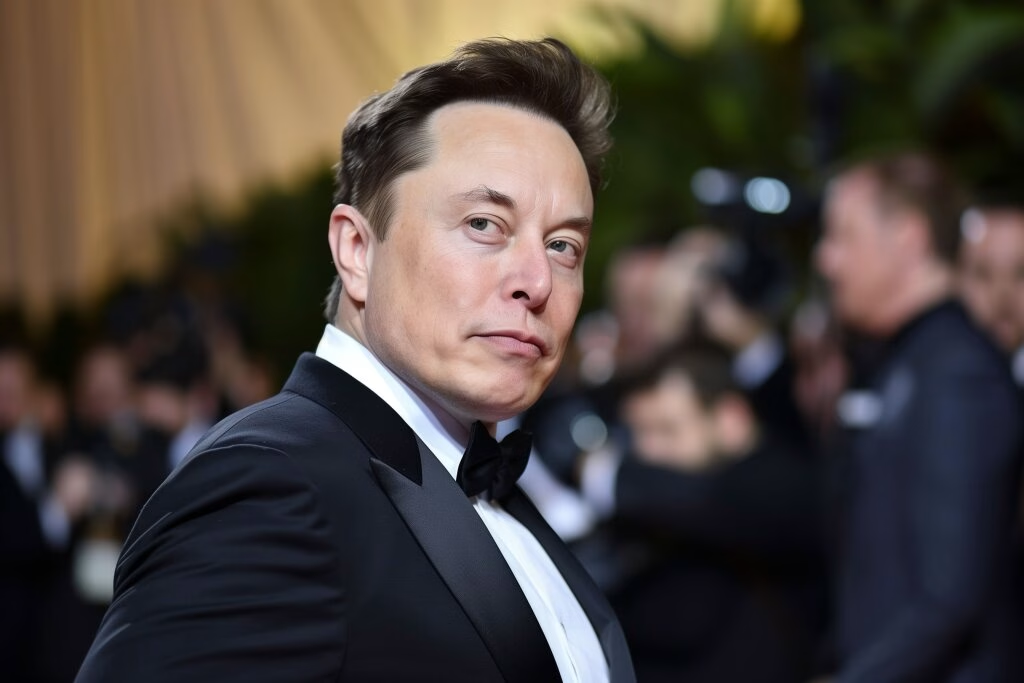
Today’s scheduled initial public offering of SpaceX stock has generated considerable coverage of the company and its founder, the world’s richest man.
NYT (“A Trillionaire?“):
SpaceX, Elon Musk’s rocket-building, satellite-launching and artificial intelligence company, is set to go public today at $135 a share. The company plans to sell 555 million of them. That means SpaceX would raise around $75 billion, putting its valuation at $1.77 trillion, the largest I.P.O. in history.
It could make Musk the world’s first trillionaire. Or it could tank. Some analysts have argued that SpaceX is significantly overvalued. The market could decide that Musk’s an overpromiser and pass on the stock’s high price. (Remember his purchase of Twitter for $44 billion in 2022? The company, now known as X, saw its ad revenue decline by 65 percent last year. Musk folded it into his A.I. company, xAI. Which is now part of SpaceX.)
“It really does feel very much a ‘don’t look at the man behind the curtain’ situation,” one career investor told The Times.
Plenty of people will get rich anyway. One launch engineer who worked at the company for 12 years told The Times he’d earned more than 100,000 shares during his tenure. At $135 a pop, his SpaceX stock would be worth at least $13.5 million at some point today. Even if the price drops by half, he’d still have millions on paper. “The magnitude of this has been ridiculous,” he said.
Or look to Antonio Gracias, one of Musk’s staunchest friends and business allies. He and his private equity firm, Valor Equity Partners, have a $65 billion stake in SpaceX at its target I.P.O. valuation. If the stock soars, Gracias will instantly become one of the world’s richest human beings.
Axios (“Elon Musk’s age of impunity“):
Elon Musk is on the verge of financial immortality: The world’s richest man — and potentially its first trillionaire — has built a sovereign corporate kingdom that is too systemic to fail. And yet, on the eve of SpaceX’s monster IPO, its CEO was hunkered down in his digital fiefdom stoking far-right culture wars with an impunity unmatched in modern corporate history.
Musk’s years in the public eye, marked by serial controversy and an accelerating embrace of white identitarian politics, have inured investors to conduct that would be disqualifying for almost any other CEO. Nothing Musk says or does can dent Wall Street’s appetite for a stake in his future-forging empire. Look no further than SpaceX’s $1.75 trillion IPO, where demand for shares has already vastly outstripped the available supply ahead of Friday’s historic market debut.
Anti-immigration riots erupted in Belfast on Tuesday night after graphic footage of a brutal street stabbing, allegedly by a Sudanese migrant, ricocheted across X. Masked mobs set fire to vehicles, a city bus, and several homes, marching through neighborhoods while chanting “foreigners out” and forcing minority families to flee under police protection.
Musk, who posts near-daily about violence committed by migrants, shared British far-right activist Tommy Robinson’s list of locations to protest against “another invader attack on our people.” “Only by protesting REPEATEDLY and LOUDLY will there be any change!!” Musk declared to his 240 million followers, drawing allegations of incitement from British leaders. Musk’s intervention in Belfast followed weeks of fixation on Henry Nowak, the white British teenager whose murder by a British Sikh man ignited a far-right backlash over claims of “anti-white” policing.
Musk’s anti-migrant activism extends across Western countries, where he suggests elites are intentionally engineering the demographic erasure of white populations — also known as the “Great Replacement” theory. In the U.S., Musk has been relentlessly focused on non-citizen voter fraud, claiming that Democrats are harvesting illegal immigrant votes to create a permanent, one-party state. That includes in California, where he joined MAGA allies this week in alleging, without evidence, that Democrats committed massive fraud in the Los Angeles mayoral primary.
[…]
As Musk’s personal net worth rockets toward the thirteen-figure mark, he has achieved escape velocity from the traditional rules of corporate governance. A decade ago, a CEO amplifying white-identitarian panic at home and overseas would have triggered a board crisis, investor revolt and days of corporate cleanup. Musk does it daily, in public, in real time, on the platform he owns. His companies have become critical infrastructure, and Trump-era politics have shifted the Overton window on the rhetoric of racial grievance.
Amy Gamerman, NYT (“Elon Musk Is Colonizing Earth“):
The gleaming new city checks every box: school, medical center, recreational center, sushi bar. There’s even a dog park with hoops and climbing toys. But you and your dog are not welcome; “Private” warns the sign at its entrance.
[…]
In this town, almost every communal space is private property. A company controlled by the world’s richest man owns nearly all of it. He shapes its future.
This is Starbase, Texas, the city that Elon Musk built on America’s ragged hem at the southern border as the home for SpaceX, his aerospace and artificial intelligence company. Locals describe a highly secretive environment overseen by a company-affiliated city commission that rubber-stamps Mr. Musk’s vision, a place where even kindergartners are guided by his philosophies. Starbase is the newest manifestation of Mr. Musk’s political power. It is a beta test for a rising oligarchy that seems intent on transforming America from the inside out.
In this town, almost every communal space is private property. A company controlled by the world’s richest man owns nearly all of it. He shapes its future.
This is Starbase, Texas, the city that Elon Musk built on America’s ragged hem at the southern border as the home for SpaceX, his aerospace and artificial intelligence company. Locals describe a highly secretive environment overseen by a company-affiliated city commission that rubber-stamps Mr. Musk’s vision, a place where even kindergartners are guided by his philosophies. Starbase is the newest manifestation of Mr. Musk’s political power. It is a beta test for a rising oligarchy that seems intent on transforming America from the inside out.
[…]
These spaceports will allow Mr. Musk to create his own reality for other people to live in. He doesn’t need Mars. Mr. Musk has already built a colony of his own.
Mr. Musk often cites “Star Trek” as inspiration for founding SpaceX. “We want to make ‘Star Trek’ real, OK?” he said in January. But Starbase bears less similarity to the enlightened wonderland depicted in that 1960s television show than it does to the autocratic company towns of the 19th and early 20th centuries. Like Mr. Musk, the industrial titans of that era built their own private fiefs, not only to cement control over workers, but to realize their vision of an ideal society.
I am not a member of the Billionaires Should Not Exist Club. Or even the Trillionaires Should Not Exist Club. I do not begrudge those who launch society-altering businesses reaping huge profits. They should, however, pay taxes proportionate to their vast wealth and be beholden to the same rules as we peons.
That Musk draws massive investments despite being an open white nationalist and something of a nut is more concerning. Then again, those qualities no longer disqualify people from holding the highest offices in the land. It’s not obvious why a guy running a social media platform, an automobile manufacturer, or a rocket company should be held to a higher standard.
That said, Musk’s seeming impunity is troubling. That he could spend $44 billion on Twitter for the pleasure of essentially burning it to the ground is not a great thing for our society. But, again, we live in a world where convicted insurrectionists roam free.
It’s also problematic, if not unprecedented, for a man to essentially own entire towns lock, stock, and barrel. Nobody is forced to live there, I guess, but it borders on un-American.









