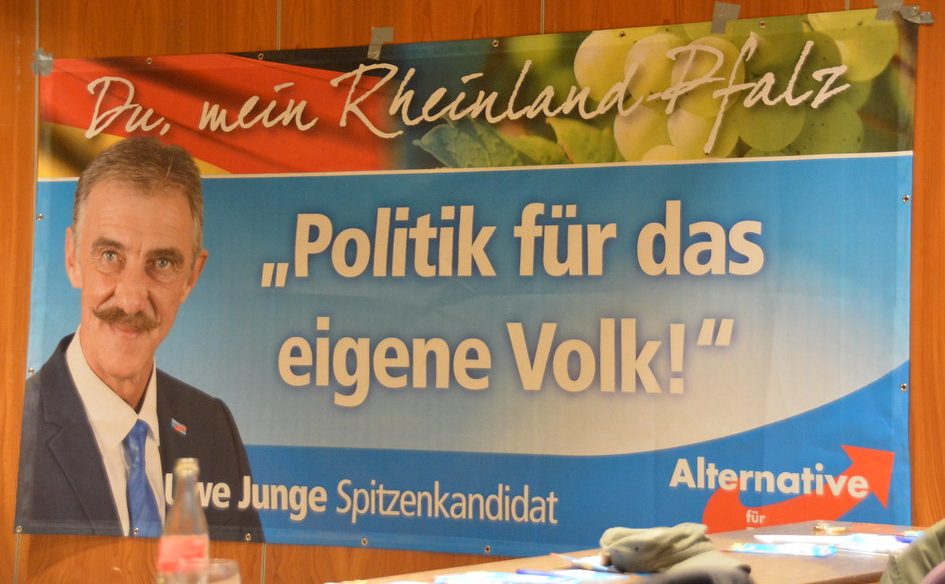
Scholar-journalist Hans Kundnani warns, “Something Alarming Is About to Happen in Germany.”
The far-right party Alternative for Germany, or AfD, is set to make a major breakthrough.
Saxony-Anhalt, a former East German state of around two million people, is relatively small. But the significance of the election there on Sunday could be seismic. The AfD is on track to win overwhelmingly and perhaps even secure an overall majority, which would mean that it could form a state government for the first time in its history. Long confined to the opposition, the AfD now stands on the cusp of wielding power — regionally, at least.
“Long” is relative, but it’s worth noting that the AfD didn’t exist before 2013.
The rise of the AfD has already made coherent and stable government difficult at the national level. Its success in last year’s federal election, in which it came in second, with 20 percent of the vote, forced the center-right Christian Democrats to form a government with the center-left Social Democrats. The two parties have squabbled since Friedrich Merz became chancellor, and the AfD has surged in the polls. Now it is by far the most popular party in Germany.
Clicking through to the linked POLITICO poll of polls, I see that AfD voting intention is at 28%, compared to 21% for CDU/CSU, 15% for Greens, 12% for SPD, and 12% for Left. While indeed alarming, Germany’s proportional representation system, unlike our first-past-the-post system, does not automatically make the plurality winner the governing faction. Indeed, since no other right-leaning party has any significant support, I’m hard-pressed to conjure a scenario where AfD can form a governing coalition. Then again, given that another CDU/CSU-SPD grand coalition would only start with 33% of the seats, it would be enormously challenging for anyone to do so.
What makes the AfD’s rise especially shocking is that it is much more extreme than other European far-right parties that are either already in power, like Giorgia Meloni’s Brothers of Italy, or could be soon, like Marine Le Pen’s National Rally. Whereas those parties have sought in some ways to detoxify and moderate themselves, the AfD has become more radical over time, deepening its ties to neo-Nazis and promising to repatriate migrants. As it has done so, it has grown more popular.
While Kundnani is certainly more expert on German politics than I am, it’s at least debatable that AfD is more extreme than Brothers of Italy or National Rally. Writing at some unspecified point during the Biden Administration, Jefferson Chase (PhD in German Studies, UVA) paints them as the German MAGA equivalent:
The AfD has only been in existence since 2013, but it’s ridden widespread anger with the status quo to join a series of local state parliaments before finishing as Germany’s third-most-popular party in the 2017 national election. Its results are even rosier in state parliaments in Germany’s eastern states, where economic fortunes still lag, more than three decades after the Berlin Wall fell.
As for the affinities with Trump Republicans … fear of immigrants and foreigners? Check. Hostility toward the European Union? Check. Contempt for the standard operating procedure in government and willingness to gut the state apparatus? Check.
As a jingoistic “Make Germany Great Again” outfit full of unpredictable political neophytes, the AfD is fairly comparable to the Trumpites — critics would say it’s to the credit of the German system that there is little chance the AfD will come to power. All other parties have refused to govern with the AfD, and when the CDU flirted with that option at the state level, a major scandal ensued.
The nonpartisan American-German Institute, though, agrees with Kundnani:
Founded just over a decade ago, the populist radical right Alternative for Germany (Alternative für Deutschland, AfD) has significantly disrupted German politics ever since. […] The party gained support after adopting xenophobic and Islamophobic positions following the refugee crisis in 2015. It has continued to adopt extreme right positions, so much so that members and branches have come under investigation for anti-constitutional activities. The simultaneous normalization and radicalization of the party makes it an outlier even in comparison to other far-right parties in Europe.
Regardless, it would be a radical departure from the longstanding norms of German politics if AfD were somehow to have a significant voice in policymaking.
Kundnani continues:
Last year, Germany’s domestic intelligence agency classified the party as “right-wing extremist.” But the scale of the party’s support means it is too late to ban it. Instead, it has fallen to Mr. Merz’s government to stop it. Yet preoccupied with remilitarization and foreign policy, it is seemingly incapable of doing so. For Germany — and the rest of Europe — the implications are truly alarming.
At the heart of the matter is the economy, which is going through a deep structural crisis. Over the past two decades, the German economy was often described as Europe’s strongest. In reality, its extreme dependence on exports made it quite fragile. This fragility has now caught up with it: Germany’s manufacturing industry, the basis of its economic success, is being hit by a combination of American tariffs and Chinese competition — what is often referred to as China Shock 2.0. This economic decline underpins the AfD’s recent surge in support.
An old and familiar story, alas.
The AfD actually began with economic issues. It was created in 2013 as a direct response to Angela Merkel’s insistence that there was no alternative to bailing out Greece — hence its name — and was originally a party of fiscal hawks who opposed a redistributive European Union. After the refugee crisis in 2015, it repositioned itself as an anti-immigration, anti-Islam party; two years later it got into the Bundestag, leading some to imagine that it had become focused only on cultural issues. But alongside xenophobes and nativists, fiscal hawks retained a home in the AfD.
Again, not unfamiliar. And AfD has gotten more extreme over time, as more centrist leaders have bolted.
Central to their concerns was maintaining the so-called debt brake, a constitutional amendment that limited government borrowing. During his 2025 campaign, Mr. Merz promised to keep it, even as it prevented much-needed investment. But after the Christian Democrats won the election, he reached an agreement with the Social Democrats and the Greens before the new Parliament had been formed to amend the constitution, exempting military spending from the brake. This democratically dubious move alienated many right-wing voters. It was around this point that the AfD overtook the Christian Democrats in the polls for the first time.
While I wholeheartedly support Germany spending more on their military in the face of Russian aggression and U.S. rebalancing to counter Chinese revisionism in the Indo-Pacific, breaking a major campaign promise almost instantaneously is naturally and rightly going to anger voters.
Mr. Merz didn’t dismantle the debt brake entirely. That would have made it possible to begin to solve some of Germany’s problems. Instead, as nonmilitary spending remains subject to the debt brake, Mr. Merz has continued to cut back the welfare state and told Germans that they need to work harder so that the economy can regain its “competitiveness.” This approach — increasing military spending while cutting elsewhere — may appeal to foreign policy analysts, but it is politically disastrous. A significant part of the AfD’s appeal lies in its focus on job losses and declining prospects.
Again, a familiar story.
Germany’s remilitarization has also been disastrous in another way. Since 2022, centrist parties in Germany have largely abandoned their commitment to the idea of Germany as a “Friedensmacht,” or force for peace, and now speak more about preparing for a full-scale war with Russia. Mr. Merz, for his part, says he wants Germany to possess “the strongest conventional army in Europe.” This has allowed the AfD to present itself as the party of peace — not unlike the way that President Trump positioned himself in opposition to the “forever wars” undertaken by American Democrats and Republicans alike.
The increase in military spending has caused some to wonder whether Germany could become “Europe’s next hegemon.” But that is a fantasy. For one thing, it is far from clear that Germany’s spending plans will translate into real military capabilities, to say nothing of reviving the economy. For another, Germany is increasingly isolated within the European Union, not least because of its unconditional support for Israel and willingness to block any measures against it, like suspending the European Union’s association agreement with it. Perhaps most important, there is little support for military power, let alone war, among German voters.
One of the great ironies is that, while NATO was formed, as its first Secretary-General, Lord Ismay famously put it, “to keep the Russians out, the Americans in, and the Germans down,” the United States and other allies have been begging the Germans for years to invest more in defense. They’re far and away the richest country in Europe but long lagged behind the Brits and French in spending. No longer. While they are still investing a mere 2.4% of GDP, good for twelfth place among NATO countries, their $120.7 billion budget puts them in a strong second place behind the United States ($980B), outpacing the UK ($92.8B) and nearly doubling France ($68.9B).
But Kundnani is right: necessary though it may be, the decades-long campaign to shame the Germans for the atrocities of World War II radically altered the national culture. It is deeply anti-military. And, with the economy faltering, the demand is for more social spending. It’s understandable, then, that the governing coalition—made up of the two major parties that have run the Federal Republic since its founding — is wildly unpopular.
That a far-right party has emerged as the most popular alternative is troubling. But, again, it’s hard to see how they can put together a majority coalition.