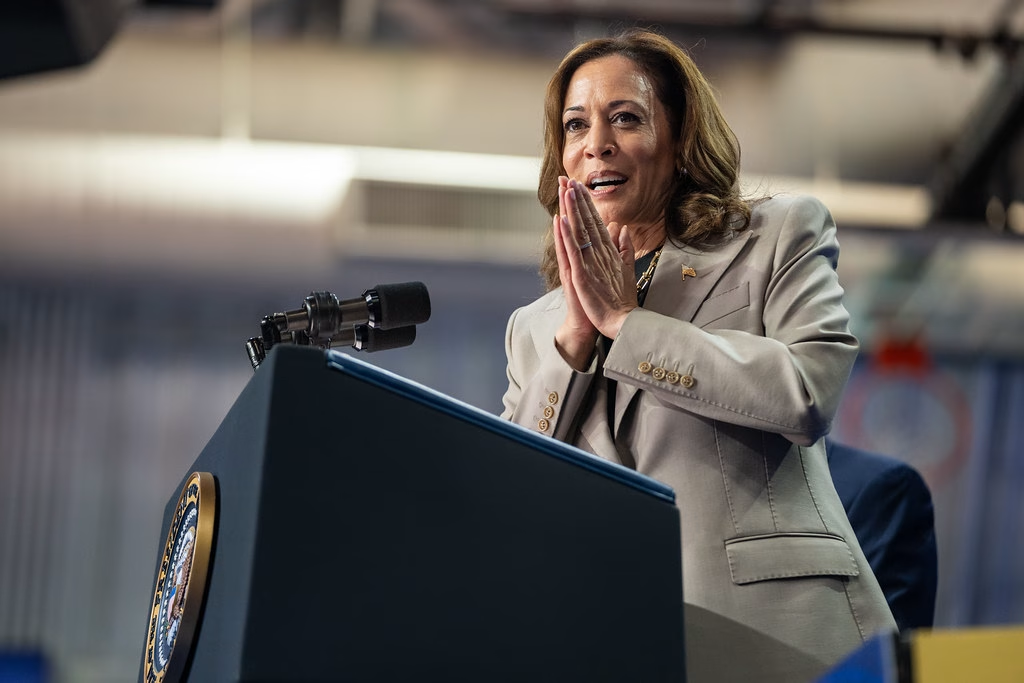

Florida Governor Ron DeSantis has suspended the Sheriff of Broward County over his department’s response to last February’s mass shooting at Marjorie Stoneman Douglas High School in Parkland:
Broward County Sheriff Scott Israel was suspended from office Friday by Florida’s new governor, a move that comes after nearly a year of intense criticism over how the sheriff’s office responded to a rampage inside a Parkland, Fla., high school.
Gov. Ron DeSantis, a Republican who took office on Tuesday, traveled to Broward to announce his decision to remove Israel, a Democrat reelected to a second term in 2016. Israel became a lightning rod after revelations that one of his deputies failed to confront the shooter and that, long before the first shot was fired, the Broward Sheriff’s Office had repeated contacts with the former student charged with killing 17 people at the school.
In his executive order, DeSantis highlighted these and other details in explaining why he made the unusual decision to dismiss an elected official, stating that Israel “egregiously failed” in his role as the top law enforcement officer in Broward.
“The neglect of duty and the incompetence that was connected to the massacre at Marjory Stoneman Douglas High School has been well documented,” DeSantis said at a news conference, joined by relatives of some Parkland victims. “Suffice it to say that the massacre might never have happened had Broward had better leadership in the sheriff’s department.”
DeSantis’s executive order pointed to the findings of a state commission that investigated the Feb. 14, shooting in Parkland; his order also includes previous criticisms of how Israel’s office responded to a shooting at the Fort Lauderdale airport in January 2017. The Parkland commission submitted a report singling out the Broward Sheriff’s Office for its policies on ongoing attacks, a lack of training and how it responded to the gunfire. The panel also found that multiple deputies, rather than one, failed to rush toward the attacker.
Israel pilloried DeSantis’s decision as “a massive political power grab by the governor” and vowed to fight the move in court and before the Florida Senate.
“I wholeheartedly reject the statements in the governor’s executive order as lacking both legal merit and a valid factual basis,” Israel said during a news conference after DeSantis’s order was released. “There was no wrongdoing on my part.”
He added: “This was about politics, not about Parkland.”
Israel’s attorney, Stuart Kaplan, said they were still determining their legal path forward and added that Israel planned to run again for sheriff in 2020.
Under the Florida constitution, the governor can suspend officials for reasons including “neglect of duty” and “incompetence.” DeSantis invoked both of those in his order, which says Israel is prohibited from receiving pay. To replace Israel, DeSantis selected Gregory Tony, who runs a firm that offers active-shooter training and is a retired police sergeant who worked in Coral Springs, a city that neighbors Parkland.
DeSantis’s decision to suspend Israel was widely expected, as he had said during the gubernatorial campaign that the sheriff should have been removed from office. With DeSantis taking office Tuesday, media reports began circulating in South Florida saying Israel had told people he expected to be suspended.
While mass attacks are often followed by reviews that reveal missteps or ominous warning signs, the Parkland shooting was remarkable for the sheer breadth of red flags preceding the massacre. Nikolas Cruz, the 20-year-old who police say confessed to the shooting, had come to the attention of local, state and federal officials again and again. Some of the warnings — including those made to the FBI and the Broward Sheriff’s Office — were explicit in labeling Cruz as a threat to attack a school. In Florida on Friday, DeSantis offered additional criticism for the FBI, calling its handling of the issue “a disgrace.”
None of the red flags stopped Cruz from buying weapons or carrying out the attack, officials said. After the shooting, Cruz dropped his weapon and blended in with fleeing students. Concerns about him were so well known, the state commission reported, that a student who encountered him at that time told him, “I’m surprised you weren’t the one who did this.”
Cruz’s attorneys acknowledge he was the shooter and have offered to have him plead guilty in exchange for a life sentence. Prosecutors are seeking the death penalty.
After the shooting, Israel became the very public face of the law enforcement response to the carnage that horrified the country and prompted a sweeping new push for gun-control measures. He appeared at a CNN town hall one week after the attack to encourage new gun-control laws and spar with a spokeswoman for the National Rifle Association.
More from the Florida Sun-Sentinel:
New Florida Gov. Ron DeSantis suspended Broward County Sheriff Scott Israel on Friday over his handling of February’s massacre at Marjory Stoneman Douglas High School .
The Republican governor flew to Fort Lauderdale three days after taking office to remove the Democratic sheriff, appointing a former police sergeant to serve as acting sheriff. Gregory Tony, 40, worked for Coral Springs police for 12 years before leaving in 2016 to start a company specializing in active-shooter training. He is the first African-American to serve as Broward’s sheriff.
DeSantis’ office issued a statement saying, “Sheriff Israel has repeatedly failed and has demonstrated a pattern of poor leadership. He failed to protect Floridians and visitors during the tragic Fort Lauderdale International Airport shooting in 2017. He failed in his duties to keep our families and children safe during the devastating shooting at Marjory Stoneman Douglas High School on February 14, 2018. These incidents demonstrate Sheriff’s Israel’s repeated incompetence and neglect of duty.”
The statement added, “The families of the victims deserve accountability.”
Israel was expected to issue a statement later in the afternoon.
Under Florida law, the governor can suspend elected officials for criminal activity, misfeasance, incompetence or neglect of duty. Israel intends to challenge the suspension to the state Senate, which will conduct a trial and then remove or reinstate him. Israel’s lawyer, Stuart Kaplan, said this week the sheriff did nothing warranting removal and his future should be left to Broward voters in the 2020 election. Israel had been sheriff six years.
Last April, DeSantis said he would have suspended Israel if he were governor but he backed off later in the campaign, saying only that he would hold officeholders accountable. DeSantis’ Republican predecessor, now-U.S. Sen. Rick Scott , refused to suspend Israel, saying he wanted to wait until investigations into the Feb. 14 shooting that left 17 dead were complete before deciding.
Some parents of Stoneman Douglas victims and conservative state lawmakers began pushing for Israel’s ouster shortly after the shooting when it was revealed that the Broward deputy assigned to guard the school, Scot Peterson, had not gone into the building to confront the shooter and his AR-15 semi-automatic rifle, but took cover outside.
Other Broward deputies who arrived during the shooting also didn’t enter, even while officers from neighboring Coral Springs — Tony’s former department — charged inside. Parents also bashed Israel for saying during a nationally broadcast interview he had provided “amazing leadership” in the shooting’s aftermath.
“Nothing, nothing, nothing will bring my kid or 16 others back, but there was failure everywhere you turned,” said Fred Guttenberg, whose 14-year-old daughter Jaime died in the shooting. “And after that failure, there was just a refusal to take accountability and responsibility. I wish him well but it was time for a change.”
The heat increased after it was learned the sheriff’s office received a call in 2016 and another in 2017 warning that suspect Nikolas Cruz , now 20, was a potential school shooter but deputies disregarded them. Deputies also had about 20 contacts with Cruz as a juvenile — mostly over arguments with his now-deceased mother. Israel has said none of those contacts warranted an arrest — a conclusion law enforcement members of the state commission investigating the shooting have agreed with.
But commissioners in their report finalized last week criticized Israel for earlier changing his office’s policy to say deputies “may” confront active shooters instead of “shall,” giving deputies an excuse for not charging the school. Israel told them he didn’t want deputies to think they had to conduct suicide missions.
Commissioners also concluded that the department’s active shooter training had not been effective. Still, Pinellas County Sheriff Bob Gualtieri, the commission’s chairman, and other law enforcement officials on the panel have said they didn’t think Israel should be suspended.
Israel, 62, was elected sheriff in 2012 after a long career in law enforcement, ousting the Republican incumbent on his second attempt in the overwhelmingly Democratic county. After taking office, Israel, a Republican until changing parties shortly before running in 2008, received criticism over his friendship with notorious GOP operative Roger Stone , for promoting Stone’s inexperienced stepson to detective and for accepting gifts from a wealthy benefactor.
Given the number of failures that the Sheriff’s Office seems to have been guilty of in connection with this case, Israel’s dismissal seems to be more than justified. Even before the shooting itself, the Sheriff’s Office and other law enforcement agencies failed to pick up on multiple warning signs about the shooter, Nikolas Cruz, that could have potentially prevented last February’s massacre had they been acted on. On the national level, there were several warning signs brought to the attention of the Federal Bureau of Investigation, but because there was no other information about Cruz in the national criminal database, nobody put the pieces together to be aware of the possibility that he could be a danger. At the same time, local law enforce was Cruz was, as the saying goes, “troubled.” For example, CNN reported that Sheriff’s deputies had visited Cruz’s home nearly 40 times since 2010 for problems that included reports of “a mentally ill person, child/elderly abuse, a domestic disturbance and a missing person.” The reports don’t state exactly who the reports were aimed at, but it seems likely that at least some of them were related to Cruz. Other reports indicated that at times Cruz would introduce himself to people by saying “Hi, I’m Nick. I’m a school shooter.” One neighbor recalled that Cruz “would sometimes be hitting his head and covering his ears.” Additionally, Cruz apparently had a long history of misbehavior before being expelled from school in January 2017, just three days before he bought the AR-15 that he used in the shooting a year later. Additionally, in the weeks after the shooting that school authorities were well aware of Cruz and his potential for danger. Had there been at least some effort to connect all of this together, then it’s possible that Cruz could have been dealt with properly, and received the mental health treatment he obviously needed, before last February 14th. Had that happened, the whole Parkland tragedy could have been stopped before it even started.
Leaving all of that aside, the greatest failure of Israel’s department came on the day of the shooting itself. Instead of heading into the building where the shooting took place to confront and potentially stop the shooter, Israel’s deputies stayed outside under cover while students were massacred inside, something for which they have been widely criticized. Most recently, of course, Israel and his department won a court victory in a lawsuit filed by Parkland survivors and the family of the victims when a Federal Court Judge reiterated long-standing legal doctrine that law enforcement does not owe a specific duty to individuals to protect them. Given all of this, it’s clear that Governor DeSantis was more than justified in removing Israel from his position.