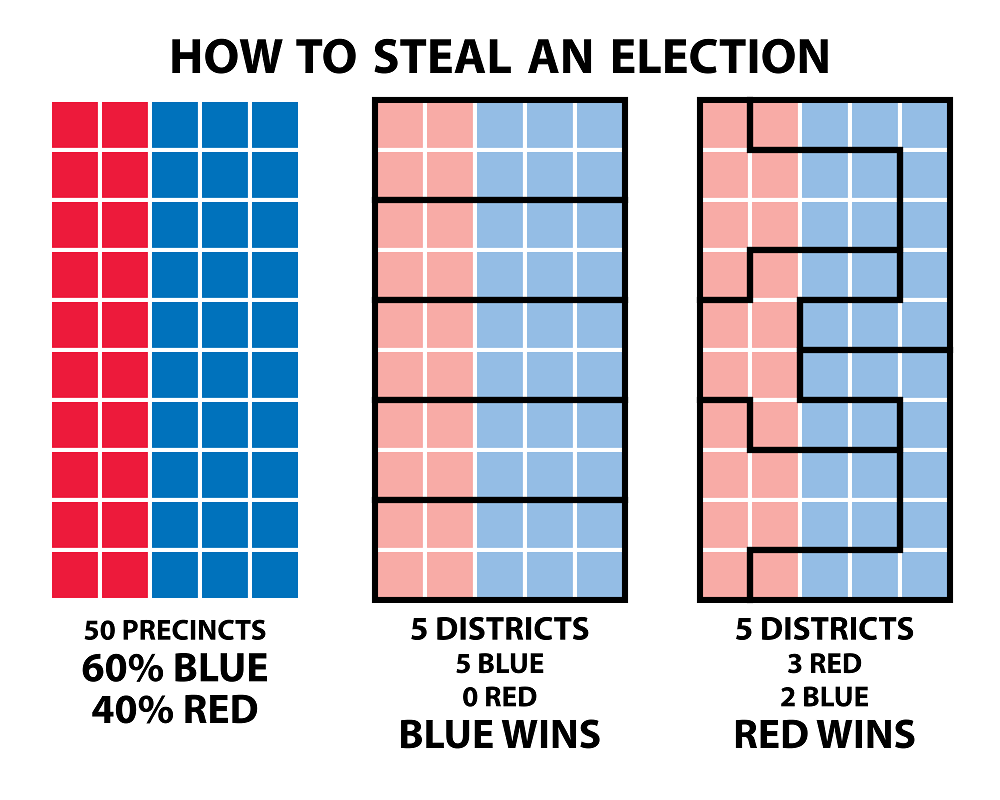

A perhaps slightly overwrought report in POLITICO (“Say goodbye to swing districts. Lawmakers are drawing easy wins in dozens of states.“) that nonetheless points to a real problem.
When most voters go to the polls to elect members of Congress next year, the general election will essentially be meaningless. That’s because winners are being determined right now, by a small number of party officials who are surgically ensuring preordained victories in the majority of the nation’s congressional districts.
The current redistricting cycle is garnering more interest and scrutiny than ever because the power of the process has become so clear: When politicians control redistricting, they have the tools to render most or even all of the congressional districts in a state solid red or solid blue for years to come.
So, look, this isn’t right. Voters are supposed to choose their representatives, not the other way around. Steven Taylor and I (especially the former, since elections are his professional specialty) have been complaining about this for a long time. But here’s the thing: it’s not a new issue and the fact of the matter is that incumbents have been damn near guaranteed re-election as long as I can remember and beyond.
Tom Murse provides this handy table:
| Re-election Rates for House Members | |
|---|---|
| Election Year | Percentage of Incumbents Re-elected |
| 2020 | 95% |
| 2018 | 91% |
| 2016 | 97% |
| 2014 | 95% |
| 2012 | 90% |
| 2010 | 85% |
| 2008 | 94% |
| 2006 | 94% |
| 2004 | 98% |
| 2002 | 96% |
| 2000 | 98% |
| 1998 | 98% |
| 1996 | 94% |
| 1994 | 90% |
| 1992 | 88% |
| 1990 | 96% |
| 1988 | 98% |
| 1986 | 98% |
| 1984 | 95% |
| 1982 | 91% |
| 1980 | 91% |
| 1978 | 94% |
| 1976 | 96% |
| 1974 | 88% |
| 1972 | 94% |
| 1970 | 95% |
| 1968 | 97% |
| 1966 | 88% |
| 1964 | 87% |
| 1962 | 92% |
| 1960 | 93% |
| 1958 | 90% |
| 1956 | 95% |
| 1954 | 93% |
| 1952 | 91% |
| 1950 | 91% |
| 1948 | 79% |
| 1946 | 82% |
| 1944 | 88% |
| 1942 | 83% |
| 1940 | 89% |
| 1938 | 79% |
| 1936 | 88% |
| 1934 | 84% |
| 1932 | 69% |
| 1930 | 86% |
| 1928 | 90% |
| 1926 | 93% |
| 1924 | 89% |
| 1922 | 79% |
| 1920 | 82% |
| 1918 | 85% |
| 1916 | 88% |
| 1914 | 80% |
| 1912 | 82% |
| 1910 | 79% |
| 1908 | 88% |
| 1906 | 87% |
| 1904 | 87% |
| 1902 | 87% |
| 1900 | 88% |
Outside of a handful of wave elections, incumbents have been overwhelmingly re-elected going back to the days before the invention of radio. Granting that there’s some self-selection going on here—incumbents who are very likely to lose often decline to run to avoid the embarrassment–it’s rare, indeed, for there to be more than 15 percent turnover.
I suppose it’s possible that this particular wave of gerrymandering is so dastardly that it will raise the re-election rate from 95 percent to 100 percent. But we’re already at Soviet-level rates and have been since, well, before there were Soviets.
Still, that shouldn’t distract us from the fact that this is all very wrong and there are much better ways to go about ensuring representative democracy.
Over the last decade, nearly 90 percent of congressional races held in states where legislators drew the district lines resulted in easy victories — margins of 10 percentage points or greater — for one party or the other, according to a POLITICO analysis. The rate of competitive races was almost twice as high in states where courts or commissions drew the districts.
[…]
In each of the past three elections, most of the swing seats that changed hands between the parties came from commission- and court-drawn districts, while the congressional delegations from legislature-drawn states changed relatively little.
The most striking example is from the 2018 “blue wave,” when Democrats won control of the House. They needed to flip 23 congressional seats to flip control of the chamber. But even as the national vote swung nearly 10 points toward Democrats compared to the previous election, the party could only flip 10 seats in states where legislators drew the congressional maps. The levees built around many safe Republican seats drawn years before — even in the suburbs, amid fierce anti-Trump backlash — were higher than the crest of the wave.
That was not the case in states where commissions and courts drew the maps. Democrats netted 31 seats in those states, including longtime court-drawn battlegrounds in the Las Vegas suburbs and upstate New York, commission-made districts in California and Arizona and several seats in states, like Virginia and Pennsylvania, where courts declared old districts illegal mid-decade and replaced them with maps that included more swing seats.

Now, of course, this may not be an apples-to-apples comparison. Presumably, states that have chosen to have commissions draw districts vice the state legislature are less dominated by a single political party. And, since this data is drawn mostly from the post-Shelby v Holder era, states that have court-ordered redistricting may be outliers.
Interestingly, my home state of Virginia approved a move to a bipartisan redistricting commission in the November 2020 elections but the commission has been unable to come up with a map they could agree on and punted to the courts. But, again, we’re a purple state that voted Democrat the last four presidential cycles, have two Democratic Senators (who are both former governors, owing to our bizarre one-term policy) and yet just had a Republican sweep for the three statewide officers and will have a majority Republican state legislature.
There’s a whole lot more to the piece, but it’s mostly a focus on the effects in various states. I don’t have enough insight into the relevant politics to have an opinion.
Regardless, while the Constitution gave the power to draw Congressional districts to the state legislatures, it’s really an outmoded practice. The Framers started with two very wrong but perfectly understandable assumptions. First, they simply didn’t foresee the rise of political parties, let alone the sheer polarity that drives them to such ruthlessness. Second, they believed people would naturally be much more informed about and keep a much closer eye on their state legislatures than the goings-on in Congress. If that was ever the case, it hasn’t been for a long, long time.
Again, incumbents have been near shoo-ins for re-election since time immemorial. They certainly don’t need any additional advantages.