After months of compromising to satisfy Blue Dog Democrats and garner at least one Republican vote for the Senate version of health care reform, they’ve come up with a bill that their progressive base hates. Yes, they’ve apparently lost Nebraska’s Ben Nelson. Oh, and Olympia Snowe may be off the train again, too. But they’ll figure out a way to appease them.
Indeed, they’ve gone so far down that route — killing off the public option and Medicare buy-in — that many Democrats think it’s unrecognizable as what they fought for during the 2008 campaign. Former DNC Chair Howard Dean wants to “kill the bill” and start from scratch.
This is essentially the collapse of health care reform in the United States Senate. Honestly the best thing to do right now is kill the Senate bill, go back to the House, start the reconciliation process, where you only need 51 votes and it would be a much simpler bill.
Rather impractical, of course. (Although it’s interesting that what was “the nuclear option” when Republicans wanted to do it to force votes on judicial nominees is merely “reconciliation” when the Democratic leadership wants to use it to force a bad bill down the throats of their own caucus.) How do you justify blowing up the institutional arrangements that have been in place for decades to go back to something that was previously not worth fighting for?
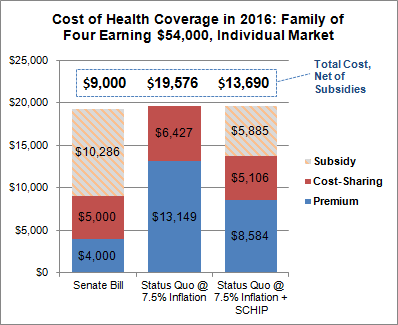
 Beyond that, stathead Nate Silver thinks progressives are guano mad to oppose this. He presents a handy dandy chart showing how much of a break the Senate bill would give a middle class family of four:
These estimates are straightforward — they’re taken directly from the CBO’s report on premiums for people at different income levels. A family of four earning an income of $54,000 would pay $4,000 in premiums, and could expect to incur another $5,000 in out-of-pocket costs. The $4,000 premium represents a substantial discount, because the government is covering 72 percent of the premium — meaning that the gross cost of the premium is $14,286, some $10,286 of which the government pays.
[…]
Not only, however, would this family paying a lot more under the status quo, but they’d be doing so for inferior insurance. According to the CBO, the amount of coverage in the individual market would improve by between 27 and 30 percent under the Senate’s bill. Taking the midpoint of those numbers (28.5 percent), we can infer that there would be about $1,427 in additional cost sharing to this family in the status quo as compared with the Senate bill; this would bring their cost sharing to $6,427 total.
What’s not to like? Free money from Uncle Sugar, paid for by the rich! Why, even people making median household income would get massive subsidies! Woo hoo!
Why would progressives object? Well, judging from Silver’s commentariat, Nancy Wheeler, and others, it seems that the problem is that one result of the bill is that private health insurance companies would make more money. In their view, this amounts to a massive government subsidy for the greedy bastards who are making a profit off of sick people.
Matt Yglesias would prefer a Swedish-style system but, since that’s not politically feasible, he’d take the Senate bill over the status quo notwithstanding all that.
[T]he mechanism by which insurers can get extra money under reform is that . . . more people get health insurance at a price they can afford. The bill will also expand Medicaid eligibility to include many currently uncovered poor and near-poor people. The tax increases in the bill fall overwhelmingly on richer-than-average people and it also includes important reforms to the delivery system, promising ideas to reduce the growth in health care costs, curbs overpayments to Medicare Advantage, etc.
So, while it’s not a perfect socialist utopia, it gives free stuff to poor people at the expense of richer-than-average people. That’s probably sellable since, as Dave Schuler likes to say, when you rob Peter to pay Paul, you can always count on the support of Paul.
Thus far, however, Obama and company have not sold it. The latest ABC/WaPo poll — which has typically skewed more Democratic than most major polls — shows 53 percent disapprove of Obama’s performance on health care even while 52 percent approve of his job performance overall. Those numbers are just a snapshot and are likely quite soft, since most people don’t know what’s in the bill. (Hell, most Senators don’t know what’s in the bill.) But the process itself has been a fiasco.
UPDATE: BooMan makes a point that I should have: it’s silly to get too excited about the bill before Conference (the reconciliation of the House and Senate bills into a final bill). That‘s the version that matters. Now, it’s likely that the final bill will look more like the Senate than the House version, given that the Senate is the chief stumbling block. But the haggling isn’t yet over.