
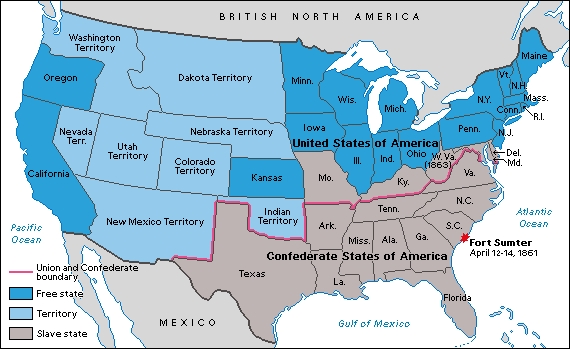

One of the prevailing myths that animates the argument that secession was motivated by a “complex” set of issues, of which slavery was only one (if not a minor) aspect, is the notion that tariffs were a central reason for secession.
Now, it is true that tariff policy was an issue of significant contention between the northern and southern states, due to the differing economies of the regions. However, the idea that the South was being taxed to death at the hands of the North and that that, above all else, led to secession is an incorrect understanding of history. Indeed, tariff policy was of issue for all of the US’ antebellum history and was not as cut and dry an issue as Confederate apologists often make it out to be.
Let’s consider why it might be the case that there were regional differences over tariff rates. In broad brushstrokes, it is easy to note that the northern economies were more based on industrialization while the southern economies were based far more heavily on agriculture. Many northern interests wanted protection for their products, while many southern interests wanted freer trade for their agricultural output. In short, the various political interests of the day were inextricably linked, as one might suppose, to economic interests.
The plantation-based economies of the South required vast pools of cheap labor to function. Hence, the need for slaves and the steadfast desire to maintain slavery. As such, even the issues that undergirded the tariff debate are linked to the Southern slave-driven economy. It is impossible to escape the issue of slavery when talking about the politics of the day and slavery.
Specifically, the tariff that is used as the supposed best example of why secession was not about slavery was the Morrill Tariff of 1861. It is true that raising tariffs was a key plank of the Republican Party and something that Lincoln campaigned on. Further, it is true that the House of Representatives passed the Morrill bill in 1860, before the elections. However, the legislation did not become law until 1861. More importantly, the Act only passed the Senate after several Southern states seceded, actions which flipped control of the Senate from Democratic to Republican hands. Note that this was back when the new Congress did not come into office until the March after the election, so we are talking about the same Congress (the 36th) that had passed the Act in the House.*
Indeed, when the Morrill Tariff first came to the Senate after its passage by the House, the Democratically controlled Finance Committee blocked the bill from going forward. Instead, it took the secession of seven states from December 1860 to January 1861 (in chronological order: SC, MS, FL, AL, GA, LA and TX) to shift the partisan balance of the Senate to Republican hands, allowing for the Morrill Tariff to pass.
So: secession not only predated the tariff, secession allowed for the tariff to pass.
This does not fit the “Lost Cause” narrative, wherein the tyrannical Congress forced the hands of the southern states, but the historical sequence is quite plain. It is further worth noting that northern political interests were not uniform in supporting the tariff. Indeed, the Chamber of Commerce of New York petitioned the Senate not to adopt the bill in February of 1861 (Hofstadter, 54). As such, it is hardly the case that political opposition to the tariff was inconceivable. In other words, despite the narrative preferred by many, secession was hardly the only potential solution to the problem.
Further, it is rather difficult for the seven states listed above to have claimed the tyranny of the tariff, given that their state of rebellion meant that they did not have to abide by said legislation.
Attempts to pretend like secession can be linked to the tariff fight are a way to try, however lamely, to say “See! It wasn’t about slavery, it was about taxes!” which has a lot more resonance in contemporary politics than fessing up to the fact that fundamental issue at hand was the right of human beings to own other human beings.
Going beyond the tariff, if we look at many of the major political events that led up to secession and the subsequent war, they all have one common thread, and it is slavery. Consider the following list: The Missouri Compromise, the Kansas-Nebraska Act, Bloody Kansas, the Fugitive Slave Law, Dred Scott v. Sanford. The basic facts are inescapable: the fundamental issue was slavery.
I do not seek to condemn the contemporary South for the sins of the past, nor do I think that Southerners and Southerners alone were responsible for slavery. Slavery was the original sin of the United States itself. However, this constant attempt on some quarters to downplay that sin, and its subsequent results needs to stop. This is why things like Haley Barbour stating that the civil rights struggle in Yazoo City, MS “wasn’t that bad” is a problem and why we don’t need to be commemorating the sesquicentennial of secession nor Jefferson Davis’ swearing in. (It is also why the Confederate battle flag is problematic, btw).
—————-
Taussi, F. W. (1909). The Tariff History of the United States, Part I. 5th Edition. New York: The Knickerbocker Press. (available online [PDF]).
Hofstadter, Richard (1938). “The Tariff Issue on the Eve of the Civil War,” The American Historical Review. 44,1 (October): 50-55.
*As such, the tariff was passed during a lame duck session, which is at least an interesting coincidence given the recent lame duck Congress.









