
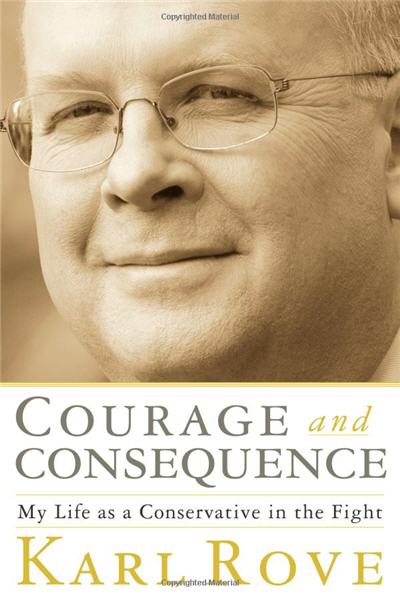
 Reagan apostles Craig Shirley and Donald Devine take to the WaPo editorial page to argue that Karl Rove is not a conservative.
From William F. Buckley Jr. to Barry Goldwater to Ronald Reagan, the creators of the modern conservative movement always taught that excessive concentration of power in government leads inevitably to corruption and the diminution of personal freedoms. But while Rove credits these leaders for shaping his early political views — “at the age of thirteen, I was wild for Barry Goldwater,” he writes — he did not pursue their values while in the White House. To the contrary, as the chief political architect of the Bush presidency, Rove was instrumental in directing an administration most notable for its enormous expansion of national government.
Throughout his memoir, Rove is partial to “compassionate conservatism” — the phrase made famous during Bush’s 2000 presidential campaign — and describes the “four big foundations” of the idea as “education reform, the faith-based initiative, a generous middle-class tax cut and Social Security and Medicare reform.”
Consider that list. Bush’s tax cut was, certainly, basic conservatism in action, yet even President John F. Kennedy, a Democrat, did as much. And the faith-based initiative mainly allowed religious groups to compete equally with other groups seeking federal grants — commendable, but still merely leveling the playing field for access to government largesse, and an initiative in keeping with the principles of Jimmy Carter.
The truly unique aspects of Bush and Rove’s compassionate conservatism were in the arenas of education and entitlements. The goals of Bush’s No Child Left Behind education initiative were certainly worthy, but its trampling of states’ rights sounded early alarms for traditional conservatives. And Bush’s market-oriented proposals for Social Security reform notwithstanding, the Medicare prescription drug benefit the president signed into law in 2003 has created an unfunded liability of $9.4 trillion over the next 75 years, according to the 2009 report from the Medicare trustees. This is far beyond what the White House estimated would be saved with Social Security reform, and the first new major entitlement since the days of Lyndon Johnson. And we all remember steel tariffs, the creation of the Department of Homeland Security, the McCain-Feingold campaign finance law, a massive agricultural subsidy bill, and other spending and regulatory moves by the Bush administration that tilted power toward Washington and away from individuals and states.
[…]
Bush was not the first Republican president to claim the conservative mantle yet merrily grow the size of government; Nixon and Gerald Ford did much the same. Rove and Bush are heirs to a brand of Republicanism rooted in a Tory-style, top-down defense of the status quo. It is not modern conservatism, not the brand that today is finding voice in the “tea party” movement, and certainly not the populist conservatism that found electoral success beginning in the late 1970s.
This is absurd on a number of levels.
First and foremost, Rove served as a political strategist, not a spiritual adviser. His job was to get Bush elected and re-elected. That entails matching the candidate’s core values and strengths with the extant domestic political culture. Bush felt genuine empathy for the less-well-off — a function of the noblesse oblige passed down by his family, his own spiritual awakening, and an awareness that he survived the indiscretions of his youth because of his family’s wealth and status — and this paired nicely with a country that wants government to do more.
Second, Shirley and Devine let their love for Reagan cloud their judgment of the president they served. While Reagan talked the rhetoric of the Conservative Movement as well as anyone who ever lived, he governed by it quite selectively. Yes, he cut taxes and built up the Defense budget. But he also massively increased the deficit because he was unwilling to take the political heat of fighting for more than token cuts in domestic spending. In fairness, the Democrats controlled the House. But Reagan famously worked well with Speaker Tip O’Neill. He signed a massive amnesty bill for illegal aliens, a move that would now make him apostate.
Third, “conservative” and “liberal” and the various other labels of our political system are moving targets. By most lights, the John Kennedy of 1960 would be considered a conservative in 2010. In many ways, that’s true of the Jimmy Carter of 1976, a Southern businessman and born-again Christian who began what we now think of us the Reagan defense build-up and deregulation of various industries . They were progressive for their time on a handful of issues but were both more socially and fiscally conservative than most Republican leaders are today. The mood of the country evolves and the center thus moves with it.
Finally, while I find internecine squabbles to define the parameters of political movements interesting and generally helpful, it’s one thing to fight over the message and another to try to weed out the membership rolls. There are plenty of reasons that Republicans and conservatives might want to be leery of association with Rove. His ideological impurity, however, is not among them.









