In yet another sign of the deteriorating relationship, such as it was, between the United States and North Korea, the DPRK’s top diplomat at the United Nations is making clear that top goal of the United States in talks with the regime is off the table:
North Korea’s ambassador to the United Nations said on Saturday that denuclearization is off the negotiating table with the United States and lengthy talks with Washington are not needed, the starkest statement yet emphasizing the gulf between the two sides ahead of a year-end deadline set by Pyongyang.
U.S. President Donald Trump sought to play down a recent surge in tensions with North Korea, stressing what he said was his good relationship with its leader Kim Jong Un and saying he thought Kim wanted a deal, not to interfere in next year’s U.S. presidential election.
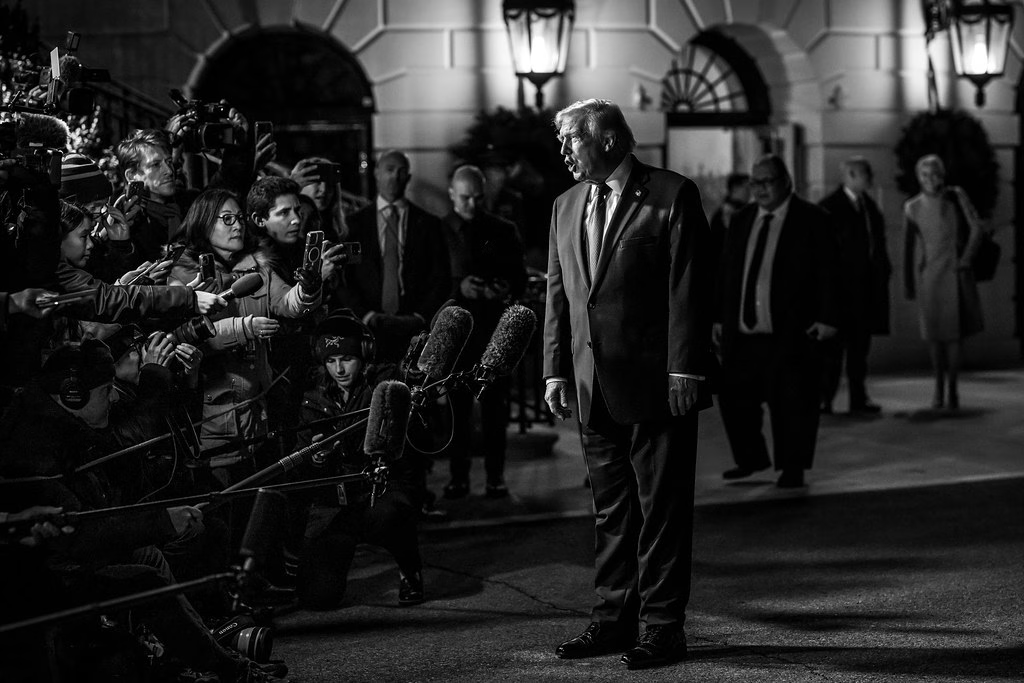
“We’ll see about North Korea. I’d be surprised if North Korea acted hostilely,” Trump told reporters at the White House before leaving for Florida.
“He knows I have an election coming up. I don’t think he wants to interfere with that, but we’ll have to see … I think he’d like to see something happen. The relationship is very good, but you know, there is certain hostility, there’s no question about it.”
Trump has invested considerable time trying to persuade North Korea to give up a nuclear weapons program that has grown to threaten the United States, but progress has been scant in spite of his three meetings with Kim Jong Un.
Tensions have risen ahead of a year-end deadline set by North Korea, which has called on the United States to change its policy of insisting on Pyongyang’s unilateral denuclearization and demanded relief from punishing sanctions.
Kim Jong Un has warned of an unspecified “new path” next year, raising fears this could mean an end to a suspension in nuclear bomb and long-range missile testing in place since 2017 that Trump has held up as a key win from his engagement efforts.
U.N. Ambassador Kim Song said in a statement the “sustained and substantial dialogue” sought by the United States was a “time-saving trick” to suit its domestic political agenda, a reference to Trump’s 2020 reelection bid.
“We do not need to have lengthy talks with the U.S. now and denuclearization is already gone out of the negotiating table,” he said.
Kim Song’s comments appeared to go further than North Korea’s earlier warning that discussions related to its nuclear weapons program might have to be taken off the table given Washington’s refusal to offer concessions.
As we’ve discussed before, of course, “denuclearization” in the context of the talks between the United States has always been something of an ambiguous term. This is largely due to the fact that the American position in talks with North Korea ignores the fact that the United States and North Korea have fundamentally different ideas of what “denuclearization” means.
For the United States, it essentially means that the North Koreans would give up their nuclear weapons, their ballistic missile technology, and their research programs in both areas. In exchange, it appears that the United States has made what seem to be vague at best promises about sanctions relief and the grandiose promises that President Trump has made about the benefits that would result from to the North Korean economy if it opened itself to the world even though there’s no indication that Kim Jong Un or the leadership in Pyongyang want that kind of future for their country.
When the North Koreans talk about “denuclearization,” though, they speak of the “denuclearization of the Korean Peninsula.” This means not only some action on the part of the North Koreans, but also the understanding that the United States would remove any nuclear weapons it may have in the region and that it would renounce the idea of providing South Korea and Japan with a “nuclear umbrella,” which is essentially the threat that any attack on an American ally. It is also fairly clear that the North Koreans also include in their definition of “denuclearization” the idea that the American military presence in South Korea, and potentially in Japan, which the DPRK has made clear it considers to be part of the nuclear threat posed by the United States.
Based on the realities on the ground, this difference in the understand of what “denuclearization” means to each side makes sense given the fact that, as I have said before, the history of the past twenty years or so makes it clear that Kim would be a fool to completely give up either his nuclear weapons or the research program, and to understand why, one need only look to the examples of Libya, Iraq, and other nations that have pursued a nuclear weapons program and the different ways that they have been treated.
In any case, all of this comes in the context of what appears to be deteriorating relations between Pyongyang and Washington. In 2018, the situation on the peninsula, and particularly the direct relationship between North and South Korea, seemed to calm down. Over the same period, President Trump and Kim Jong Un met three times at summits in Singapore, Hanoi, and the Demilitarized Zone between the two Koreas for meetings that ended up being little more than photo opportunities that accomplished next to nothing. More recently, the DPRK appears to be becoming more interested in expanding its missile testing program and continuing with its development of a nuclear deterrent that some have estimated to already include dozens of usable devices.
This negative turn in the relationship started to become apparent in September, October, and November as the North Koreans made clear that they were not interested in further talks with the United States. At the same time, continuing a policy that has been in place since the early summer, the DPRK resumed a program of testing short-range missiles that could be used to carry a nuclear device to South Korea or Japan which President Trump dismissed as not being a big deal. Meanwhile, as The New York Times reports, the DPRK is seeking to up the pressure on the United States in other ways:
SEOUL, South Korea — With North Korea’s deadline for American concessions fast approaching, the North announced Sunday that it had conducted a “very important test” at a missile-engine site, rapidly ramping up pressure after months of carefully calibrated provocations.
Although President Trump has generally played down the North’s actions, on Sunday — just weeks before the Dec. 31 deadline — he issued a strong statement of his own, tweeting: “Kim Jong Un is too smart and has far too much to lose, everything actually, if he acts in a hostile way.”
Analysts said North Korea had most likely conducted a ground-based test of a new type of engine for long-range ballistic missiles. But the North did not yet describe the test or release pictures of it, as it has in the past, so it is unclear whether it was a success.
Still, if an engine was tested, analysts say it could be a warning that Mr. Kim is considering returning to long-range missile tests. It was a series of such launches in 2017 that provoked a crisis with the United States as it became clear that the North’s longest-range missiles were capable of reaching the West Coast of the United States, and perhaps beyond.
Mr. Kim last year announced a halt to all tests of those intercontinental missiles and nuclear weapons, a self-imposed moratorium that Mr. Trump has repeatedly cited as one of the main achievements in his on-again, off-again diplomacy with Mr. Kim. Should they resume, it could mark a complete breakdown in what Mr. Trump had hoped would be his signature foreign policy achievement.
The latest provocation comes after a series of short-range missile tests and statements by senior North Korean leaders that indicate Mr. Kim is running out of patience with diplomacy that has not won him the relief he craves from crippling sanctions. Those statements included a warning by a vice foreign minister that “it is entirely up to the U.S. what Christmas gift it will select to get.”
North Korea has not been explicit about what might happen after Dec. 31, except that Mr. Kim has warned of finding a “new way” if Washington persists with sanctions and tries to force an unpalatable denuclearization deal. But senior North Korean officials have hinted that the new approach might include resuming nuclear and intercontinental ballistic missile tests.
President Trump, meanwhile, took to Twitter to respond in precisely the wrong way:
In response, Daniel Larison notes that Trump’s response is precisely the wrong way to respond:
Nothing is less likely to convince Kim and the North Korean government to make concessions than threatening them with the loss of “everything” (i.e., regime change). Much depends on what Trump chooses to define as “hostile” behavior from North Korea. If he thinks that North Korea made a meaningful commitment to disarm and then concludes that they are reneging on it, that spells serious trouble for the new year. Trump is absurdly wrong to say that the Singapore summit produced a “strong denuclearization agreement.” It produced no agreement at all, and even the vague statement that did come out of the summit doesn’t suggest that North Korea is willing to disarm. The U.S. and North Korea are on the cusp of a completely avoidable crisis, and Trump will bear a significant portion of the blame for it.
The president also overrates the importance of his relationship with Kim. Kim has little or nothing to show for negotiating with Trump and probably sees no reason to do Trump any favors in an election year. The reality is that North Korea made no such commitment to disarm, and their government’s patience has all but run out. The end-of-year deadline that they have talked about for months approaches, and the U.S. negotiating position remains as hopelessly unrealistic as ever. The U.S. and North Korea are already well on their way to resuming the tit-for-tat insults and provocations that we saw in 2017.
The deadline that North Korea has set expires at the end of the year and it’s not clear exactly what we can expect to see from the DPRK. Most likely, it will consist of a resumption of at least some testing in at least the ballistic missile area, which would be a clear threat to the United States. It’s also possible we’ll see a resumption of nuclear tests, although experts have said that the nation is likely far beyond the point where it needs to conduct frequent testing to perfect its weapons designs. Whatever it is, though, it will show the world that the Trump Administration’s brain dead policy toward North Korea has been an abject failure.