
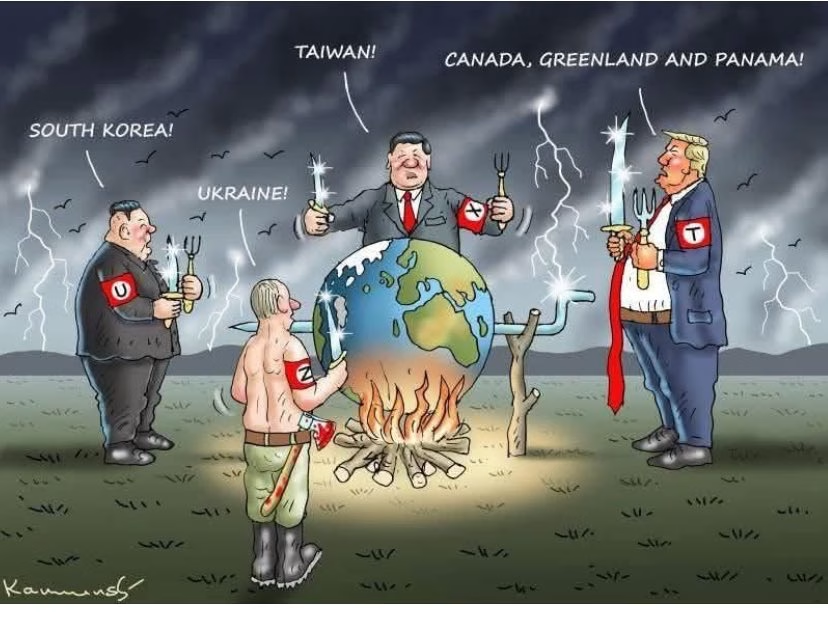
I have been thinking about all of Trump’s rhetoric about Greenland, Canada, and Panama (plus the Gulf of Mexico), for a few days now, and still am not sure what the best place to start is. On the one hand, it is deja vu all over again, as we are now in the cycle wherein Trump says outrageous things, and social media and cable news all erupt in a deluge of attention.
Wash. Rinse. Repeat.
So, on the one hand, should one just ignore it? I mean, we all know that the US is not going to invade Greenland or Panama and that we are not going to annex Canada.
But on the other hand, the words of the president-elect matter. It matters that the US President is using rhetoric that sounds very much like Putin. Indeed, as Ian Bremmer noted on LinkedIn, Trump’s Truth Social post about Panama uses the same logic that Putin has used for Ukraine.
It is disconcerting to have the President of the United States talking like this, even if it is not surprising.
It also has the effect of getting his co-partisans to buy in. As Aaron Ruper correctly noted:
Meanwhile, Republicans are already referring to Canada as a “territory” and have drafted legislation to rename the Gulf of Mexico the “Gulf of America.” If nothing else, they’re making clear there’s nothing their Dear Leader could say or do that they won’t enthusiastically support.
The whole thing is being discussed as a topic worth consideration on FNC. For example:
Again, this is Putinesque. And, I would hasten to add, Greenland, as part of Denmark, is already in an “alliance” with the United States.
And there are gems such as this:
(To correct the community note, via NPR: Did Harry Truman Really Try To Buy Greenland Back In The Day?).
But, of course, past attempts at these kinds of territorial acquisitions don’t make them a good idea in the now. All this talk of buying or seizing land is the stuff of the pre-WWII political order. And it is also the kind of thing that we opposed in the first Gulf War when Saddam Hussein made similar claims about Kuwait, for example. The notion that bigger powers can claim what they want is 19th-century imperialist thinking.
Talk about renaming the Gulf of Mexico the “Gulf of America” sounds like a parody of rhetoric that Teddy Roosevelt might have used about the Caribbean over a hundred years ago. All this talk about the Panama Canal utterly ignores the fact that the reason it belonged to the US in the first place was that the US helped Panama secede from Colombia so that a new and compliant Panamanian government would acquiesce to signing it off to us (because the Colombia government wouldn’t).
The US can get what it needs from Greenland, for example, in terms of national security via working within NATO. The US already has a military presence in Greenland, and if an expanded one was needed, working with our NATO partners, rather than bullying them would be the smarter way to go. And if there is money to be made extracting rare minerals, one suspects that appropriate business arrangements will be made.
Back to the 19th-century (and older) of it all, I was recently reminded of this 2019 piece in WaPo, Marc Thiessen (Trump’s idea of buying Greenland is far from absurd) made the following assertion (which echoes some things I have seen and read in the more recent discussion over Greenland and Trump):
Indeed, a Greenland purchase would be in keeping with a long history of presidential land acquisitions. In 1803, Thomas Jefferson bought the Louisiana territory from France. In 1819, President James Monroe bought Florida from Spain. In 1854, President Franklin Pierce, in the Gadsden Purchase, bought part of New Mexico and Arizona from Mexico. In 1867, President Andrew Johnson bought Alaska from Russia. In 1898, President William McKinley bought the Philippines from Spain. And in 1903, President Theodore Roosevelt rented the Panama Canal Zone from Panama and Guantanamo Bay from Cuba. If Denmark won’t sell Greenland, maybe we can rent it!
Two things are striking to me about Thiessen’s piece and the general discourse by anyone who does not see Trump’s desire to acquire Greenland (and rhetoric about other places) as anything other than absurd.
- All such discussions ignore the people who live there.
- They all are predicated on a pre-WWII notion of imperialism.
All of this rhetoric ignores that human beings live in these places. They should not be treated as mere pawns who should be ignored (or, as per Hannity-as-Putin, lied about). Of course, I don’t really think Republicans would be keen on adding Canadians to the voting pool.
But it is really important to realize the degree to which territorial expansion as a normal part of international politics was taken off the table after WWII. The number of great wars fought in the 19th and early 20th centuries with territorial aims underscores why such attitudes are dangerous and destabilizing.
As noted above, the Iraqi invasion of Kuwait was seen as a massive violation of international norms. It is why the Ukraine invasion is so problematic. It is why China’s designs on Taiwan are seen as unacceptable.
Indeed, Russia’s violation of Georgia’s territorial sovereignty and its subsequent annexation of the Crimean peninsula helped lead to the invasion of Ukraine. Small violations of norms often lead to larger and large ones.
Norms matter. As does tearing them down.
I oversimplify given the medium, but one of the major positive results of the post-WWII global order (and subsequent decolonization period) is the establishment of solid, persistent international borders that were considered more or less sacrosanct. The US, in particular, fostered and upheld this notion. Rogue countries like Russia did not. For the incoming US president to speak this way, even if actions are not a likely outcome, is dangerous.
It will change the way some Americans think about this topic (as we are seeing media allies and members of the GOP parrot his nonsense).
It will erode global trust in the US (of course, our national foolishness in re-electing Trump has already done that, but this will just deepen the problem).
And it will embolden people like Putin.
None of this is good, in case anyone was wondering.
At a minimum, it is utterly discouraging to again have a president who reasons like a child playing a game of Risk and who thinks that making threats is an impressive negotiation tactic.
Update:
Another example of a member of the Congress spreading this nonsense.
And for a serious analysis concerning Greenland (which echoes and deepens points I made above), see this piece at War on the Rocks.
h/t: LGM for both.









