
WSJ (“The Standoff That Has Turned Minnesota Into a Tinderbox“):
The collision of the Trump administration’s huge immigration operation and the enormous pushback from residents is leading to a tinderbox in Minneapolis.
For locals, much of the anger stems from the clash between the administration’s stated rationale for being in the area and the reality on the ground.
They are here, federal officials say, to find “criminal illegal aliens hurting Americans” after a sprawling welfare-fraud scandal involving dozens of Minnesotans of Somali descent gained national attention.
But residents see massive federal overreach in a place with a relatively small proportion of immigrants in the country illegally compared with other states.
Minnesota’s population of immigrants here illegally stands at an estimated 2.2%, about half the national average, according to the Pew Research Center. More than 90% of the state’s Somali population, the group highlighted in the fraud investigation, have some sort of permanent legal status, according to the Census Bureau’s American Community Survey.
[…]
In a statement Friday, Tricia McLaughlin, a spokeswoman for the Department of Homeland Security, said allegations that ICE engages in racial profiling were false, and that “obstructing federal law enforcement officers during the performance of their duties is not only dangerous but also a federal crime and a felony.”
“Law enforcement uses ‘reasonable suspicion’ to make arrests, as allowed under the Fourth Amendment to the U.S. Constitution,” she said.
Over the past 12 months, DHS has pushed personnel into one liberal city at a time with high-profile immigration actions, but the Minneapolis operation feels different on the ground. Some 3,000 federal officers are operating in and around a city of just 430,000, compared with a few hundred sent to Chicago—population of 2.7 million—this past fall.
Immigration and Customs Enforcement officers here and elsewhere are under pressure from daily arrest quotas that leadership has set at 3,000 a day across the country—the number it would take to reach one million arrests in a year, according to ICE officials familiar with the matter. Though ICE has never come close to meeting that daily goal, officers are rewarded for making arrests, even if the immigrants they take in are later released.
In Minneapolis, those officers are walking and driving through the largely residential city looking for people to arrest—and coming into close contact with angry and organized residents. That proximity helps explain why federal agents are clashing more with locals here than anywhere else.
[…]
A growing contingent of thousands of federal officers dwarfs the roughly 600 police officers in Minneapolis, leading some locals to believe they must protect themselves. Some City Council members now carry gas masks everywhere they go, and the Minneapolis Star Tribune editorial board described the city as being “under siege” by the federal government. Late Friday, a federal judge overseeing a suit brought by protesters imposed new limits on how immigration-enforcement officials can interact with demonstrators, including blocking agents from pepper-spraying or arresting peaceful protesters.
Sadly, the crisis seems to be escalating.
CNN (“Minnesota Gov. Tim Walz mobilizes state National Guard amid ongoing protests“):
Tensions are flaring in Minneapolis as protestors decrying ICE and its agents’ use of force face off with federal law enforcement and Minnesota Gov. Tim Walz mobilizes the state National Guard to stand ready to assist.
Crowds of bundled-up demonstrators chanted and waved signs Saturday in subfreezing temperatures in downtown Minneapolis and at the Bishop Henry Whipple Federal Building. Extra measures were put in place in downtown Minneapolis with blocked roads and at least one hotel bolstering security due to the protests.
At the federal building, there were tense standoffs between federal law enforcement officers in riot gear and protesters. As a large group of officers approached the protesters from the federal building, the crowd responded with chants of expletives and boos. Some demonstrators urged the crowd to stay calm and stay together.
[…]
Walz has mobilized the state National Guard to support the Minnesota State Patrol, a spokesperson for the guard said Saturday. An official in the governor’s office said the move was a reconfirmation of Walz’s direction for the state National Guard to mobilize in support of the local law enforcement. The guard hasn’t been deployed.
[…]
Demonstrations now continue with new restrictions on federal immigration agents placed by a federal judge on Friday: Agents carrying out a sweeping operation in Minnesota can’t deploy certain crowd-control measures against peaceful protesters or arrest them.
The limitations came as word spread that the Department of Justice is investigating Walz and Minneapolis Mayor Jacob Frey over possible obstruction of federal law enforcement, sources familiar with the matter told CNN. The probe raises the possibility of criminal consequences for the two Democrats, who have repeatedly told protesters to remain peaceful and to “not take the bait” that could lead to a heavier federal response.
[…]
The National Guard is “staged and ready to respond,” Minnesota National Guard spokesperson Army Maj. Andrea Tsuchiya said in a statement to CNN. “We are not deployed to city streets at this time.”
Troops will help provide “traffic support to protect life, preserve property, and support the rights of all Minnesotans to assemble peacefully,” Tsuchiya said.
WaPo (“Pentagon readies 1,500 soldiers to possibly deploy to Minnesota, officials say“):
The Pentagon has ordered about 1,500 active-duty soldiers to prepare for a possible deployment to Minnesota, defense officials told The Washington Post late Saturday, after President Donald Trump threatened to invoke the Insurrection Act in response to unrest there.
The soldiers are assigned to two infantry battalions with the Army’s 11th Airborne Division, which is based in Alaska and specializes in cold-weather operations.
The Army placed the units on prepare-to-deploy orders in case violence in Minnesota escalates, officials said, characterizing the move as “prudent planning.” It is not clear whether any of them will be sent to the state, the officials said, speaking like some others on the condition of anonymity to discuss sensitive military planning.
[…]
The Insurrection Act, a federal law dating to 1807, permits the president to take control of a state’s National Guard forces or deploy active-duty troops domestically in response to a “rebellion.” Invoking the act would be an extraordinary move and mark the first time a commander in chief has done so since President George H.W. Bush called on the military during the Los Angeles riots of 1992 that killed dozens of people and caused widespread destruction.
Typically, invoking the Insurrection Act is considered a last resort, when law enforcement personnel are unable to keep the peace during times of civil unrest.
Trump threatened Thursday to invoke the law, saying on social media that unless officials in Minnesota could stop protesters from “attacking” agents with Immigration and Customs Enforcement, he would “institute the INSURRECTION ACT” and “quickly put an end to the travesty that is taking place in that once great State.”
The situation is already well out of hand, with Renee Good killed by ICE agents and others shot. Minneapolis was already something of a tinderbox, with community-police relations incredibly strained by the George Floyd murder.
While I believe we ought enforce our immigration laws (and that our immigration laws should reflect the policies we want enforced), there does not appear to be any reasonable justification for a massive ICE presence in Minneapolis. There’s just not a major illegal immigrant population there.
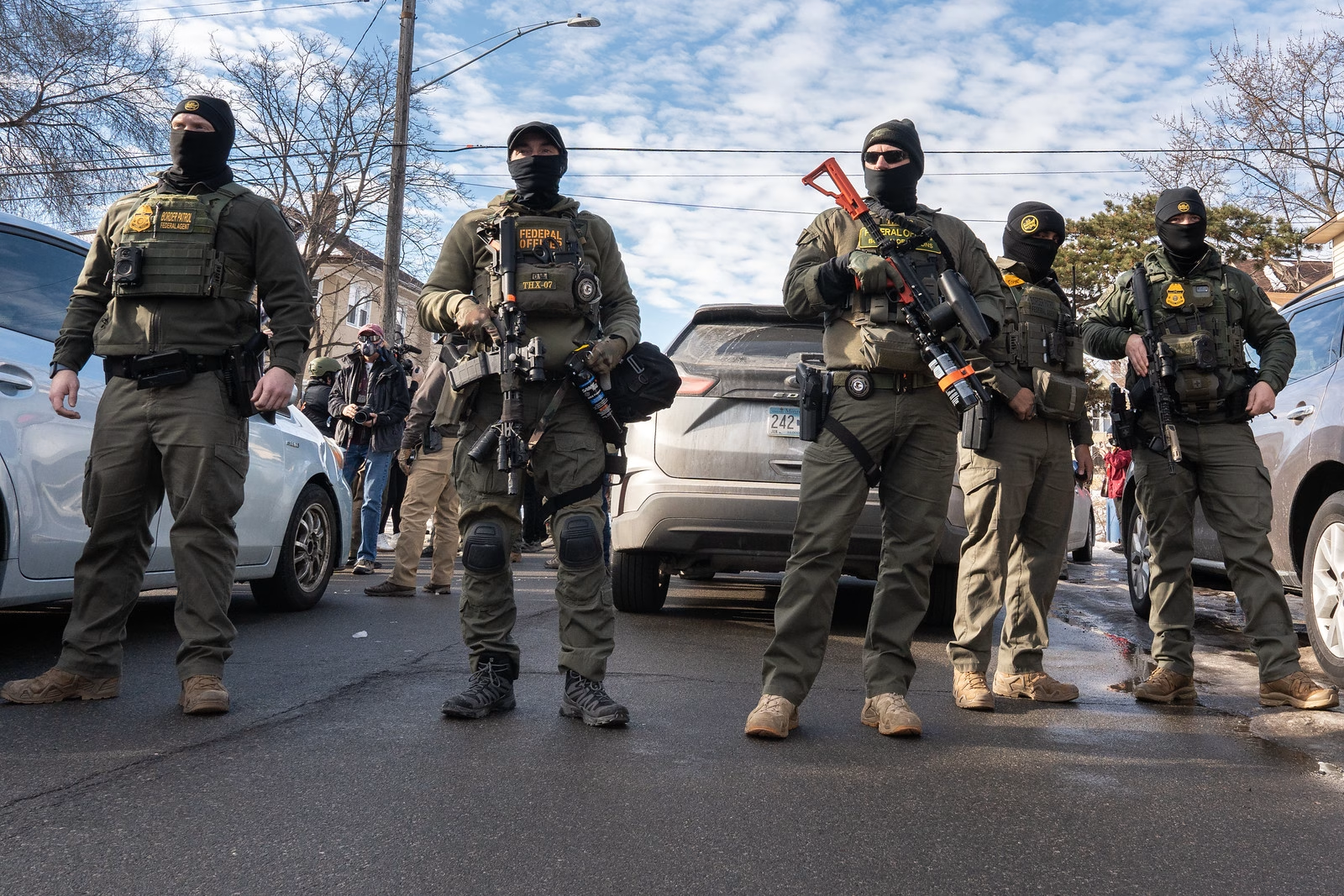
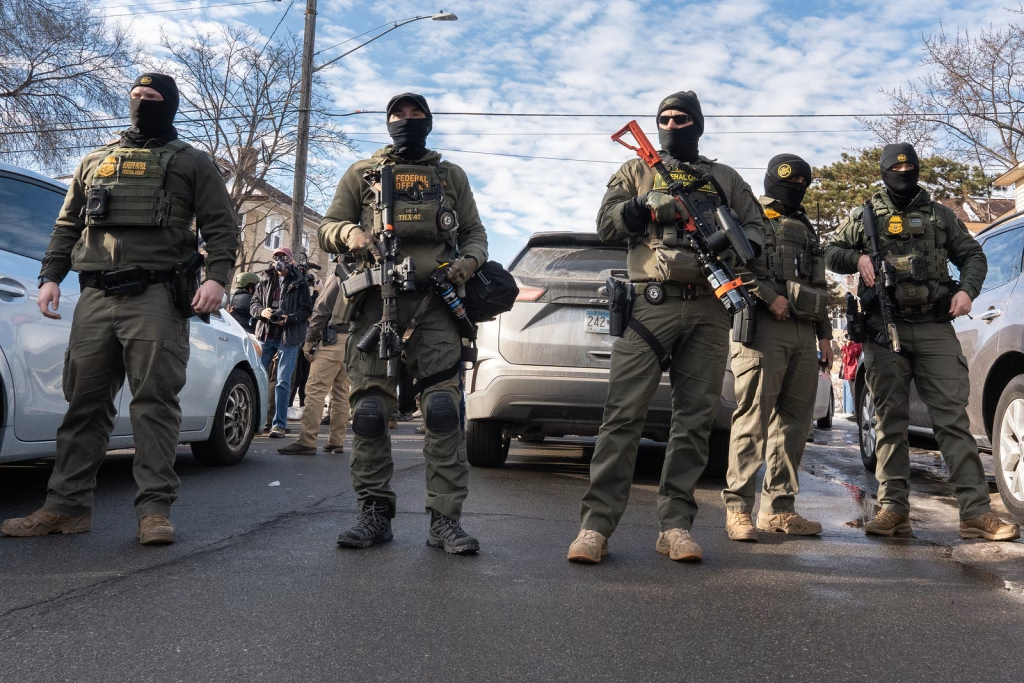
This is compounded by the militarization of these officers. While there are circumstances where camouflage makes sense for domestic law enforcement, patrolling an American city is not one of them. Their being masked adds to this problem: they present as a secret police rather than as public servants.
That said, the nature of the protests is not helpful. Interfering with law enforcement personnel while they are carrying out their official duties practically invites confrontation and escalation. That’s particularly true when they are armed for combat.
Calling out the National Guard would only escalate the situation further. Having opposing militarized forces practically guarantees violence. And, have mercy, invoking the Insurrection Act and sending in active duty personnel would put all concerned into a precarious situation.









