
Via Politico: Trump’s ‘Golden Age’ has arrived for the top 10%.
The top 10 percent of U.S. earners spent $20.3 trillion through the first half of 2025 — nearly matching the $22.5 trillion shelled out by everyone else, according to the Royal Bank of Canada. That splurge has been primed by a buoyant stock market, elevated real estate prices and solid wage gains for the wealthy. Bank of America says its top account holders saw take-home pay climb 4 percent over the last year, while income growth for poorer households grew just 1.4 percent.
That the wealthiest are doing well is not a surprise. And it would seem that some people are still living in the 1980s.
Steve Bannon, who served as Trump’s chief strategist during his first term, said the president needs to “hammer relentlessly” on how the economy is expanding and that higher wages will come from supply-side tax cuts from his One Big Beautiful Bill, which passed in July.
No doubt, supply-side economics will finally work this time. Let that wealth trickle, baby!
I expect that there will be a lot of touting of no tax on tips and overtime, but since those savings are not realized until workers file their income taxes, there isn’t going to be some big change in people’s paychecks.
And then there is stuff like this, wherein the Secretary of Commerce asserts that 3Q GDP growth of 4.3% means we all earn more money. That is, of course, not how any of this works and leads again to the age-old question about these guys: are they idiots or do they think we are? (Or, of course, the very real possibility of los dos).
I would note that this is a politically foolish message, as people know whether they have larger paychecks or not. And while I acknowledge that the US’ economy grew in Q3 better than England, Japan, or the EU, ask Joe Biden about how making macro-economic comparisons works out.
Meanwhile, Krugman notes: A New K in America.
According to current economic commentary, it’s all about “K”. Talk of a “K-shaped economy,” in which incomes and wealth are rising only for those at the top, has become ubiquitous. And rightly so. For high-income Americans who own a lot of stock, the past year has treated them pretty well. But for those who don’t, not so much.
[…]
The proximate cause of the K-shaped economy is a weak job market. As I’ve written repeatedly, the U.S. economy has not (yet) experienced mass layoffs. Employers have, however, become very reluctant to hire new workers.
[…]
The key point about Trump’s tariffs and to some extent his other policies is that they keep changing, and nobody knows what will come next. This uncertainty makes businesses reluctant to make commitments, including the commitment involved in hiring new workers: If you hire workers based on current tariffs, what happens if the Supreme Court rules those tariffs illegal, or the Trump administration picks a different country or countries as enemies?
As such, I am skeptical that all of this is heading in the direction that the administration keeps promising, even with the good Q3 numbers and a strong holiday spending season (e.g., via CNBC, Holiday retail spending rose 4.2% this season, driven by e-commerce and electronics: Visa report). But, we shall see.
On the politics-of-it-all, I would note this graph from Krugman’s post, which is of Black unemployment
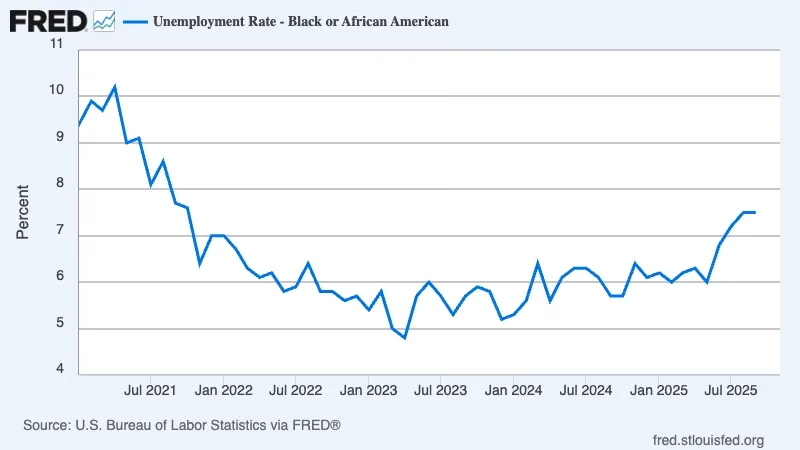
Trump improved his share of the Black vote, predicated largely on economic discontent. Having unemployment for Black Americans under his watch go from around 6% at his inauguration to over 7.5% is going to make it kind of difficult for the GOP to capitalize on those 2024 gains, shall we say.