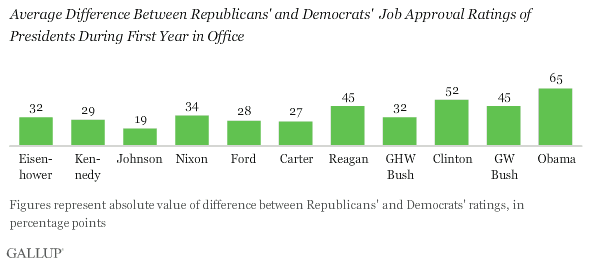
The 65 percentage-point gap between Democrats’ (88%) and Republicans’ (23%) average job approval ratings for Barack Obama is easily the largest for any president in his first year in office, greatly exceeding the prior high of 52 points for Bill Clinton.
So begins Jeffrey Jones‘ introduction of a new Gallup poll. Here’s the graphic illustration:
 It didn’t start out that way.
Overall, Obama averaged 57% job approval among all Americans from his inauguration to the end of his first full year on Jan. 19. He came into office seeking to unite the country, and his initial approval ratings ranked among the best for post-World War II presidents, including an average of 41% approval from Republicans in his first week in office. But he quickly lost most of his Republican support, with his approval rating among Republicans dropping below 30% in mid-February and below 20% in August. Throughout the year, his approval rating among Democrats exceeded 80%, and it showed little decline even as his overall approval rating fell from the mid-60s to roughly 50%.
 Jones continues:
Thus, the extraordinary level of polarization in Obama’s first year in office is a combination of declining support from Republicans coupled with high and sustained approval from Democrats. In fact, his 88% average approval rating from his own party’s supporters is exceeded only by George W. Bush’s 92% during Bush’s first year in office. Obama’s 23% approval among supporters of the opposition party matches Bill Clinton’s for the lowest for a first-year president. But Clinton was less popular among Democrats than Obama has been to date, making Obama’s ratings more polarized.
Of course, Bush had the unifying impact of the 9/11 terrorist attacks to boost his first-year numbers.
So, is this gap is about Obama? About Republican frustration? About Democratic optimism? Or simply a result of a steadily more polarized society? Probably, some combination. But the last would certainly seem to be the most powerful.
Prior to Ronald Reagan, no president averaged more than a 40-point gap in approval ratings by party during his term; since then, only the elder George Bush has averaged less than a 50-point gap, including Obama’s average 65-point gap to date.

We’ll see if Obama ultimately tops Bush — who seemed untoppable a year ago. But it sure seems likely. It’s the nature of a permanent campaign and, as Jones observes, a radically different information climate:
The way Americans view presidents has clearly changed in recent decades, perhaps owing to the growth in variety, sources, and even politicization of news on cable television and the Internet, and the continuing popularity of politically oriented talk radio. The outcome is that Americans evaluate their presidents and other political leaders through increasingly thick partisan lenses.
Not only is there more information out there competing for eyeballs — with hype, fear, and anger as the chief selling points — but no one has to ever hear the opinions of people who disagree with them unless they really want to. If you’re getting all your news from Fox or MSNBC, you’re simply going to have a different outlook on the world than was the case when everyone was watching one of three national anchormen presenting 22 minutes of news each night in a Midwestern accent.