Once again, President Obama has offended some Europeans by “snubbing” them. This time, it’s the Norwegians, who are apparently “incensed” that he was “rude” in not attending all the festivities Nobel laureates usually participate in, notably lunch with the king. It’s getting some play in the blogosphere.
As I argue in my New Atlanticist essay “Obama ‘Snubs’ Norwegians en Route to Nobel Prize,” though, the overweening sensitivities on the other side of the Pond are getting a bit old.
Perhaps it’s bad form to accept one’s award and then run out before the dinner’s over, metaphorically speaking. But the fact of the matter is that most Nobel recipients have a little less on their plate than Obama, who is managing two major wars and an economic mess while trying to overhaul the health care system.
Oh, and by the way, his acceptance speech was surprisingly strong, forthrightly defending America’s place in the world and calling on the NATO Allies to do more.
Whatever mistakes we have made, the plain fact is this: The United States of America has helped underwrite global security for more than six decades with the blood of our citizens and the strength of our arms. The service and sacrifice of our men and women in uniform has promoted peace and prosperity from Germany to Korea, and enabled democracy to take hold in places like the Balkans. We have borne this burden not because we seek to impose our will. We have done so out of enlightened self-interest — because we seek a better future for our children and grandchildren, and we believe that their lives will be better if others’ children and grandchildren can live in freedom and prosperity.
[…]
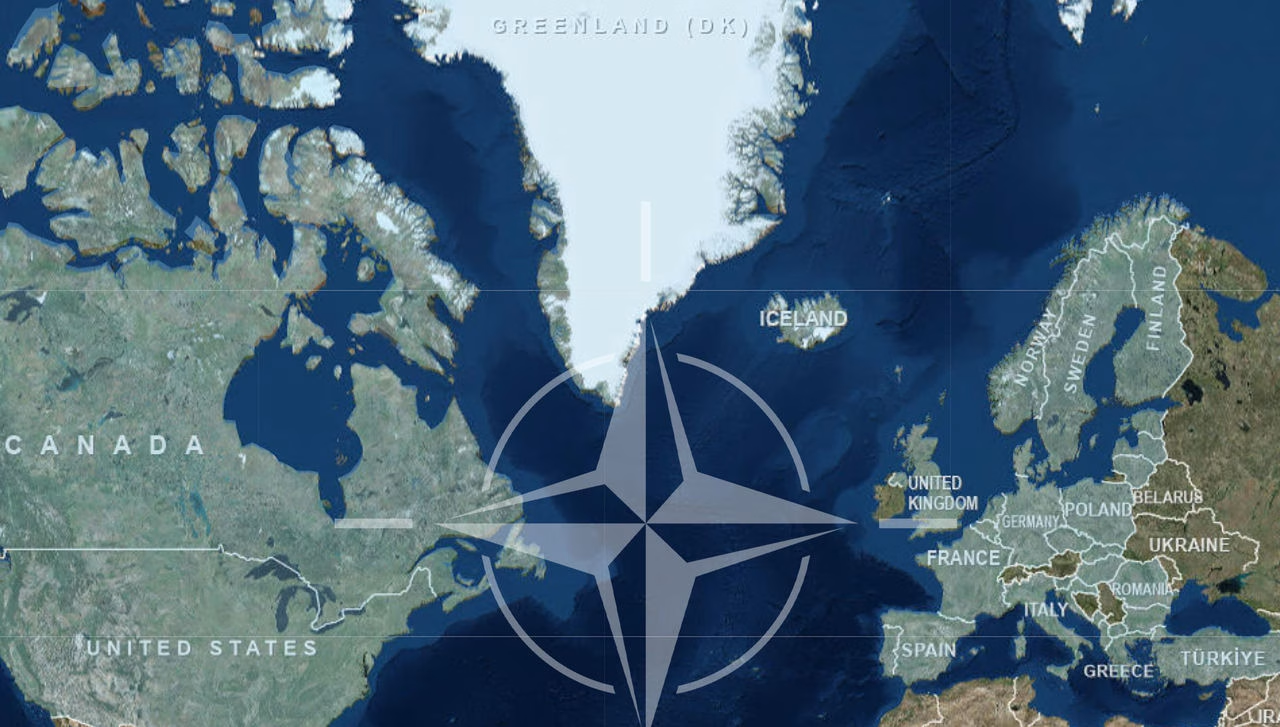
America’s commitment to global security will never waver. But in a world in which threats are more diffuse, and missions more complex, America cannot act alone. America alone cannot secure the peace. This is true in Afghanistan. This is true in failed states like Somalia, where terrorism and piracy is joined by famine and human suffering. And sadly, it will continue to be true in unstable regions for years to come.
The leaders and soldiers of NATO countries, and other friends and allies, demonstrate this truth through the capacity and courage they’ve shown in Afghanistan. But in many countries, there is a disconnect between the efforts of those who serve and the ambivalence of the broader public. I understand why war is not popular, but I also know this: The belief that peace is desirable is rarely enough to achieve it. Peace requires responsibility. Peace entails sacrifice. That’s why NATO continues to be indispensable.
Ultimately, Obama’s commitment to this ideal — and Europe’s response to it — will matter for more for transatlantic relations than a missed meal or a poorly chosen gift.
Photo: Reuters Pictures.