
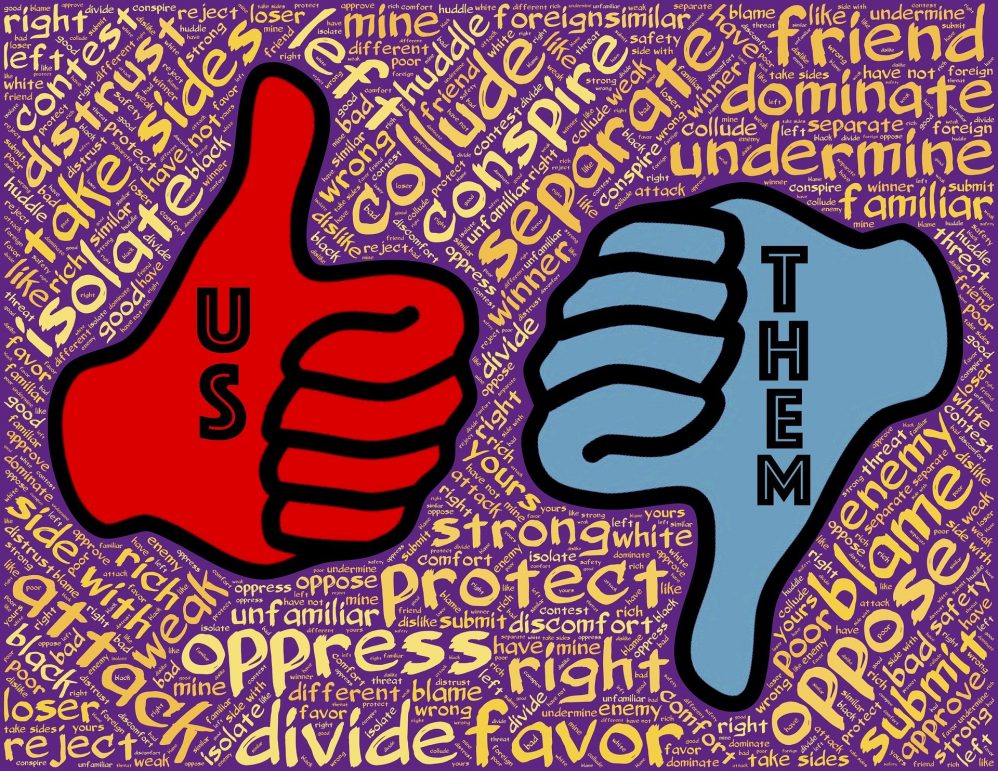

In his latest column for the NYT, “Don’t Let the Culture War Degrade the Constitution,” David French dutifully plays his role as a “responsible conservative.” Yet, while I endorse almost every word of it, the degree to which he makes it a problem that is equally one of the left and right undermines its impact.
The opener is pure Classical Liberalism:
The Constitution of the United States, properly interpreted, provides a marvelous method for handling social conflict. It empowers an elected government to enact even contentious new rules while protecting the most fundamental human rights of dissenting citizens. Political defeat is never total defeat. Losers of a given election still possess their basic civil liberties, and the combination of the right to speak and the right to vote provides them concrete hope for their preferred political outcomes.
But if a government both enacts contentious policies and diminishes the civil liberties of its current ideological opponents, then it sharply increases the stakes of political conflict. It breaks the social compact by rendering political losers, in effect, second-class citizens. A culture war waged against the civil liberties of your political opponents inflicts a double injury on dissenters: They don’t merely lose a vote; they also lose a share of their freedom.
One can quibble with the presentation as a bit idealized, given the many obstacles to the majority enacting new rules, contentious or otherwise, or, indeed, to the majority actually winning control of the governing apparatus given some undemocratic features of our system. But, otherwise, it’s straight out of the Federalist Papers.
But, as a fellow former Republican who left our erstwhile party out of disgust with Trump and the “populist” takeover, I naturally expected this setup to be a condemnation of extraordinary measures in Florida, Arkansas, and other red states that clearly fly in the face of the First Amendment. Alas . . .
That’s exactly what’s happening now. The culture war is coming for American liberty — in red states and blue alike. The examples are legion. Let’s start with America’s progressive strongholds. On Wednesday, Gov. Gavin Newsom announced that the State of California would not renew a multimillion-dollar contract with Walgreens — not because Walgreens had failed to comply with its contractual obligations but rather because it had responded to Republican legal warnings and decided not to dispense an abortion pill in 21 red states. Newsom used his political power to punish a corporate position he opposed.
So, look, I think Newsom was wrong to punish Walgreens, a company that was dispensing “abortion pills” nationwide, for complying with post-Dobbs laws passed by several states and bowing to threats of lawsuits in others. But I don’t really see how this constitutes an infringement on anyone’s civil liberties.
California is not alone in its efforts to suppress constitutionally protected rights. Late last month the Court of Appeals for the Second Circuit held that New York’s so-called Boss Bill, which prohibits employers from discriminating against employees on the basis of their “reproductive health decision making,” may violate the expressive associational rights of pro-life organizations that require employees not to have abortions and to refrain from extramarital sex.
This one is just bizarre. New York passed a law seeking to protect the rights of its citizens to do things that are perfectly legal under state law but lost a court case saying that certain employers had a right to punish people for doing those things. I think the Second Circuit is clearly right. But it’s certainly not a case of New York using its power to “punish losers.”
But no, I’m not letting red America off the hook.
That’s mighty white of you, Dave.
The educational culture wars are inspiring a host of educational gag orders across states that purport to block advocacy of disfavored ideas about race and gender. Many of those statutes are aimed at K-12 education, where the government has considerable control over teacher speech. But others are aimed at speech in public universities and private corporations, where states have much less control. Indeed, a federal court has already blocked enforcement of Florida’s so-called Stop WOKE Act to the extent that it limits free expression on public campuses and in private boardrooms.
Surely, these are vastly more egregious than the California and New York examples? I mean, by orders of magnitude? So why not lead with this?
Florida is one of the hot spots of right-wing censorship and punitive government. It passed an unconstitutional law to control social media moderation in the state, and Gov. Ron DeSantis took direct action against Disney after the company objected to Florida House Bill 1557, which tightly regulated “classroom instruction” on “sexual orientation or gender identity.” If the right is going to condemn Newsom’s action against Walgreens, shouldn’t it also oppose DeSantis’s attack on Disney?
Sure. But they’re not remotely equivalent examples! Newsom stopped doing business with Walgreens; DeSantis literally took over Disney, overturning a decades-old law giving the company autonomy over land that they developed, bringing billions in revenue to the state, on the basis of those guarantees.* Further, Newsom punished Walgreens for bowing to political pressure from outside, whereas DeSantis punished Disney for standing up for civil liberties. Those are very different things!
It’s a sign of the times that the list above — from the left and the right — is woefully incomplete. Careful observers will be able to point to any number of additional culture-war-motivated statutes, regulations and government actions that take aim at the Bill of Rights.
State attacks on civil liberties are even affecting our most valued relationships: the bonds between parent and child. In January, The Times reported on how public schools sometimes withhold from parents information about a child’s gender transition, even in the absence of any evidence of parental abuse. California has enacted a statute that grants the state broad authority to permit children to receive “gender-affirming health care” there, even potentially over the objection of a custodial parent.
For example, Section 7 of the law states that California courts won’t weigh as a factor against a petitioner seeking California court jurisdiction if the person took a child “from the person who has legal custody” in order to obtain “gender-affirming health care” and that care is limited by the law or policy of another state.
And because every culture war action against civil liberties has its mirror image on the other side, Gov. Greg Abbott of Texas issued a directive to the Texas Department of Family and Protective Services to investigate as “abuse” both surgical and pharmaceutical interventions for transgender children, regardless of the good faith and desires of the parents, children and caregivers involved.
Again, these are not equivalent assaults on civil liberties. Even if one starts with the presumption—as I do—that parents should have considerable latitude in making decisions about their minor children, we have to recognize that these rights have to be balanced against the mental health of those children. And that there are a lot of shitty parents out there, especially with regard to LGBTQ issues and other matters of human sexuality. I struggle with how to achieve that balance and am not at all sure California has gotten it right. But I’m quite certain Texas has gotten it wrong.
To understand the gravity of the state interference with parental authority, it’s worth remembering the words of Chief Justice Warren Burger in the 1972 case Wisconsin v. Yoder, in which he wrote that the “primary role of the parents in the upbringing of their children is now established beyond debate as an enduring American tradition.” To simply presume that parents are abusive because they may dissent from state consensus on transgender care is to violate this principle of American law.
So, that case was more than half a century ago. It’s so old that abortion was still illegal! (Oh, wait.)
Further, it wasn’t about medical care but about the right to raise one’s children according to one’s religious beliefs. A unanimous Court ruled that the state’s interest in children attending school through age 16 didn’t outweigh the rights of Amish parents to pull them out after 8th grade according to their religious beliefs.** Frankly, I think Burger and company got it wrong. Regardless, subsequent SCOTUS rulings set boundaries, notably two cases in which Christian Scientist parents killed their children by refusing to provide appropriate medical care and were punished by the state.
French’s close is strong:
In a nation as diverse as the United States, conflicts over values are inevitable, but our most basic civil liberties must remain inviolate. To govern otherwise both inflicts a grave injury on dissenting citizens and violates the letter and spirit of the Constitution itself. Our right to speak, much less to parent, should not be contingent on our ability to gain political control.
The much better course for our democracy is to uphold a legal corollary to the golden rule: Defend the rights of others that you would like to exercise yourself. It doesn’t end the culture war. We’ll still clash over contentious issues. But maintaining a bedrock defense of civil liberties lowers the stakes. Protecting individual freedom tells all Americans and all American families that the social compact holds and — win or lose on any given issue, regardless of how controversial — this country is still their home.
While there are margins at which perceived societal interests will clash with the deeply-held beliefs of individual citizens, our instinct should be broadly libertarian: to each his own.
But French’s argument would be much more compelling if he had acknowledged that the assault on “basic civil liberties” is coming almost entirely from one side of the culture wars.
Amusingly, even bending over backward to pretend that the problem is equally one on the left, French is being attacked from the right as a “conservative” engaged in the “pathetic drawing of false equivalencies.”
Comparing the protection of children from harmful life-altering procedures to California promoting the same is asinine. It’s a weak attempt to draw a moral and legal equivalency that simply doesn’t exist. The state that is trying to stop children from being abused (yes, it’s abuse) is not the same as the state mandating that same abuse.
[…]
Pervasive transgender ideology targeting children is not a philosophical game in the pages of the Times. It’s a dangerous, growing poison that thrives on its opponents ceding ground. States absolutely have a legal right to regulate medical procedures, and they certainly have a legal (and moral) obligation to protect children in the process.
So, he isn’t even winning over what is essentially his own side with his framing.
_____________
*Disney literally brought electricity, water, roads and police to the area.
**The ruling was unanimous, but there were multiple concurrences, a partial dissent, and Justices Powell and Rehnquist took no part in the case.









