POLITICO is trending with a story headlined “New Pentagon training refers to protesters, journalists as ‘adversaries’.” It’s much ado about very little.
A new mandatory Pentagon training course aimed at preventing leaks refers to protesters and journalists as “adversaries” in a fictional scenario designed to teach Defense Department personnel how to better protect sensitive information.
The new course was recently launched as part of Defense Secretary Mark Esper’s effort to improve “operational security,” or OPSEC, and clamp down on leaks. The training materials are public and include a video message from Esper, as well as a July 20 memo outlining his concerns about operational security and directing all DoD personnel — military, civilian and on-site contractors — to take the course within the next 60 days.
Because we’re still on minimum manning and I had a ton of work to get done before our annual summer faculty development session kicks off today, I haven’t yet completed said training but was dreading it.
“Unfortunately, poor OPSEC practices within DoD in the past have resulted in the unauthorized disclosure or ‘leaks,’” Esper writes in the memo. “The Department of Defense (DoD) remains committed to transparency to promote accountability and public trust. [However] unauthorized disclosures jeopardize our DoD personnel, operations, strategies and policies to the benefit of our adversaries.”
While I’m dubious that we need yet more mandatory, poorly-crafted training to solve this problem, it’s unassailable that there are constant leaks, some of which endanger the mission and help our adversaries.
The training comes amid worsening relations between the federal government and protesters. President Donald Trump in June threatened to deploy active-duty troops in U.S. cities to tamp down protests against police brutality, and more recently, federal agents wearing military-style uniforms have cracked down on vandalism and demonstrations in Portland, Ore. And while Trump has repeatedly labeled news outlets as “the enemy of the people,” the Defense Department has been careful to avoid doing the same.
Correct. At least at my—admittedly somewhat sheltered—level, I have seen zero difference during this administration from the attitudes during the Obama administration. We teach our students to be wary of reporters tricking them into divulging sensitive information or framing things in a way detrimental to the mission. But we simultaneously try to convey the importance of communicating with the American people. It’s a delicate balancing act.
Lt. Col. Uriah Orland, a Pentagon spokesperson, defended the use of the term “adversaries” in the training.
“An adversary — a common generic term for a person or group that opposes one’s tactical goals — is acting counter to our information security objectives and therefore personnel must understand that threat,” Orland said in a statement. “Attempting to read more into the use of the term obfuscates the clear purpose of the training: to prevent information from falling into unauthorized hands regardless of its potential use.”
So, Orland is probably wrong here. It’s milspeak, not how normal people talk. Still, had I seen the training absent POLITICO’s framing, I wouldn’t have blanched. (More on that shortly.)
George Little, who was a Pentagon press secretary and CIA spokesperson in the Obama administration, called the characterization “appalling and dangerous.”
“It brings to mind the same tin ear Secretary Esper recently demonstrated when he used the military term battlespace to describe America’s city streets,” Little said. “The Pentagon and the press have a long history over working alongside each other in service of the American people. Even when they don’t see eye to eye on the issues, there’s been a long history of respect for their common mission, and it’s unfortunate that the current Pentagon leadership has largely abandoned it.”
That’s histrionic. Esper has from time to time embarrassed himself by echoing the President’s nonsense. But the Obama administration was practically obsessed with leaks and going after leakers.
In one section of the course, trainees are given a fictional scenario in which news of a secret military exercise gets out, and TV cameras and hundreds of “anti-government protesters” show up. The exercise and the protest end up as the lead story on the evening news.
In such a scenario, the course instructs trainees to identify the “adversaries,” who it says are driven to exploit “vulnerabilities” for their own gain. In the particular scenario in the course material, the exercise organizers aimed to keep the event unnoticed, a goal that was contrary to the aims of reporters and protesters, Orland explained.
“The protest group was an adversary, not because of its political beliefs, but because its intentions were contrary to the success of the training mission,” the narrator says. “Reporters also had contrary intentions and capabilities. They wanted to capture exercise activities and on video and report them on the evening news. In this instance, the reporters are adversaries.”
In the scenario, the protest group “clearly exploited one or more vulnerabilities,” the narrator states.
This is simplistic and unhelpful. But pretty much all DoD training modules are simplistic and unhelpful. Further, the training is repetitious and mundane. We all hate it, seeing it as box-checking rather than serious professional development.
But here’s the slide in question:

The verbiage couldn’t be more clear: “Sworn enemies, foreign governments, or terrorists are certainly adversaries. Adversaries much closer to home may pose threats as well. An adversary is any person or group with intentions or capabilities contrary to our own.”
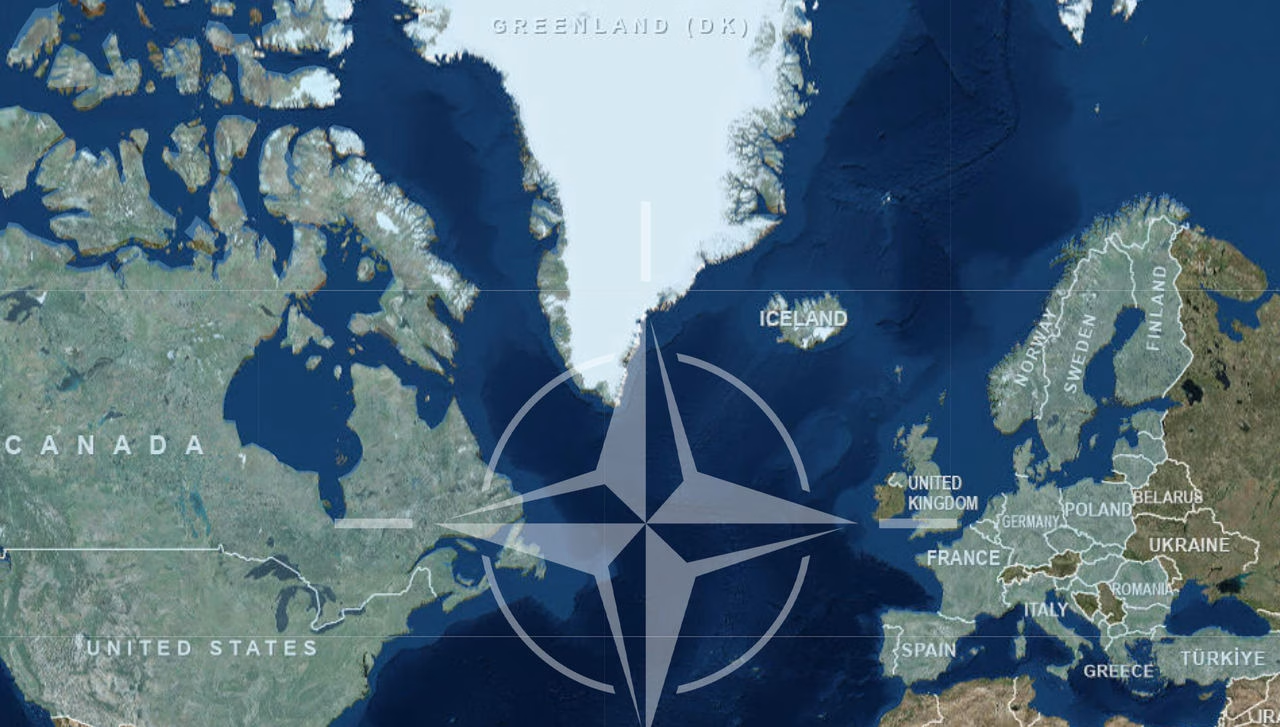
Now, this is problematic in all manner of ways. All foreign governments aren’t certainly adversaries. I hope our NATO Allies and, especially our Five Eyes partners (UK, Canada, Australia, and New Zealand) aren’t considered adversaries—although, even in those cases, there is information classified NOFORN that we are forbidden from sharing. And I have no idea what the hell “capabilities contrary to our own means.”
In the context of this training, it’s perfectly innocuous to consider protestors and the press as “adversaries.” They have contrary goals that endanger the stated objective of keeping the mission secret.
Again, the training is terribly written. I’d have advised some other word than adversaries. Obstacles, maybe.
But this isn’t some sinister plot to condition soldiers to shoot journalists on sight. Rather, it’s a poorly-conceived module reinforcing the idea of safeguarding information that can harm the operation’s goals.