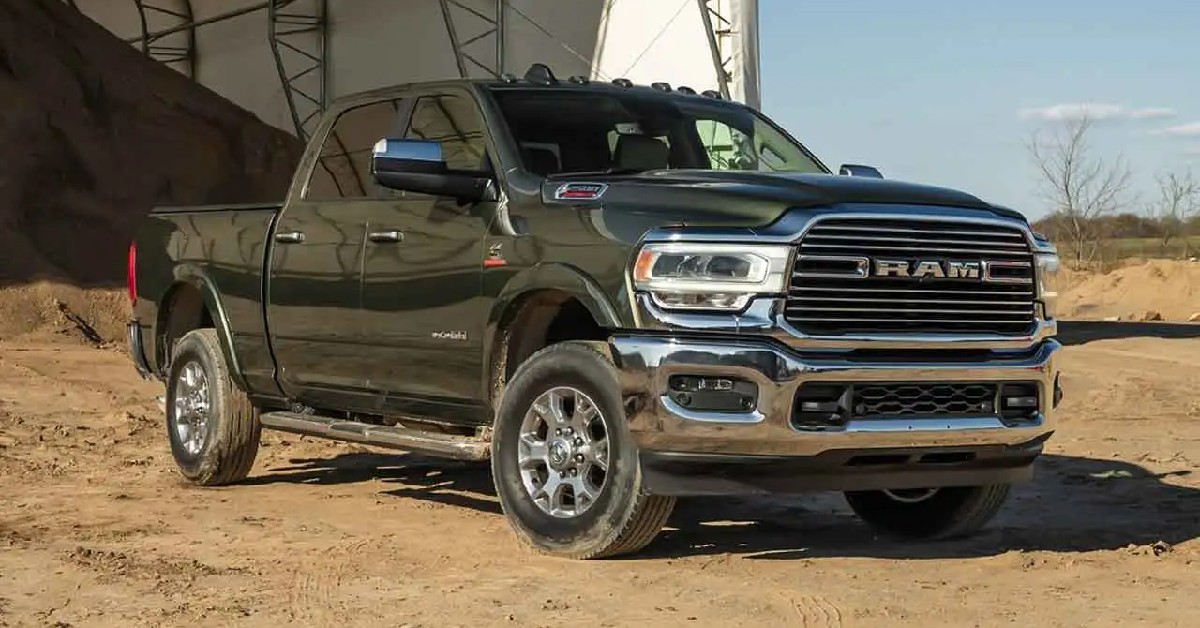
The discussion section to Wednesday’s post “Making It Worse,” exploring the reasons that brands once known for producing high-quality products gradually shifted to lower-quality products, touched on a lot of issues but somehow devolved from people no longer being willing to spend what it costs to buy a pair of high-quality, American-made boots but somehow still being willing to pay big money for pickup trucks that are larger and more luxurious than they really need.
That led me to doing some quick search on the evolving pickup truck market and, sure enough, the prices have gone up rather considerably over the years—well beyond that which would be explained by inflation (at least, as measured by the Consumer Price Index) alone.
Writing at The Drive just before the COVID pandemic sent used car prices through the roof, Caleb Jacobs examined “Here’s How Much the Ford F-150 Has Increased in Price Over the Decades.”
We’re taking a look way back to the original Ford F1 half-ton from 1948 for this comparison, since that’s the modern truck’s closest equivalent. Even adjusted for inflation, trucks ain’t as cheap as they used to be—far from it. In fact, base pricing for a current-generation F-150 is significantly more than double that of the aforementioned F1. Then again, when you consider everything you get on modern trucks—from safety equipment and emissions gear, to features that make it basically a rolling office that can tow many times its own weight—it does make some sense.
These prices all represent the entry-level models for the first year of each generation. Original MSRPs are provided by the National Automobile Dealers Association, and the inflation calculated by the Bureau of Labor Statistics’ official online tool is reflected in italics.
- 1948 Ford F1 (First Generation): $1,279 – $13,836.62
- 1953 Ford F100 (Second Generation): $1,362 – $13,128.14
- 1956 Ford F100 (Third Generation): $1,577, – $15,087.06
- 1960 Ford F100 (Fourth Generation): $1,972 – $17,256.28
- 1967 Ford F-100 (Fifth Generation): $2,237 – $17,433.23
- 1973 Ford F-100 (Sixth Generation): $2,889 – $17,387.85
- 1980 Ford F-150 (Seventh Generation): $5,697 – $18,774.76
- 1986 Ford F-150 (Eighth Generation): $8,373 – $19,587.47
- 1991 Ford F-150 (Ninth Generation): $11,967 – $22,795.45
- 1997 Ford F-150 (10th Generation): $17,875.00 – $28,806.05
- 2004 Ford F-150 (11th Generation): $17,900.00 – $24,781.06
- 2009 Ford F-150 (12th Generation): $22,000 – $26,714.92
- 2015 Ford F-150 (13th Generation): $26,615 – $29,198.64
Ford suggested a retail price of $1,279 for the introductory F1 truck some 72 years ago, which equates to $13,836.62 in today’s money. For that, you got a 226-cubic-inch inline-six and a three-speed manual gearbox. Work capabilities seem modest, especially when pitted against trucks from this century, as the ’48 F1 had a GVWR of just 4,700 pounds. In other words, you’d better not be hauling too much around the farm.
Later generations progressively grew larger and more comfortable for everyday use. Options like a 390-cubic-inch Lincoln Y-Block V8 became available for the second-gen, while displacement was honed in later down the line. One fairly constant option has been the 5.0-liter V8 which was introduced in 1967 and is still available today, albeit severely overhauled.
The first crew-cab F-Series truck—by far the most popular configuration in today’s world—was rolled out in 1965, but wouldn’t make its way to the half-ton until 1980 with the “Bullnose” generation.
As I’m pretty sure I’ve mentioned more than once, the four-door, full-sized pickup truck is far and away the vehicle of choice for my students, most of whom are mid-grade military officers. They’re considerably more expensive than the base models–many upward of $70,000. They’re enjoyable enough to drive but are gas guzzlers and a giant nuisance in the parking lot—both if driving one* or trying to navigate around them.
CarGurus has an listing of what F-150s from every year going back to 1975 are going for on the used market. They fluctuate rather wildly on a 30- and 90-day basis, let alone over the course of a year. For whatever reason, the 1982 model is up 139.52% year-over-year, going for $23,950 as of today. The 1997 model is, for whatever reason, a comparative steal at $5979–less than half the cost of the 1996 model and almost $1200 less than the 1998.
_____________
*I owned a smallish Mazda B-2000 pickup from my days as an Army officer through my first job out of grad school, roughly 1989-1996, and it was no more unwieldy than a four-door sedan. I’ve driven the modern crew cabs a handful of times, including a roughly three-week stint as a loaner vehicle when my minivan was in the shop.