
NYT chief political analyst Nate Cohn argues the “Republicans’ Electoral College Edge, Once Seen as Ironclad, Looks to Be Fading.” And, no, this isn’t the Old Gray Lady skewing right to appear “balanced.” It’s just how the numbers are shaking out.
Ever since Donald J. Trump’s stunning victory in 2016 — when he lost the popular vote by almost three million votes but still triumphed with over 300 electoral votes — many who follow politics have believed Republicans hold an intractable advantage in the Electoral College.
But there’s growing evidence to support a surprising possibility: His once formidable advantage in the Electoral College is not as ironclad as many presumed. Instead, it might be shrinking.
This is hardly implausible. After all, states that were solidly red twenty years ago—including my home state of Virginia—have become purple, if not solidly blue. The fact that Georgia voted for Biden and is again up for grabs while North Carolina is now a plausible Harris pickup demonstrates the system’s fluidity.
But Cohn’s analysis is more granular than that: he’s looking at state-by-state margins in polling (or, in past elections, actual voting results) to determine a “tipping point.”
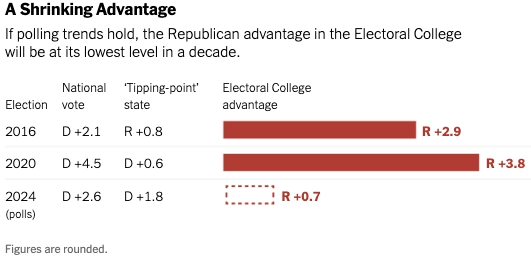
According to The New York Times’s polling average, it does not seem that Kamala Harris will necessarily need to win the popular vote by much to prevail.
The simplest way to measure the advantage in the Electoral College is to take the difference between the national popular vote and the vote in the “tipping-point” state (the state that puts one candidate over the top in the Electoral College). Right now, Vice President Harris leads the polling in the national vote by 2.6 percentage points, and leads Wisconsin — the current tipping-point state — by 1.8 points, which makes Mr. Trump’s advantage less than a point.
By this measure, Mr. Trump’s advantage is only around one-fifth as large as it was four years ago, when he fared 3.8 points better nationally than in Wisconsin (the tipping-point state in 2020).
I’m not sure this is a measurement of EC party lean so much as it is the relative popularity of the candidates. But Cohn sees it this way:
How is it possible?
On the one hand, Ms. Harris is holding her own in Michigan, Wisconsin and Pennsylvania. It’s worth noting this is tenuous: Together, these states help Ms. Harris win the Electoral College, with little room for error. Should the polls meaningfully underestimate Mr. Trump in any one of Michigan, Pennsylvania or Wisconsin, as they did in the last two presidential elections, much of his Electoral College advantage could return.
The second half of the explanation, oddly, is that Mr. Trump is gaining in noncompetitive states like New York, improving his position in the national popular vote without helping him in the most important states. In particular, he appears to be faring best in the states where Republicans excelled in the midterm election two years ago.
Assuming the polling is accurate—a big caveat to be sure—this is interesting. While I tend to think of the EC advantage in terms of which states are essentially “locks” for a given party and how many Electors said states bring, Cohn sees it in terms of how many “wasted” votes the loser got.
So, for example, Texas has voted for the Republican nominee in every presidential election since 1980. Over that time, it has gone from 26 Electoral votes to 40. I see that as a growing Republican advantage because they get 14 more Electors for winning Texas, which they’re almost sure to do again this cycle. (Indeed, Texas alone puts the GOP almost 15% of the way to the magic 270.)
But, from Cohn’s perspective, the Republican advantage is shrinking because Biden got 5,259,126 votes—a mere 631,221 fewer than Trump. While that’s rather odd from a near-term perspective, it could be that Texas is the next California, which went from a reliably Republican state (1952-1960, 1968-1988) to a reliably Democratic state (1992-present) while going from 32 Electors to 55.
Next, Cohn reinforces a point made here many times over the years:
You might be under the impression that Republicans do so well in the Electoral College because of the disproportionate power afforded to small rural states, but that’s not really what’s behind the Electoral College’s skew in the Trump era. Instead, the most distorting feature is that it’s (almost entirely) winner-take-all: You get all of the electoral votes from a state if you win it by a single vote; conversely, you get zero additional electoral votes if you win a state by a lopsided margin.
In 2016, Mr. Trump narrowly prevailed in Florida, Michigan, Pennsylvania and Wisconsin, winning all 75 Electoral College votes from those states, despite winning them by a combined average of less than one percentage point.
Hillary Clinton fared very well in several noncompetitive states; not just big blue states like California, but also a red state like Texas, where she gained seven points compared with Barack Obama. These gains helped her win the popular vote nationally, but they did nothing to help in the Electoral College.
The fact that Wyoming, population 584,057, gets the same two base Electors as California, population 38,965,193, certainly skews the results. That’s dwarfed by the 6,006,518 Trump voters in California whose votes were entirely disregarded in the 2020 election.
Mr. Trump’s declining Electoral College gap today thus reflects some combination of his relative weakness in the core battlegrounds and relative strength in the noncompetitive states.
The core battlegrounds are clear enough: The polls show Ms. Harris leading in Pennsylvania, Wisconsin and Michigan, states that would be enough for her to win the presidency provided she wins the more Democratic-leaning states and districts where she currently leads. On average, Ms. Harris is faring a hair better than President Biden’s election results across these states.
The national polls, on the other hand, show Ms. Harris faring about two points worse than Mr. Biden’s results. Clearly, Mr. Trump is polling better in noncompetitive parts of the country, even as Ms. Harris shows resilience where it counts. Together, it reduces the size of Mr. Trump’s advantage in the Electoral College.
Again, this strikes me more as a measure of Trump’s popularity than the structural advantage of Republican candidates.
The idea of Republicans faring better in the popular vote might seem a little odd, but it actually happened recently: the 2022 midterms.
No, the midterm election didn’t turn out to be a “red wave,” as had been prophesied. Democrats held firm in key battleground states. But a red wave really did materialize in many parts of the country.
Republicans ran far ahead of Mr. Trump’s 2020 performance in New York, Florida and much of the Deep South. They also ran well ahead of Mr. Trump — say, by 5 to 10 points in the House popular vote — in many less competitive states across the South and West, including California and Texas.
As a result, Republicans won the popular vote for U.S. House, even though Democrats were only a few seats away from retaining control of it.
l’m not sure what this has to do with the EC’s skew.
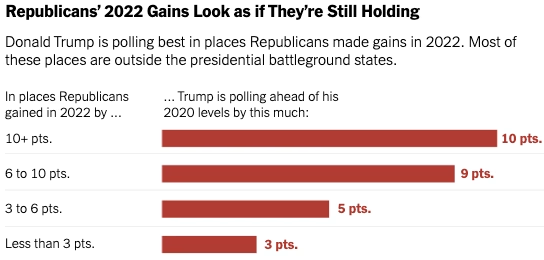
While the evidence is inconclusive, there are signs that Mr. Trump is excelling in many of the places where Republicans won big in the midterms.
One piece of evidence: Times/Siena polling this year. If this year’s national surveys are aggregated together — including the polls when Mr. Biden was the nominee — there’s a clear relationship between Mr. Trump’s gains and how well Republicans fared in the midterms.
I’m not sure what to make of this, to be honest. Presumably, it points to yet more realignment of blue-collar whites and men of all races into Republican voters.
Although there’s less data from the three Times/Siena polls since Ms. Harris became the nominee, they nonetheless show the same pattern: Mr. Trump makes large gains where Republicans posted above-average results in the midterms, but he makes few or no gains elsewhere in the country.
Ideally, individual state polls — not subsamples from national polls — would be the basis for this analysis. Unfortunately, there’s very little state polling outside the battleground states. In New York, there’s plenty of evidence that Ms. Harris is struggling, relatively speaking, but that evidence mostly comes from our partners at Siena College. Their methodology is different from the Times/Siena poll, but not so different that it counts as independent corroboration. On the other hand, Ms. Harris holds up relatively well in most of the Texas, Florida and California polling, so it’s not a straightforward picture.
Admittedly, this is a bit speculative. Polling, at least quality polling, is expensive. And there’s not much incentive to poll in places where the outcome is in doubt. Given that the NYT and Sienna College are based in New York, it’s not shocking that they do poll the Empire State. (Where, incidentally, Harris is “struggling” with a mere 13-point steady lead. In fairness, Clinton got 59% in 2016 and Biden 60.9% in 2020.)
Beyond the public polls, there’s the private polling, fielded by campaigns and other political groups, only a sliver of which is released to the public. I asked Dave Wasserman of the Cook Political Report what he was seeing and hearing lately, especially in the dozen or so potentially competitive races for U.S. House in California and New York. Here’s what he said:
It’s fair to say that in both parties’ polling, Harris is underperforming in New York and California districts (relative to Biden’s 2020 margin) more than in presidential battleground states. My sense is that the political environment in those states might be modestly better for Democrats than it was in the midterms, but that Harris isn’t on track to get Biden-type margins.
Alone, none of this data is conclusive. But together, there are a lot of hints that the 2024 electoral map might look a bit more like 2022 than many would have guessed. If so, it would narrow the gap between the popular vote and the decisive states in the Electoral College.
Which, again, is irrelevant from the standpoint of winning the election. There is simply zero doubt that Harris will win all of California’s 54 Electors and all of New York’s 28. But that’s Cohn’s point: getting all those Electors with thinner margins would be a Democratic skewing, eating away at Republican skewing in Texas and Wyoming.
Of course, from a “democracy” standpoint, skewing is skewing. The fact that the outcome is the same regardless of the voting margin is problematic, not a cause for relief. The fact that the various state-level skews may largely balance themselves out in a given cycle doesn’t mean the design isn’t flawed.
Eight years ago, Mr. Trump’s advantage was built on demographics.
He made huge gains among white voters without a college degree, propelling his breakthrough in the disproportionately white working-class Northern battleground states. Yet at the same time, he alienated millions of highly educated voters, losing a lot of votes in fast-growing and well-educated metropolitan areas, without doing much damage to his chances in the key battlegrounds.
Over the last four years, the demographic foundations of Mr. Trump’s Electoral College advantage have eroded. He’s running ahead of usual Republican benchmarks among Black and Hispanic voters, but they tend to represent a below-average share of the electorate in Michigan, Pennsylvania and Wisconsin — the three battleground states that represent Ms. Harris’s path of least resistance in the current state polling.
But, again, the fact that we have to analyze the election in terms of state-by-state outcomes—and the fact that there is even such a thing as “battleground states”—is a problem. Whether losing college-educated voters changes the outcome in a given state should be irrelevant. All that ought to matter is how many voters in the polity in question—the United States of America—cast a ballot for Candidate A over Candidate B.
Mr. Trump’s gains among Black and Hispanic voters ought to have only a marginal effect on the electoral math. But in the 2022 midterms, one curious pattern was that Republicans made outsize gains among nonwhite voters in noncompetitive states, whether in the Deep South or in the big states like New York or California, even as they made relatively few gains in the battlegrounds, where it counts most.
A similar pattern seems evident in the Times/Siena data amassed over the last year, including in each of Texas, Florida, New York and California — but the samples are too small to represent especially strong evidence. Even so, the possibility that Mr. Trump’s gains among nonwhite voters might be greater in noncompetitive states would start to help make sense of several different electoral trends.
The realignment of voters with the demise of the old GOP and the rise of the MAGA party is interesting. But the institutional design skews the impact of that.
Why did the Republicans do so well in some places, but not others, back in 2022?
At the time, the best explanation seemed to be about the issues at stake. In many key battlegrounds, the Republicans nominated MAGA-backed stop-the-steal candidates and threatened to take away abortion rights. Where they did, Democrats excelled. Elsewhere, the story was often very different. In many blue states, abortion rights were safe and the threat of a stolen election seemed distant, but many voters were concerned by crime, housing shortages and homelessness, resentful of pandemic-era restrictions and frustrated by a perceived failure of Democratic governance. Many conservative and more religious states, meanwhile, weren’t so upset by the end of Roe and remained supportive of Mr. Trump; there, the “red wave” sloshed ashore, unimpeded.
Right. In extremely polities, it’s really, really hard to nominate a candidate bad enough to lose. Unless the candidate is a serial dater of barely-legal girls or, I don’t know, secretly a gay Black Nazi, it’s nearly impossible for the other party to lose. But, yes, nominating nutballs tends to diminish a party’s chances of carrying a swing state or district.
None of this necessarily seemed likely to affect a national presidential election. But if the 2022 patterns really do hold in this year’s election, it might suggest that the shifts in the midterms weren’t just about the issues focused on by different campaigns in different states, but about how new issues altered people’s political allegiances.
It would suggest that the social, economic and political upheaval in the wake of the pandemic, inflation, Jan. 6 and the end of Roe left a lasting political impact — one that was felt very differently in different parts of the country and among different constituencies.
With the polling predictably focused on the battlegrounds, we may not have a great idea on this until the final results arrive in November. If the results wind up looking somewhat more like the midterms, I won’t be surprised. Much crazier things have happened.
Again, this is ultimately speculative. But Cohn’s analysis strikes me as reasonable and even plausible.
I think Trump’s act has worn thin. He’s less popular than he was four, much less eight, years ago. His performance on the stump has clearly declined and the sheer nuttiness of the “They’re eating our pets!!!” type rants is hardly likely to motivate swing voters. And, while she may be a bit of a cipher, Harris doesn’t carry anything like the baggage Hillary Clinton did in 2016.
Further, the demographics keep changing, largely in the Democrats’ favor. Trump carried the over-65s, who constituted 27% of the electorate, 53-44 in 2016. A significant share of that cohort has passed on eight years later. Conversely, Clinton carried the 18-29 demo, a mere 13% of that electorate, 58-28. They’re now 26-37 and much more likely to turn out.