
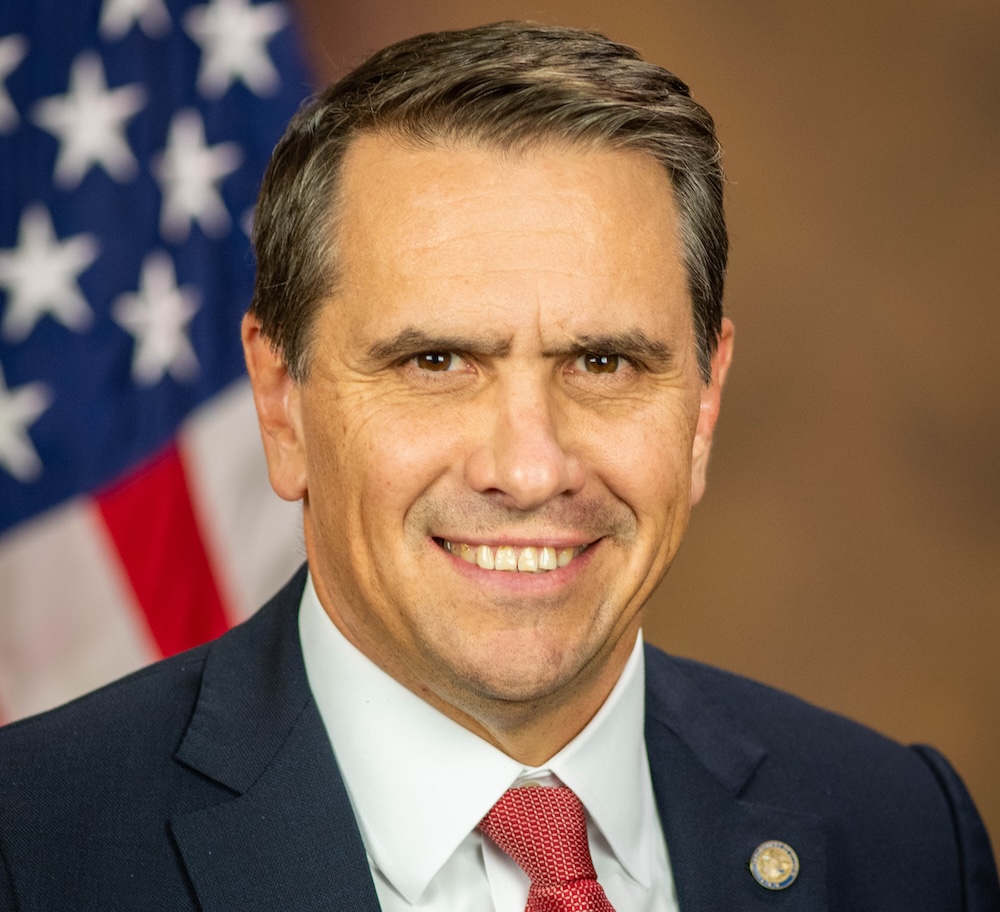
AP (“Todd Blanche is narrowly confirmed as Trump’s attorney general in an overnight Senate vote“):
The Senate confirmed Todd Blanche as attorney general in a vote early Saturday, cementing the command of President Donald Trump’s former personal lawyer at a Department of Justice that Trump has sought to bend to his will.
The Republican-led Senate voted 50-49 to make Blanche the second confirmed attorney general since Trump returned to the White House last year with a stated desire to use the law enforcement agency to investigate his political enemies. While Blanche has already been leading the department in an acting capacity, his confirmation could free him to pursue the administration’s agenda even more aggressively.
Blanche said on social media that he was “deeply honored by the trust and confidence President Trump has placed in me,” adding that he was “grateful” to senators for working late to confirm him.
The vote followed a tumultuous confirmation fight that exposed deep concerns — from some Republicans as well as Democrats — about installing Trump’s close ally atop a Justice Department that historically prided itself on its independence from the White House.
In the end, Blanche was confirmed by the narrowest of margins, opposed by two Republicans — Sens. Susan Collins of Maine and Lisa Murkowski of Alaska — and by every Democrat.
The path to confirmation for Blanche was unusually rocky, due in large part to Republican concerns about a controversial settlement of Trump’s lawsuit against the IRS.
Under pressure, Blanche publicly promised in writing that the department would abandon Trump’s proposed $1.8 billion compensation fund for the president’s allies, including those who attacked the Capitol on Jan. 6, 2021, and rein in another piece of the settlement designed to shield Trump and his family from IRS tax audits.
His appeals were enough to win over Republican Sen. Bill Cassidy, the decisive vote who threw his support behind Blanche on Friday morning. Cassidy said no other nominee may be able to run the department better under Trump and suggested Blanche’s role as Trump’s former criminal defense lawyer can make him more effective at pushing back on the Republican president’s demands.
It’s quite something that Cassidy, John Cornyn, and Thom Tillis all went along despite being lame ducks. Indeed, Cassidy and Cornyn did so despite Trump backing their primary opponents, likely ending their careers in politics.
NYT Justice Department reporter Glenn Thrush states the obvious: “In Confirming Blanche, Senators Endorse a Justice Dept. Under Trump’s Sway.”
The three lame-duck Republican senators who narrowly saved Todd Blanche’s confirmation as attorney general ended up backing him because they believed he was the only person who had earned enough trust, and enjoyed enough access, to rein in President Trump.
One issue with that calculation: Mr. Blanche is a champion of unbridled presidential power.
Time and again during his turbulent nomination process, Mr. Blanche made it unmistakably clear that he believes Mr. Trump possesses a nearly limitless right to directly control the actions of the Justice Department under Article II of the Constitution. It is an argument that formed the foundation of his strategy as the president’s criminal defense lawyer and is the lodestar of his government service.
Mr. Blanche’s confirmation in the pre-dawn hours on Saturday was largely symbolic: as acting attorney general, he could have served indefinitely. But it represented a powerful endorsement by Congress of the philosophy that has guided him under a meddling, demanding boss — that he has a constitutional obligation to execute every lawful White House order, even if it shatters longstanding policy and rule-of-law norms, or contradicts what he thinks is right.
He articulated that view from the moment he took over as acting attorney general in April, telling reporters that Mr. Trump had “the right” and “duty” to order up investigations of people he targets. During his confirmation, both in public and in private conversations, Mr. Blanche sidestepped questions over whether actions Mr. Trump ordered were right, saying only that Mr. Trump had the right to do them.
Barbara McQuade, a University of Michigan Law School professor and former federal prosecutor, said this marked a major break from past administrations. “Just because a president can control the Justice Department does not mean he should,” she said. “Since Watergate, America has prized a Justice Department that is independent from partisan politics.”
The administration has argued for, and the Supreme Court has mostly endorsed, unbridled presidential control over the executive branch. So, all that holds any president back from weaponizing the Justice Department is their personal morality and sense of obligation to uphold norms.
Thrush’s WaPo counterpart, Jeremy Roebuck (“Todd Blanche takes over Justice Department wracked by low morale and vacancies“) sees challenges ahead:
With his bruising confirmation battle behind him, Todd Blanche will soon be sworn-in as the Senate-backed head of the Justice Department.
But the hardest part may be what comes next.
Blanche, President Donald Trump’s former criminal defense lawyer, will officially assume the title of attorney general and take command of an agency he has led on an acting basis since April.
But he will do so under competing pressures from a president intent on seeing his enemies put on trial, a federal judiciary increasingly skeptical of those efforts and a Republican-led Congress harboring growing doubts about Blanche’s ability to say “no” to his boss.
The Justice Department’s career staff has been ravaged by firings, departures and low morale over the past year and a half, as its traditional independence from the White House has evaporated. And its to-do list has only grown longer, including stepped-up efforts to prosecute fraud, illegal immigration and violent crime while pursuing the sweeping, politically charged investigations of foes that the president has demanded.
Blanche acknowledged those challenges and the difficulty of meeting Trump’s expectations as he spoke to reporters ahead of his confirmation last week.
“It’s not as if I remain blissfully unaware of what will happen if I am confirmed,” he said. “When President Trump talks about what he expects this department to do to make this country safe, I don’t think the American people should look at that as some sort of threat to me or warning to me. He wants this country to be safe.”
But as Blanche assumes his new role, now with the imprimatur of Senate backing, walking a tightrope between satisfying Trump and fulfilling an attorney general’s obligations to the rule of law is likely to only grow more perilous.
Over the next several months, the Justice Department is expected to make a number of charging decisions in sensitive cases of keen interest to the president.
Prosecutors in Florida have been at work for months on what Trump allies have referred to as a “grand conspiracy” investigation of former Obama- and Biden-era officials, including former CIA director John Brennan, who they say engaged in a long-running scheme to violate the president’s civil rights through efforts to undermine his presidency — allegations Brennan denies.
Meanwhile, department investigators continue to seek evidence to back Trump’s unproven assertions that the 2020 election was stolen, that there exist broad left-wing conspiracies to oppose his second-term agenda and that his critics, including former FBI director James B. Comey, deserve to be put in prison.
Despite concerns raised by lawmakers about Trump’s role in those probes, Blanche has repeatedly defended the president’s “right” to intervene in Justice Department business — a significant departure from long-standing norms.
“If we have discussions where we have to talk about a case and whether we’re going to charge a case or whether we have charged a case, that’s okay,” Blanche told reporters last week. “I’m not concerned about that.”
That makes one of us.








