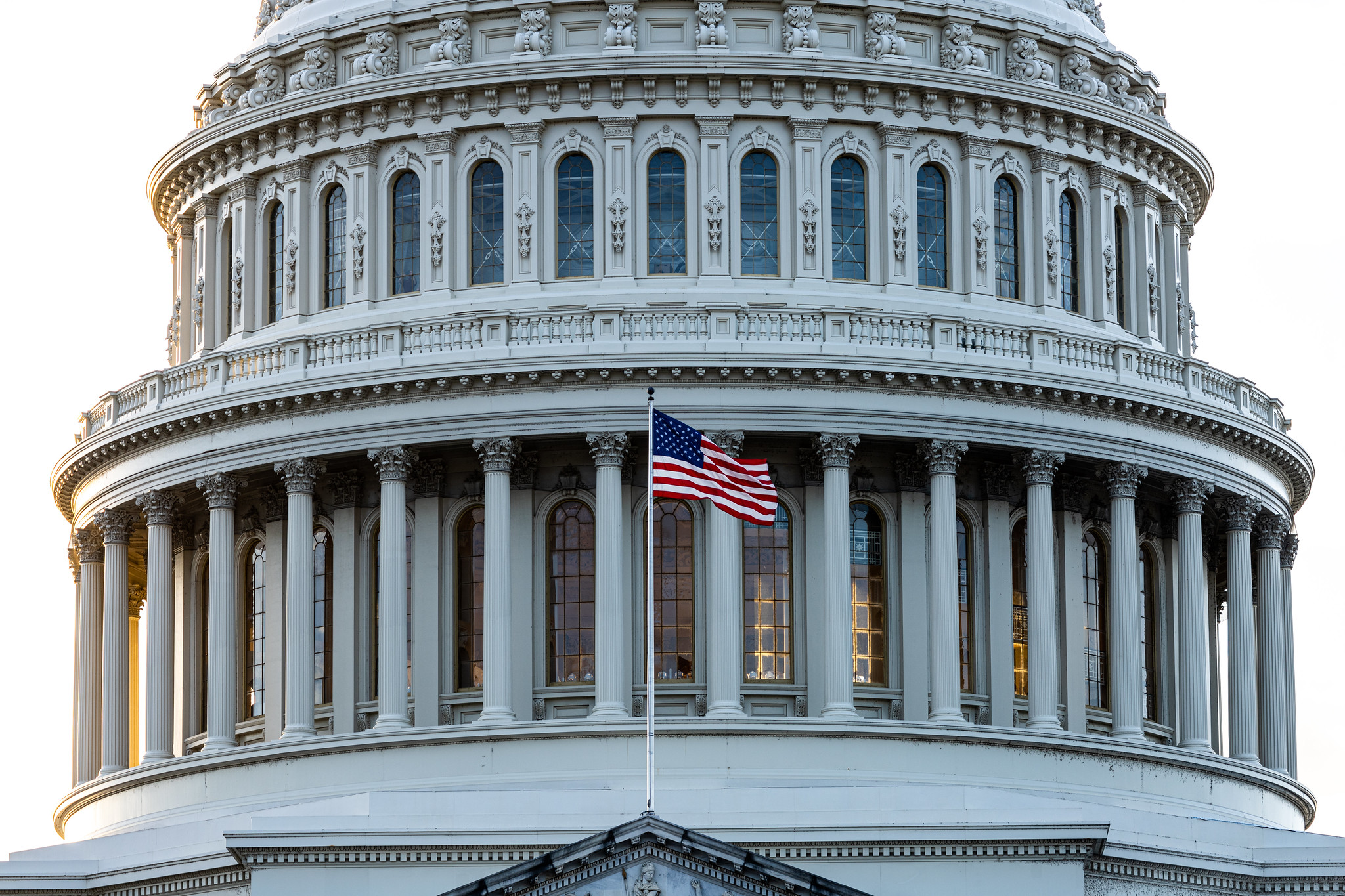
With the current Continuing Resolution set to expire on December 11th, House Republicans have come up with a plan to avoid a government shutdown while at the same time giving conservatives a largely symbolic vote on the President’s executive action on immigration, but there are already signs that many on the right aren’t happy with it:
WASHINGTON — House Republicans made progress on Tuesday steering some of their most conservative members away from a course that could shut down the government next week, a prospect that would badly damage the party as it prepares to take control of Congress in January.
Though the outcome remained unpredictable, Speaker John A. Boehner and his deputies were already counting votes for a two-part plan that they presented in a closed-door meeting in the Capitol.
The first step would be to allow a largely symbolic vote on legislation to dismantle President Obama’s executive action last month that delayed the deportation of millions of illegal immigrants. The second would be to fund the government through the current fiscal year, which ends Sept. 30, 2015, except for agencies that spend money to enforce Mr. Obama’s immigration action, like the Department of Homeland Security.
Congress would then revisit funding for those agencies early next year when Republicans are in control of both the House and the Senate and in a stronger position.
(…)
The resolution to undo the president’s action, however, would largely be a way for House Republicans to vent their displeasure, and could come as early as Thursday. Representative Ted Yoho of Florida, who came up with the plan, acknowledged that his measure would be a “symbolic message” if Senate Democrats did not take up his resolution — something Senator Harry Reid, Democrat of Nevada and the majority leader, has said he is not going to do.
“The simplest way this would work is, it will bring a stop to the action that the president wants,” Mr. Yoho said. “He talks about how he has a pen and a phone. This will take the ink out of the pen.”
Then, House Republicans would vote next week on legislation to fund almost all of the government through September 2015, but use a short-term measure known as a continuing resolution to fund the Department of Homeland Security, the agency primarily responsible for overseeing the administration’s immigration policy, only into March. Representative Tom Price, Republican of Georgia, first raised the possibility of the spending plan before the Thanksgiving break.
Both Mr. Price and Mr. Yoho come with strong conservative credentials, and the Republican leadership’s decision to include them in the strategy helped earn the trust and support of some of the conference’s more resistant members.
(…)
Representative Adam Kinzinger, Republican of Illinois, said that short of going to court — still an option that Republicans are considering — there was not much they could do.
“We are not going to shut down the government again,” he said. “There is no doubt we are in a box, in a tough position here.”
The must-pass spending legislation is the first major test for the speaker and his new leadership team, who despite increasing their majority in the House on Election Day still need to show that they can break the gridlock that has defined Washington for the past few years — and, more important, keep their most conservative members in check.
Some conservatives, however, are likely to vote against the spending bill because they believe it does not go far enough. They say they would prefer a measure to fund the entire government on a short-term basis so that they can pass a spending plan early next year shaped by Republican majorities.
The speaker and his allies have been working to ensure that their spending plan can pass, and he seemed to gain an unlikely ally Tuesday in Mr. Reid, who called Mr. Boehner’s plan a “big accomplishment” that Senate Democrats might support.
“The American people certainly will not want to face another year being governed by crisis,” Mr. Reid said. “No one wants the kind of cliffhanger fights we’ve had again and again in recent years.”
There are several complicating factors here that House and Senate leadership need to navigate their way through in the next week to avoid a shutdown, any one of which could through any prospect of a deal into doubt. At the top of the list, of course, is the Senate, which is still under Democratic control. Notwithstanding Senator Reid’s comments, it is entirely unclear that a majority of Democrats would agree to a bill that singles out the funding for the entire Department of Homeland Security from the rest of the budget for a future budget fight in March. While many of these Senators won’t even be in office at that point, it’s the kind of slap at the President’s immigration policy that they seem unlikely to agree to, and it would go against the objections of DHS Secretary Jeh Johnson, who yesterday called a short-term funding bill that singled out his agency “a very bad idea” because, among other things, it would impact programs that have nothing to do with the President’s immigration moves and would prevent the agency from engaging in any spending related to long-term planning. If the Senate doesn’t get on board, then the entire plan falls apart and both the House and the Senate will have to find some other way to get the government funded at least in the short term.
The second complication is the fact that even a short term effort to squeeze the President by limiting the funding at DHS is going to be entirely symbolic and would have absolutely no impact on funding for the President’s deportation deferment plan. The main reason for this is that the office that would handle the applications for deferments, the United States Citizenship and Immigration Services, is entirely self-funded by the fees that are paid by applicants and the statutes that authorize that agency are largely self-executing, meaning that there’s little that Congress could actually do to bring the program to a halt by “defunding” it as some conservatives have suggested. Theoretically, as one former Congressional aide has suggested, Congress could attach a rider to the next Continuing Resolution forbidding USCIS from using any of its funding to process applications related to the President’s announced deferments, but that could be potentially politically risky given the fact that the policy appears to be fairly popular both among the American public as a whole and Latino voters specifically. So, even when the GOP has control of Congress after January they would have to ask themselves if this is something that’s worth the political price they’d be likely to pay if it passed. Additionally, passage of such a measure in the Senate could be in doubt if Democrats decide to make use of the legislative filibuster in the same manner that Republicans did during their time in the Senate minority.
Perhaps the biggest obstacle to the House GOP Leadership’s plan, though, is the one inside the Republican Party itself:
The “Hell No” caucus is once again causing headaches for Republican leadership.
A cadre of the House’s most conservative members will meet Wednesday morning at the Capitol Hill Club for Rep. Steve King’s regular breakfast to discuss lame duck legislation. Texas Republican Sen. Ted Cruz, who often serves as a defacto spokesperson for congressional hardliners, is expected to attend.
These hardline Republicans are already expressing their dissatisfaction with the plan outlined by Speaker John Boehner (R-Ohio) during a closed door meeting Tuesday morning. Instead of a spending bill that keeps the government funded through September with a chance to review the the Department of Homeland Security’s funding in March, the lawmakers want to pass a much shorter resolution.
“I think a lot of us, in discussion, we don’t see the purpose of having a long CR. Why not do it the first day we’re in session?,” said Rep. John Fleming (R-La.) “I’m not sure it’s going to pass the way they are proposing it. I think it’s likely they are going to have to improve it if they want it to pass.”
These conservatives estimate the number of Republican “no” votes near 30 to 40 – enough to derail a vote on the government funding bill if Democrats oppose the measure.
Senate conservatives are beginning to badger House leaders over their plan to fund the government and symbolically disapprove of the president’s immigration action. GOP Sens. Jeff Sessions of Alabama, David Vitter of Louisiana and Mike Lee of Utah all began to blast the House GOP leadership’s plan on Tuesday afternoon, arguing that the House needs to block funding for implementation of Obama’s executive action now, not later.
Lee laid out a detailed roadmap to taking on the executive action in a statement to Breitbart News, arguing for a short-term continuing resolution that blocks funding for the executive action – the complete opposite of what Republican leaders in both chambers want.
“The House needs to do the right thing and send over the short term bill with the defund language,” said Lee spokesman Brian Phillips.
(…)
“You just can’t be bobbing and weaving on this,” Sessions told reporters. “This is not a matter to be discussed at some point. It’s just unacceptable aggrandizement of power that Congress has an institutional duty to reject.”
Added Vitter: “Make no mistake, sending a bill to the Senate without first making an attempt to include defund language is telling the American people that you support Obama’s executive amnesty. That would be a slap in the face to the voters who sent a message last month by electing Republican majorities in Congress.”
In the short term, there’s at least some prospect that these conservative dissenters could pose a problem for Boehner in getting a spending bill through the House without at least some Democratic support. If there really are 30-40 votes behind doing something tougher than than what leadership is backing then it will be difficult for a bill to pass the House without at least some Democrats voting for it, which may be difficult to get if it includes provisions for singling out the Department of Homeland Security. At the same time, though, there seems to be a wide consensus outside of this small group of House and Senate conservatives that a government shutdown ought to be off the table, not the least because polling shows yet again that Republicans have the most to lose in the event of a shutdown.
A new CNN/ORC poll, for example, shows that 50 percent of those surveyed would blame a shutdown on Congressional Republicans while only 33 percent would blame President Obama and 13% would blame both parties equally. These numbers nearly the same as they were prior to the shutdown in October 2013 which, by all accounts, was an all around disaster for the GOP tempered only by the fact that it was quickly followed by the disastrous rollout of the Affordable Care Act and that it occurred sufficiently in advance of the 2014 midterms to allow Republicans to recover to a significant degree. This time, a shutdown would occur just before the GOP takes control of Congress and would threaten to taint public opinion of the new Congress from Day One. For that reason alone, it would seem entirely illogical for Republicans to risk a shutdown even over this immigration issue. Of course, it was also completely illogical for the GOP to taint public opinion more than a year ago over a doomed plan to “defund” Obamacare and we know what happened then, so stay tuned.