
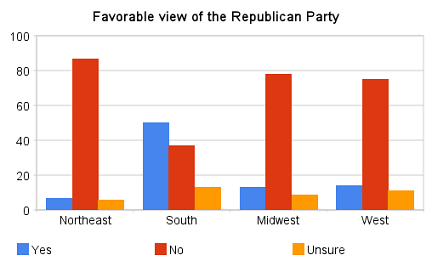
Steve Benen puts together a chart based on DailyKos’ weekly State of the Nation poll and notices that the GOP has virtually no support outside the South:

In case anyone’s having trouble reading the visual, the Republican Party’s favorability is very weak in Northeast (7% to 87%), and only marginally better in the Midwest (13% to 78%) and West (14% to 75%). In the South, however, 50% have a favorable opinion of the GOP, and only 37% have an unfavorable view.
Time will tell how the electorate responds to changing economic circumstances, the debate over health care reform, etc., and I can very easily imagine Democrats taking a drubbing in the midterms. But it seems the Republican Party would be in a much more competitive position — in the short and long term — if its base wasn’t centered in just one region.
As a long-time Southerner living in the DC suburbs of Northern Virginia (the South ends about 40 miles from here as far as I’m concerned) I agree so far as it goes. Mostly, though, the survey results (and, yes, this poll is reputable despite who’s paying for it) simply point to the low state the GOP is in at the moment
Yes, the hard core base is in the South and Southwest. Has been for years. But the Democratic Party is a bicoastal party at its core. Recall the famous 2000 and 2004 Election County-by-County maps. Or even the less controversial state-by-state map from 2004:

In fairness, that’s a representation of a winner-take-all system and not quite comparable to the favorability survey. But, remember, the Democrats were in much better shape in both 2000 and 2004 than the GOP is in 2009. But relatively small swings in approval lead to drastic changes in voting outcomes.
There’s a reason the Democrats have been around since Jefferson’s/Jackson’s day (depending on who you ask) and the Republicans since Lincoln: They’re adept at adapting to changing times. (Also, they’ve rigged the rules in their favor.) Whether it happens in time for the 2010 or 2012 election cycles, the Republican Party will naturally evolve to meet the realities of the country’s demographic and cultural shifts. The Democrats did so in the late 1980s and early 1990s, becoming decidedly more moderate in the aggregate on law and order, defense, and other issues where they were getting hammered by the GOP. And the Republicans have gradually become more embracing of popular social programs over the years ( if not yet the means to pay for them).
To survive at the state and local level, Republicans will have to find candidates who can appeal to non-Cuban Hispanics and a more socially liberal population. From that group will come the next crop of gubernatorial, senatorial, and presidential candidates. And, remember, no party has won more than three straight presidential contests since FDR and Truman made it five straight during the Depression and WWII. Indeed, only Reagan-Bush made it three straight — forcing the Democrats to quit nominating Mondales and Dukakises and reinvent themselves with Clinton. Who then nearly made it three in a row for the Dems.









