
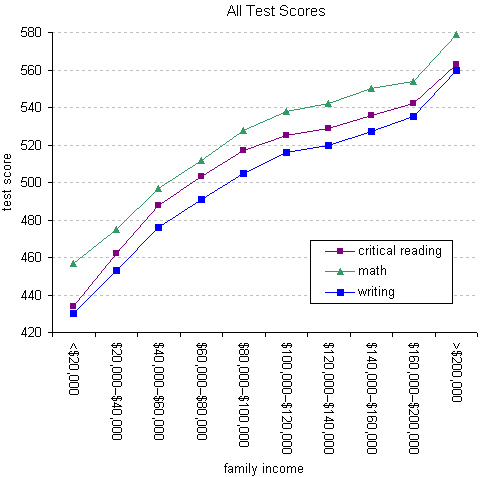
A debate is raging in the blogosphere about this graph, which shows that “Generally speaking, the wealthier a student’s family is, the higher the SAT score.”

Alex Tabarrok gets us up to speed on the debate thus far:
Greg Mankiw pointed out that the effect is unlikely to be purely causal because there may be an omitted variable bias, IQ for example. Paul Krugman and Matt Yglesias both attack Mankiw and point to graphs showing that income matters for college completion and enrollment, respectively, holding various achievement scores constant. Brad DeLong crunches the numbers on IQ and income correlation to estimate that half the effect is due to IQ and half to something else.
He says this doesn’t tell the whole story, though, “because there are a lot of ways that heredity/genes could explain the income/education correlation; IQ is only one possible mechanism, personality (e.g. conscientiousness) is another possibility.” He points to a longitudinal study of adopted children randomly assigned to parents which found no correlation at all between the income of the adopted parents and their adopted children.

While income didn’t matter, education did: “Having a college educated mother increases an adoptee’s probability of graduating from college by 7 percentage points, but raises a biological child’s probability of graduating from college by 26 percentage points.” Further, “The effect for father’s years of education is even larger; about a ten times larger effect on biological children than on adoptees.”
Obviously, this study (which I have not read beyond Tabarrok’s summary) raises other questions.









