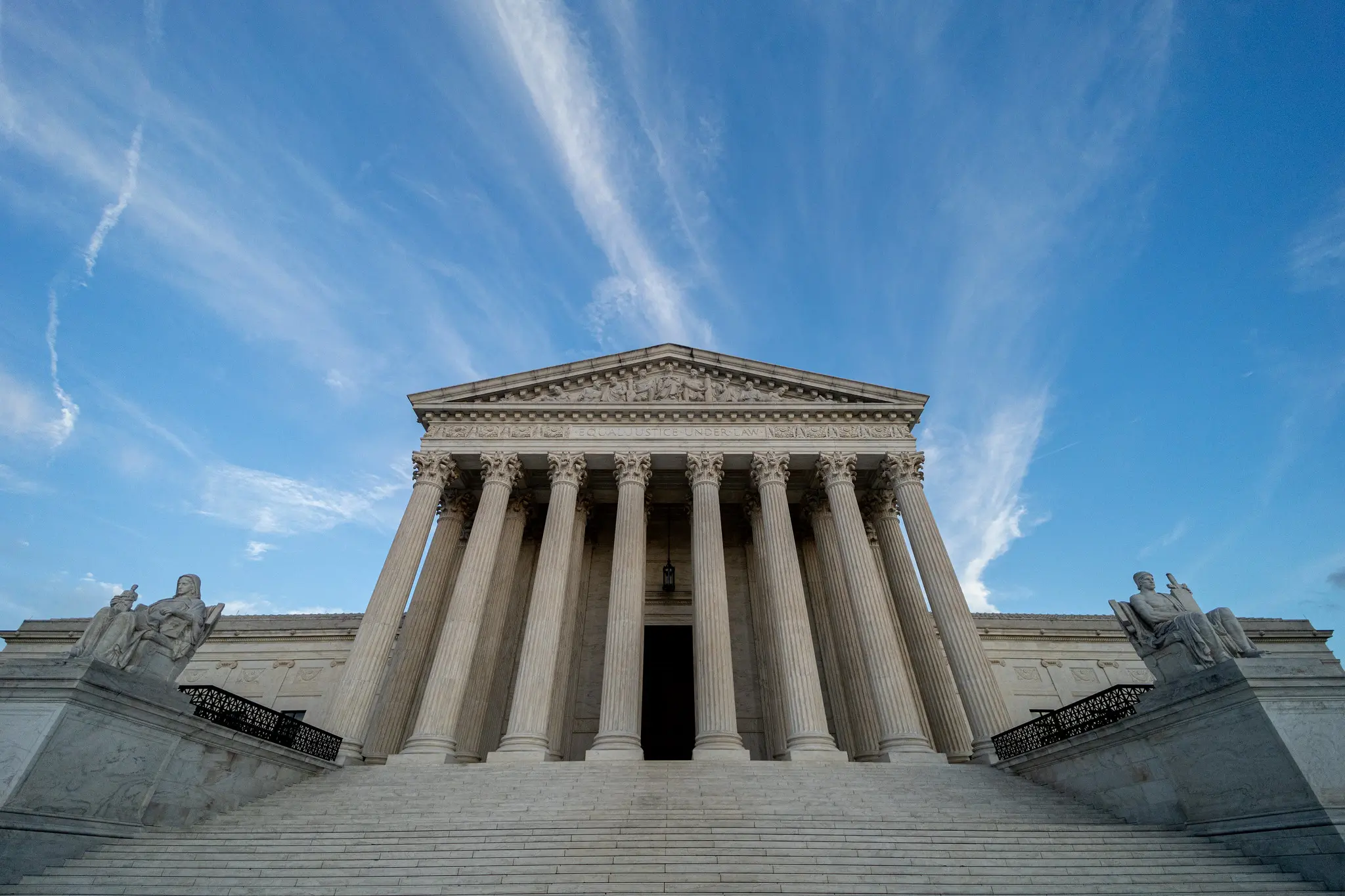
The Supreme Court, in yet another 5-4 ruling, has decided that discriminating on the basis of race is not a Constitutionally permissible solution to race discrimination. Lyle Denniston:
Concluding its current Term with a historic ruling on race in public policy, the Supreme Court divided 5-4 on Thursday in striking down voluntary integration plans in the public schools of Seattle and Louisville. Chief Justice John G. Roberts, Jr., wrote the majority opinion in the combined cases. Justice Anthony M. Kennedy did not join all of the majority opinion, but joined in the result.
“The way to stop discrimination on the basis of race is to stop discriminating on the basis of race,” Roberts wrote. On the two school plans, the majority found that the districts have “failed to provide the necessary support for the proposition that there is no other way than individual racial classifications to avoid racial isolation in their school districts.”
The Chief Justice, in his oral announcement of the ruling, insisted that the Court was remaining faithful to Brown v. Board of Education in barring public school districts from assigning students on the basis of race. Answering that, Justice John Paul Stevens said in dissent that there was a “cruel irony” in making that claim, because it involved a rewriting of the history “of one of this Court’s most important decisions.” Stevens noted that he joined the Court in 1975, and asserted that “no member of the Court” at that time “would have agreed with today’s decision.”
Whether true or not (and I suspect the latter, given William Rehnquist’s presence on the Court) the passage of 32 years presumably impacts permissible policy. The 14th Amendment rather clearly enjoins discrimination on the basis of race. In various desegregation cases in the 1960s and 1970s, though, the Court carved out what they deemed reasonable exceptions to that policy so long as they were aimed at remedying past discrimination.
Increasingly, though, the Court has applied strict scrutiny to government-sponsored discrimination. In the present cases, the districts were trying to force integration of schools to remedy benign neighborhood settlement patterns. That’s certainly a different thing than trying to remedy decades of state-sanctioned segregation.
Stevens does have a point though. While virtually everyone now agrees with the public policy result, Brown was decided on a peculiar basis. Rather than simply saying Plessy v. Ferguson was wrongly decided in 1896 and was contrary to the plain meaning of the 14th Amendment, the Court instead relied on some social science data showing that kids discriminated against on the basis of race were internally stigmatized and permanently hampered economically by a sense of isolation and limitation. If that rationale still holds as Constitutional doctrine rather than mere dicta, then it’s difficult to see why school districts aren’t within their rights to forcibly integrate students.