
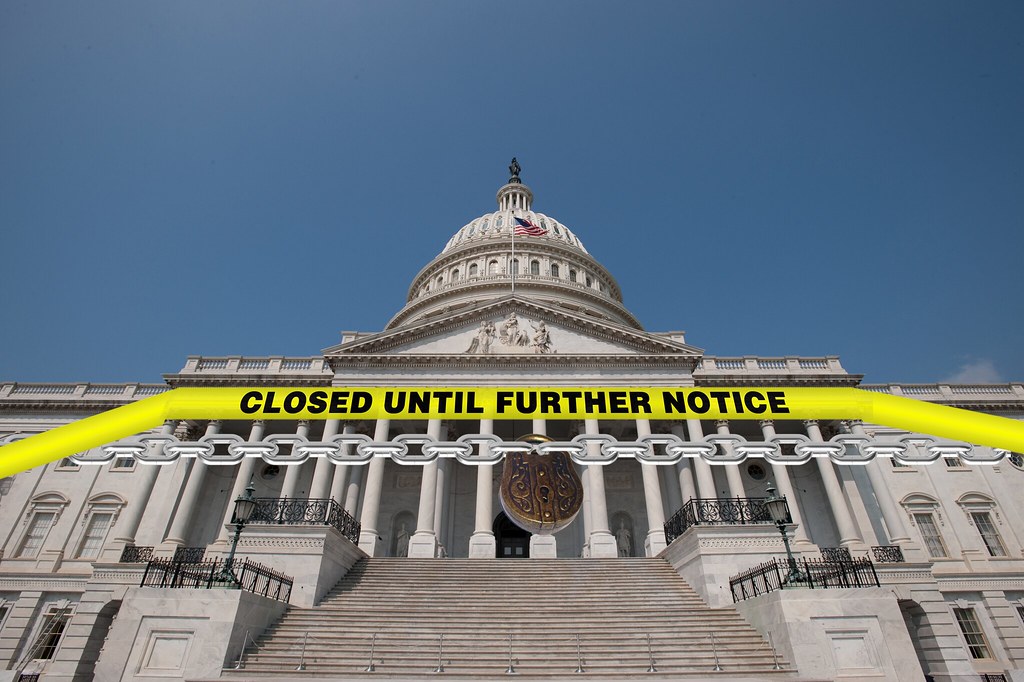
AP (“Government shutdown draws closer as congressional leaders head to the White House“):
Democratic and Republican congressional leaders are heading to the White House for a meeting with President Donald Trump on Monday in a late effort to avoid a government shutdown, but both sides have shown hardly any willingness to budge from their entrenched positions.
If government funding legislation isn’t passed by Congress and signed by Trump on Tuesday night, many government offices across the nation will be temporarily shuttered and nonexempt federal employees will be furloughed, adding to the strain on workers and the nation’s economy.
White House aides, ahead of the meeting, made it clear the Republican administration had no intention to negotiate.
“The president wants to keep the government open, he wants to keep the government funded,” press secretary Karoline Leavitt told reporters at the White House on Monday morning, adding Trump was “giving Democrats one last chance to be reasonable today.”
Republicans are daring Democrats to vote against legislation that would keep government funding mostly at current levels, but Democrats have held firm. They’re using one of their few points of leverage to demand Congress take up legislation to extend health care benefits.
“The meeting is a first step, but only a first step. We need a serious negotiation,” Senate Democratic leader Chuck Schumer said Sunday on NBC’s “Meet the Press.”
Trump has shown little interest in entertaining Democrats’ demands on health care, even as he agreed to hold a sit-down meeting Monday with Schumer, along with Senate Majority Leader John Thune, House Speaker Mike Johnson and House Democratic leader Hakeem Jeffries. The Republican president has said repeatedly he fully expects the government to enter a shutdown this week.
“If it has to shut down, it’ll have to shut down,” Trump said Friday. “But they’re the ones that are shutting down government.”
[…]
Democrats are pushing for an extension to Affordable Care Act tax credits that have subsidized health insurance for millions of people since the COVID-19 pandemic. The credits, which are designed to expand coverage for low- and middle-income people, are set to expire at the end of the year.
At a Monday news conference, Jeffries, a New York Democrat, called health care cuts a “five-alarm fire” that is rippling across communities nationwide.
“We’re not going to simply go along to get along with a Republican bill that continues to gut the health care of everyday Americans who are already living with this Trump economy, where costs aren’t going down but they’re going up,” he said.
CBS News (“Trump confident ahead of Monday showdown, says Democrats’ position makes shutdown likely: ‘I just don’t know how we’re going to solve this issue’“):
President Trump said Sunday that a government shutdown is likely unless top Democrats back down from their negotiating position.
“I just don’t know how we are going to solve this issue,” Mr. Trump said in a phone interview with CBS News.
[…]
A source close to Mr. Trump told CBS News that the president privately welcomes the prospect of a shutdown because it will enable him to wield executive power to slash some government programs and salaries.
Last week, the White House’s Office of Management and Budget sent a memo to federal agencies telling them to prepare layoff plans if there is a government shutdown.
The memo, obtained by CBS News, tells agencies to consider reduction-in-force notices — a federal term for layoffs — for employees in programs, projects or activities that have discretionary funding that stops on Oct. 1 or that don’t have any alternative sources of funding. It also goes further and says that employees should get RIF notices if they’re in programs or projects “not consistent with the President’s priorities.”
[…]
Sen. Amy Klobuchar, a Minnesota Democrat, told “Face the Nation” Sunday that “Democrats are united in pushing” on the health-care issue, adding that she’s glad the president has decided to meet with leaders in Congress.
“This is an opportunity for the country because of one big problem, and that is that the Republicans have created a health care crisis,” Klobuchar said. “My constituents, Americans, are standing on a cliff right now with these insurance premium increases that are upon them.”
POLITICO (“Federal workers unions call on Schumer, Jeffries to hold the line even if it means a shutdown“):
A coalition of federal unions are calling on Democratic leadership to fight back against budget cuts to “critical public services,” even if it leads to a government shutdown and mass layoffs.
In a letter to minority leaders Sen. Chuck Schumer and Rep. Hakeem Jeffries, the Federal Unionists Network and 35 local, council and national unions urged the Democrats to reject any proposal that cuts health care, social security, Veterans’ Affairs and scientific agencies.
“We are directly impacted when the government shuts down: our members would no longer be able to work, get paid, or fulfill their mission of serving the American public,” the letter states. “But we believe the most important thing is fighting against the centralization of executive power and for the long-term survival of the critical services the federal government provides, even if that means allowing the government to temporarily shut down.”
[…]
“A government shutdown is never Plan A,” the letter states. “Federal workers and the communities we serve will face severe hardship. But federal workers will willingly forego paychecks in the hopes of preserving the programs we have devoted our lives to administering. In order to save our services today, we need to send a message to this Administration that enough is enough.”
By all indications, both sides are perfectly willing to force a shutdown in the hope that the other side is forced to cave. There’s zero indication that either side is willing to budge.
Whether an obscure subsidy enacted during COVID is the right hill to die on politically remains to be seen. The unions have what strikes me as a more essential and sellable message: the ability to continue their Congressionally-established mission.
Obviously, that doesn’t happen during a shutdown. And, as Binyamin Appelbaum rightly notes, the impact often lingers well beyond the immediate timeline.
Repeated disruptions to the F.A.A.’s funding over the past 15 years, caused by shutdowns and other budget fights, have played a key role in preventing the agency from hiring and training enough controllers. As Congress lurches and sways toward another potential shutdown, the F.A.A.’s travails illustrate the stakes.
Shutdowns tend to be brief because Americans are soon reminded that the government does important things. But the end of a shutdown doesn’t mean that everything springs back to normal. Some of the damage endures. A government shutdown in 2013 wiped out the annual research season for the U.S. Antarctic Program, causing more than two dozen scientific studies to lose a year of data. Another shutdown, beginning in December 2018, forced the cancellation of about 86,000 immigration court hearings, some of which took years to reschedule. During that shutdown, unsupervised tourists cut down Joshua trees in Joshua Tree National Park. The slow-growing trees can take 50 years to reach full height.
The funding disruptions are particularly difficult for the F.A.A. It takes years to train air traffic controllers, and there are limits on how many can be trained at one time. When the pipeline isn’t fed, the agency falls behind — and you end up stuck in the wrong city.
Adding to the frustration is how completely unnecessary it all is. While Congress would, in an ideal world, simply pass budgets on time on an annual basis, I get that standoffs are the only way for the minority party to gain leverage to gain concessions. But there’s no reason that the government has to shut down during the standoff.
Indeed, there was no such thing until Jimmy Carter’s attorney general decided that operating in the absence of a budget violated the Antideficiency Act. Given that it has long been the custom—and since 2019 has been federal law—that federal employees are given full back pay once the budget is passed, the government is already obligated. So, either the AG could simply issue a new interpretation of the law or Congress could amend it.
As it is, not only do taxpayers lose access to services they’re paying for—including things like access to national parks and monuments to which they may have already traveled—but they have to pay for the service they’re not getting. Indeed, since employees on travel are often required to return to their home station, usually at increased expense, it actually costs them more.









