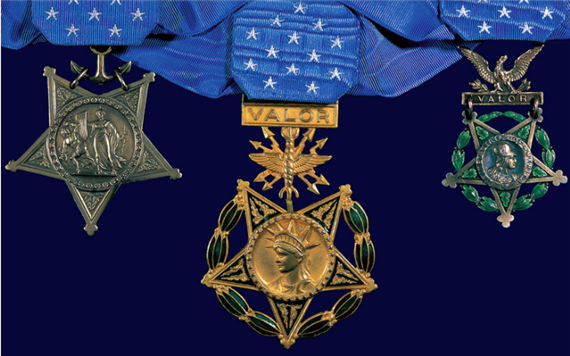

Outgoing Senator Jim Webb is making another attempt at passing the Stolen Valor Act, deemed unconstitutional last year by the US Supreme Court.
An amendment to the defense appropriations budget passed on November 28, Webb, along with co-sponsors Scott Brown and Joe Lieberman (none of whom will be back in the next Congress, unless Brown wins an election for an open seat in the case John Kerry is appointed to the Cabinet), attempt to get around the SCOTUS finding that lying about military valor is protected free speech by arguing that it’s essentially fraud, which the majority in Alvarez concedes is not protected.
The “Findings” section of the Stolen Valor Act of 2012 tries to set up this argument:
Congress find [sic] the following:
(1) Because of the great respect in which military service and military awards are rightfully held by the public, false claims of receiving such medals or serving in the military are especially likely to be harmful and material to employers, voters in deciding to whom paid elective positions should be entrusted, and in the award of contracts.
(2) Military service and military awards are held in such great respect that public and private decisions are correctly influenced by claims of heroism.
(3) False claims of military service or military heroism are an especially noxious means of obtaining something of value because they are particularly likely to cause tangible harm to victims of fraud.
(4) False claims of military service or the receipt of military awards, if believed, are especially likely to dispose people favorably toward the speaker.
(5) False claims of military service or the receipt of military awards are particularly likely to be material and cause people to part with money or property. Even if such claims are unsuccessful in bringing about
this result, they still constitute attempted fraud.(6) False claims of military service or the receipt of military awards that are made to secure appointment to the board of an organization are likely to cause harm to such organization through their obtaining the services of an individual who does not bring to that organization what he or she claims, and whose falsehood, if discovered, would cause the organization’s donors concern that the organization’s board might not manage money honestly.
(7) The easily verifiable nature of false claims regarding military service or the receipt of military awards, the relative infrequency of such claims, and the fact that false claims of having served in the military or received such awards are rightfully condemned across the political spectrum, it is especially likely that any law prohibiting such false claims would not be enforced selectively.
(8) Congress may make criminal the false claim of military service or the receipt of military awards based on its powers under article I, section 8, clause 2 of the Constitution of the United States, to raise and support armies, and article I, section 8, clause 18 of the Constitution of the United States, to enact necessary and proper measures to carry into execution that power
This all strikes me as rather laughable. That is, the harms being cited are so tiny and theoretical that it’s absurd to fashion criminal laws to prevent their occurrence.
Furthermore, as section (7) rightly points out, it’s absurdly easy to find out whether someone’s claims regarding military service are real. So, if they’re somehow determinative of a decision to offer employment, a position on a governing board, or the like, isn’t the onus on the offerer to verify–just as it is with any other claim someone might make on a resume?
Indeed, there’s plenty of data showing that having a college degree, much less a graduate degree, on one’s resume leads to better jobs and higher salaries. Because of that–and the fact that much of the value is the credential itself–a not inconsiderable number of people lie on their resumes claiming to have degrees they either never finished or never even started. Arguably, that’s a more material fraud than claiming to have served in a combat zone or been wounded in the line of duty–neither of which is likely to have any bearing whatsoever on one’s qualifications for a job. Yet, I’m pretty sure lying about one’s educational achievements, while a fireable offense, is not criminal.
I’ve said it many times since this controversy crept up several years back: Lying about military heroism is a sign of weak character. Those who do it should be appropriately shunned and ridiculed. They should not, however, go to jail.
via Ryan Caldwell