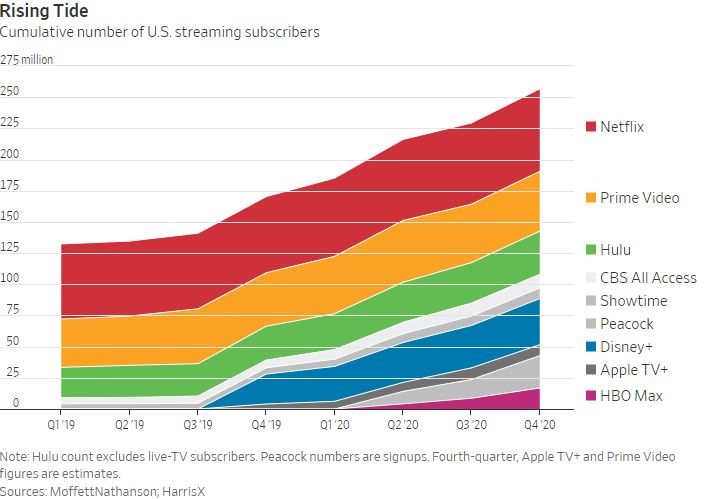
WSJ (“Forget the Streaming Wars—Pandemic-Stricken 2020 Lifted Netflix and Others“):
The past 12 months were billed as the year when a flood of new entrants would force streaming services to wage an all-out war for subscribers. Instead, incumbents and rookies alike feasted on a base of shut-in customers eager for more things to watch.
The largest streaming services are expected to finish 2020 with combined U.S. subscriber numbers more than 50% higher than a year ago, according to a Wall Street Journal analysis of data from market-research firms MoffettNathanson LLC and HarrisX.
They enjoyed a captive audience. The coronavirus pandemic triggered lockdowns that sent millions of Americans home, leaving many people with more time to watch movies and shows from the couch. The virus also prompted movie theaters to shut down and sports leagues to go on hiatus for months, further boosting streaming services’ appeal.
“Instead of a streaming war, there’s been streaming coexistence and parallel growth,” said Dritan Nesho, HarrisX’s chief executive. New services such as Walt Disney Co.’s Disney+ grew rapidly without necessarily harming established players such as Netflix Inc. NFLX -1.18% and Hulu, he said.
“Disney+ did not displace existing services,” Mr. Nesho said. “It complemented them.”
Disney+ is one of many streaming platforms that didn’t exist a little over a year ago. It launched in November 2019, a few days after Apple Inc.’s Apple TV+. Two other major players, AT&T Inc.’s HBO Max and Comcast Corp.’s Peacock, went live in recent months.
About a year ago, Americans told a WSJ-Harris Poll survey that they were willing to subscribe to an average of 3.6 streaming services—and some 30% of the Netflix subscribers among them had said they would likely cancel their subscriptions to make way for new services.
In fact, the new streaming platforms didn’t prevent Netflix and others from continuing to sign up new customers at a healthy clip. Their growth came as traditional pay-TV providers continued to lose subscribers. Satellite and cable companies have shed more than 1 million pay-TV customers each quarter since mid-2018, a trend that analysts expect to continue.
U.S. households now subscribe to 3.1 streaming services on average—up from 2.7 last year, according to Kagan, a media research group within S&P Global Market Intelligence. About three out of four U.S. households subscribe to at least one streaming service, MoffettNathanson data show.
Here’s the accompanying graphic:

As noted recently, we subscribe to more than the average number of steaming video services: Hulu, Netflix, Disney+, Amazon Prime, and HBO Max (and that doesn’t include NFL Sunday Ticket and YouTube Premium and Amazon Music). But we’re an affluent household with seven people, including five students ranging from 9 to 21.
I honestly don’t understand how more normal households can justify that many subscriptions. There just isn’t enough time in the day to watch that much content and very little of it must be seen in real time.
Aside from the pandemic creating a captive audience, I suspect a lot of it is just inertia. Most of the services are just a few bucks a month and canceling and restarting is maybe just more trouble than it’s worth. And three or four subscriptions is still way cheaper than a cable bill.