
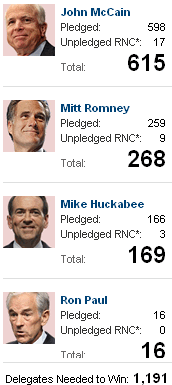
As I write this, a bit after 6 am, we don’t know the results of all the Super Tuesday states. What we do know if that Barack Obama and Mike Huckabee did much better than expected but that Hillary Clinton and John McCain strengthened their perception as frontrunners by winning California and New York, the biggest prizes of the night.
 Republicans:
ABC News goes with this shocking headline: “McCain Wins California, Huckabee Gets Boost — Romney Vows Campaign Will Go On as GOP Contest Shapes Up as Two-Man Race”
Sen. John McCain cemented his position as the Republican front-runner with his projected win in the California primary — the most delegate-heavy state up for grabs on Super Tuesday, based on ABC News’ exit poll data and partial vote counts.
While many of the biggest states on Super Tuesday went to McCain’s camp, former Arkansas Gov. Mike Huckabee also picked up key projected wins in Tennessee and Georgia, as well as leads or projected wins in four other states, based on exit poll data and vote counts.
[…]
The results were more disappointing for former Massachusetts Gov. Mitt Romney, who ABC News projects will win his home state, Colorado, Minnesota and the small prizes of Montana, Utah and the North Dakota and Alaska caucuses. But in a speech delivered from his campaign headquarters in Boston, Romney spoke passionately to a crowd of cheering supporters.
“One thing that is clear is that this campaign is going on!” said Romney.
Earlier in the evening, Huckabee told a crowd at his own campaign’s headquarters in Little Rock, Ark., “Over the past few days a lot of people have been trying to say this is a two-man race, but you know what? It is, and we’re in it!”
The problem with that, though, is that, while Huckabee managed to turn out evangelical support in the South despite having been written off, it’s unclear where his support comes from in the upcoming contests. While the 169 delegates shown on the graphic above (courtesy CNN) may move a bit as the final tallies are calculated, he remain a distant third place with the South mostly out of the way. I just don’t see him getting another 1,023 delegates.
Regardless, Huckabee helped himself big time. Not only did he further demonstrate his appeal to Christian conservatives but he’s run a sunny, humorous campaign and built what, publicly at least, seems to be a warm relationship with John McCain. The prospects of them sharing the ticket have grown.
As for Romney, WaPo’s Jonathan Weisman adds insult to injury with “Romney’s Expenses Per Delegate Top $1M.”
By Republican strategist Alex Vogel’s calculation, Mitt Romney […] has spent $1.16 million per delegate, a rate that would cost him $1.33 billion to win the nomination.
By contrast, Mike Huckabee’s campaign has been the height of efficiency. Delegates haven’t yet been officially apportioned, but roughly speaking, each $1 million spent by Huckabee has won him 20 delegates.
Over at The Corner, the estimable John O’Sullivan views the results as “a positive rejection of Romney” and suspects it’s confirmation that “many evangelicals would vote for anyone but a Mormon.” Mark Steyn agrees. There’s no doubt anti-Mormonism is a factor. As I’ve noted many times, many evangelicals — and that includes a lot highly educated, successful people, contrary to the media myth — believe Mormonism is a cult.
Mostly, though, I believe Romney just rubs rural America the wrong way in much the same way that Hillary Clinton does. He comes across as “slick” and packaged and insincere. For all their faults, McCain and Huckabee strike most people as genuine.
 Democrats:
Wow. There were plenty of indications that Obama was surging. There has been growing anti-Clinton backlash (ironically, mostly aimed at Bill but with Hillary the victim) and quite a few endorsements and other signs that mainstream Democrats were moving toward Obama. California was tightening into a toss-up but Clinton was leading the polls just about everywhere there were polls. Instead, she won Calfornia but he picked off a whole lot of other states.
Once again, ABC News summed it up well with their headline: “Clinton Wins Delegate-Rich States; Obama Takes Most States.”
Sens. Barack Obama, D-Ill., and Hillary Clinton, D-N.Y., traded Super Tuesday victories in an expectedly tight Democratic race that has turned into a fierce battle for convention delegates.
Energized, Democratic voters turned out in high numbers as an unprecedented 22 states held Democratic primaries and caucuses, but all those voters in all those states did little to determine a Democratic front-runner.
Obama appears to have won the most states, picking up victories in Illinois, Idaho, Colorado, Minnesota, Connecticut, Utah, North Dakota, Kansas, Delaware, Missouri, Georgia and Alabama, according to analysis of exit polls and the vote count.
Clinton won the delegate-rich states of California and New York, the largest and second-largest states to vote tonight. Clinton has also picked up victories in Massachusetts, New Jersey, Arizona, Oklahoma, Tennessee and Arkansas, where she and her husband have deep roots.
MSNBC goes with a similar take: “Clinton wins California, most other big states — But party’s delegate rules mean Democratic race to end up virtually tied.”
Florida and Michigan:
One point that our own Dave Schuler has made repeatedly bears re-emphasis at this time: The fate of Florida and Michigan’s delegates is going to be a huge issue here. Clinton won both of these usually-delegate-rich states handily, albeit in uncontested races. Were their normal slate of delegates in her column, she’d be much further ahead. And, if they somehow get added into the mix later in the game, it’ll have a major impact on the outcome.
Prediction Games:
A couple of states aren’t yet decided but my success rate at predicting Super Tuesday was decidedly less than stellar. To be sure, I had caveats throughout the post that I was just taking a SWAG at several states in the absence of polling. But, still, I got a lot of states wrong, guessing that there would be a lot more coalescing around the frontrunners than we actually saw.
On the Republican side, I allowed that Huckabee could pick off a Southern state or two that I gave to McCain (figuring a lot of Huck’s supporters would satisfice between one of the two “viable” candidates), so I at least covered myself. My biggest problem was underestimating Romney’s support in the Northwest, which I presumed, mostly in the absence of polling data, was likely to go for McCain’s ornery style and maverick message.
Not much better on the Democratic side and for mostly the same reason: I was way off in guessing the attitudes of the Northwest. But, really, I just underestimated Obama’s support across the board.
At least I called California right!
Where We Go From Here:
I don’t see how anyone other than McCain wins the Republican nomination at this point. Romney has plenty of cash to spend but it doesn’t seem to be getting him anywhere. Huckabee is a likable guy that too many of us have underestimated but I just don’t see where he’s going to get another thousand delegates; the map just isn’t his friend at this point.
Most of us thought Hillary Clinton would be the prohibitive favorite this morning. She ain’t. The David Broder conventional wisdom has been that, the longer this race went on, the more it benefited Obama. That sure seems to be the case. He’s clearly the Democrats’ better general election candidate and the guy who seems to appeal most to the base.
Chris Bowers, Ed Morrissey, Steve Bainbridge, and others are talking brokered convention for the Democrats, with potentially ugly results. It’s much more likely now than I’d have ever guessed. Still, I’d be surprised if it comes to that. While it’s true that the Democrats’ bizarre combination of proportional representative primaries and non-democratic superdelegates complicates the process, it’s a two-person race and my guess is that the party coalesces around one of them before long. To the extent that Hillary’s still relying on inevitability, though, she’s in trouble.
Update (Dave Schuler)
I think the honest truth is that Barack Obama needed to do better in California than he did to secure the Democratic nomination. The big states whose primaries are still to be held are Ohio and Texas on March 4 and Pennsylvania on April 22 so I expect that both Clinton and Obama will devote substantial time to them, particularly to Ohio and Pennsylvania. It’ll probably be the most attention that Pennsylvania has received in generations. And, since Ohio is a state that Clinton very much wants to carry in November, I suspect she’ll practically live there, giving the Buckeye State the sort of attention that’s usually reserved for Iowa and New Hampshire.
In Obama’s favor are that he’s tended to do well when he’s had enough time to devote to particular states and that he’s got the money to keep trooping on. In Clinton’s favor are the organization that she’s been building for the last 16 or more years and the superdelegates who are mostly pledged to her. Obama didn’t win big enough yesterday to cause them to bolt.
Remember that there are 796 Democratic superdelegates. That means that the 783 Clinton delegates vs. the 709 Obama delegates (the standings as they’re currently being reported) don’t really tell the whole story. Taking the superdelegates into account and assuming the same pattern of neck-and-neck gaining of delegates by Clinton and Obama in the remaining primaries, Clinton will be the Democrat’s nominee in November.









