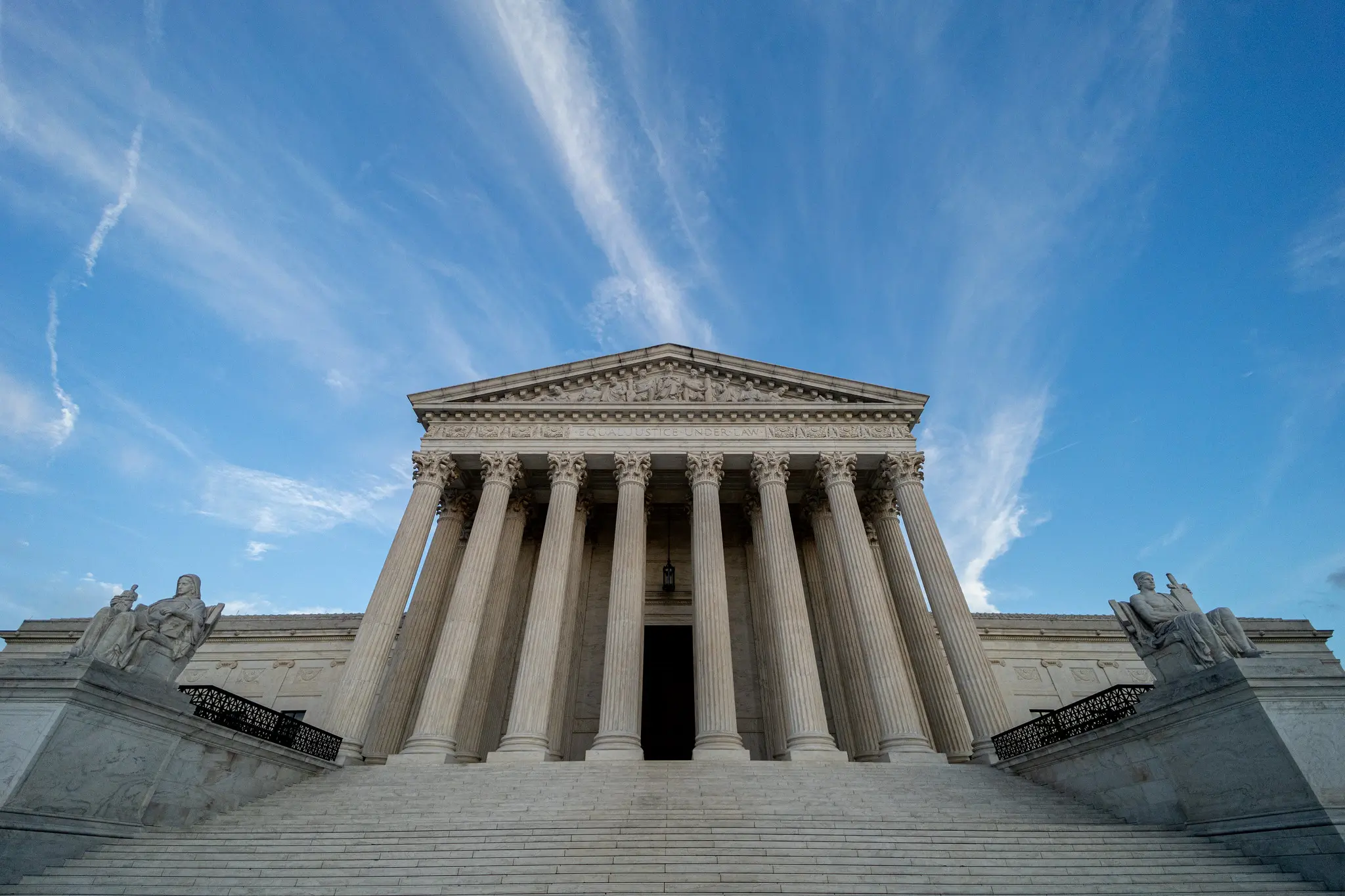
The Supreme Court heard oral argument today in a case that has the potential to severely restrict the power of public employee unions to collect dues from those who do not wish to be members, and the initial assessment of the oral argument is one that does not look good for the union’s side of the argument:
WASHINGTON — The Supreme Court seemed poised on Monday to deliver a severe blow to organized labor.
The justices appeared divided along familiar lines during an extended argument over whether government workers who choose not to join unions may nonetheless be required to help pay for collective bargaining. The court’s conservative majority appeared ready to say that such compelled financial support violates the First Amendment
Collective bargaining, Justice Anthony M. Kennedy said, is inherently political when the government is the employer, and issues like merit pay, promotions and classroom size are subject to negotiation.
The best hope for a victory for the unions had rested with Justice Antonin Scalia, who has written and said things sympathetic to their position. But he was consistently hostile on Monday.
“The problem is that everything that is bargained for with the government is within the political sphere,” he said.
The court’s four liberal members were on the defensive, asking questions about whether there is good reason to overturn a 1977 precedent allowing the fees and potentially unraveling tens of thousands of collective bargaining agreements. They added that a ruling against the unions could affect compelled fees paid to bar associations by lawyers and to public universities by students.
The case was brought by 10 California teachers who said they were being forced to subsidize activities with which they disagree.
Should the teachers’ argument prevail, public-sector unions across the nation, already under political pressure, could lose tens of millions of dollars and find their effectiveness diminished.
Unions say the teachers’ First Amendment argument is a ruse. Nonmembers are already entitled to refunds of payments spent on political activities like advertising to support a political candidate. Collective bargaining is different, the unions say, adding that the plaintiffs are seeking to reap the benefits of such bargaining without paying their fair share of the cost.
The larger threat, the unions and their supporters say, is that a decision in the plaintiffs favor would encourage many workers who are perfectly happy with the work of their unions to make the economically rational decision to opt out of paying for it.
Limiting the power of public unions has long been a goal of conservative groups.Even before Monday’s argument, they had reason to be hopeful that their side would prevail in the case, Friedrichs v. California Teachers Association, No. 14-915.
(…)
In the 1977 decision, Abood v. Detroit Board of Education, the Supreme Court made a distinction between two kinds of compelled payments. Forcing nonmembers to pay for a union’s political activities violated the First Amendment, the court said. But it was constitutional, the court added, to require nonmembers to help pay for the union’s collective bargaining efforts to prevent freeloading and ensure “labor peace.”
The challengers in the new case say the distinction is untenable and unworkable, and they asked the justices to overrule Abood and bar both kinds of compelled payments.
Under California law, public employees who choose not to join unions must pay a “fair share service fee,” also known as an “agency fee,” typically equivalent to members’ dues. The fees, the law says, are meant to pay for collective bargaining activities, including “the cost of lobbying activities.”
More than 20 states have similar laws. In a brief in the case, Kamala D. Harris, California’s attorney general, said her state’s law was good policy and constitutional.
“Mandatory agency fees ensure that all employees in a particular bargaining unit pay a fair share of the cost of the representation,” she wrote. “They prevent the unfairness and conflict that could arise were only part of the work force to support representation activities that, by law, must advance and protect the interests of every employee.”
The teachers challenging the requirement say that collective bargaining is a political activity when the employer is the government and that it violates the First Amendment to make them pay for it.
“In this era of broken municipal budgets and a national crisis in public education,” a petition by the teachers said, “it is difficult to imagine more politically charged issues than how much money strapped local governments should devote to public employees, or what policies public schools should adopt to best educate children. Yet California compels petitioners to fund a very specific point of view on these pressing public questions.”
Buzzfeed Supreme Court reporter Chris Geidner agrees with the assessment that the argument in favor of mandatory fees did not fare well today:
WASHINGTON — A majority of the Supreme Court appears poised to overrule a 1977 case allowing public sector union “agency fees” — a ruling that would end the fees, which are paid by non-members to support public sector unions’ collective bargaining work.
The 1977 case, Abood v. Detroit Board of Education, allows public sector unions to require non-union members to pay a fee for the services provided to all employees regarding contract negotiations and administration.
Monday’s case, Friedrichs v. California Teachers Association, was presented by Jones Day partner Michael Carvin as a free speech and association case about the First Amendment. Representing teacher Rebecca Friedrichs, Carvin argued that the First Amendment bars California from forcing Friedrichs to pay money to a union with which she disagrees and has chosen not to join.California, Justice Department, and union lawyers countered that the 1977 case “converged” — as Solicitor General Donald Verrilli Jr. put it — with other Supreme Court cases about the more lenient speech rules that apply to the government when it acts as an employer.
(…)
The Supreme Court, in a 2014 decision, hinted at the majority’s dissatisfaction with the Abood ruling. Although Justice Clarence Thomas said nothing Monday, as is his usual practice, it does appear that the same five justices are prepare to overruleAbood with Friedrichs.
Justice Stephen Breyer pressed Carvin heavily on the role of stare decisis — the court’s practice of following its past precedents — and several of the four more liberal justices questioned what special reason there was to overrule Abood.
“It was 40 years ago,” Breyer said of the Abood decision. “It was 40 years ago,” he repeated, questioning the effect on other related decisions — ranging from bar association fees to student activity fees.
When California Solicitor General Edward DuMont got up, however, the more conservative justices took the lead in questioning — with Justice Anthony Kennedy calling it “almost axiomatic” that public sector union matters are “matters of public concern” because, among other reasons, public money is involved.]
The 2014 case that Geidner refers to is Harris v. Quinn a case out of Illinois that dealt with union representation for home health care workers who were essentially contractors for the state in that they worked primarily if not exclusively on Medicare and Medicaid cases. In that case, the law counted the home health aides as public employees simply because they had been employed by a patient whose medical expenses were paid by the state. As a result of that designation, the home health care workers were required to pay the same union dues as other public employees in order to have their bills paid for by the state. One group of aides filed suit against the law, and the Supreme Court ruled that the aides should be classified as ‘partial public employees,’ meaning that they cannot be required to pay union dues notwithstanding the fact they may have benefited from the negotiations that the union conducted with the state. At the time, there were those who argued that the Court should use the opportunity presented by the Harris case to strike down the 1977 ruling in Abood that allowed public employee unions to continue charging fees to those who did not wish to advance views they disagreed with. Instead of taking that step, though, the Justices ruled in favor of the Plaintiffs via the most conservative and limited means possible, while at the same time hinting rather strongly in their opinion that Abood rested on shaky ground to say the least. Given that, it’s not entirely surprising to hear that oral argument proceeded as it did today.
In the Harris case, it appeared that the Court didn’t reach the question of overturning Abood because the majority was not willing to go that far, but Lyle Denniston’s analysis seems to suggest that this is no longer the case thanks largely to Justice Anthony Kennedy:
Early in the argument, a Washington, D.C., lawyer, Michael A. Carvin, made clear the basic complaint of the non-union California teachers he represents when he told the Court that the teachers don’t want to be forced to pay any support to “an outside advocacy group like a political party or like a union.” It was not a slip of the tongue, yet no one challenged whether the two actually were equivalent political entities.
What may have been most revealing is that the five Justices whose votes are likely to control the outcome showed no sign of doubting the non-union members’ premises, so most or all of those five would appear to be inclined to conclude that any charge of an “agency fee” to a non-member would be a compelled endorsement, with their money, of “a group that advocates an ideological viewpoint” (as Carvin also described the teachers’ union).
Those are the Justices who made up the majority in a five-to-four ruling in 2014, Harris v. Quinn, that stopped just short of inviting the kind of First Amendment challenge that Carvin brought to the Court Wednesday, after rushing it through lower courts as a test case on whether the Court was ready to overrule its 1977 decision in Abood v. Detroit Board of Education. That is the precedent which established the legality of an “agency fee” to be levied by public-sector unions on non-union members to support collective bargaining.
The four Justices who were in dissent in the Harris case appeared to be headed toward dissent again, even as they made no headway in shaking Carvin’s assault on the teachers’ union as a state-compelled advocate for workplace policies that the non-union members appear to find objectionable. Those four appeared to be clinging to the Court’s usual reluctance to overturn a constitutional precedent that had been followed for nearly four decades.
The more liberal Justices gained a measure of support from Justice Anthony M. Kennedy, as they wondered what would be the fate of “agency fees” that now exist in thousands of union contracts affecting millions of workers, if the Court were to overrule the Abood decision. The liberals seemed unpersuaded by Carvin’s suggestion that such fees outside the public sector were not in jeopardy.
Kennedy otherwise appeared to be lining up with the developing consensus against the Aboodprecedent. He emphasized his worry about suppressing the views of individual workers who had opted not to join unions or to support union causes. At one point, in fact, Kennedy interpreted the operation of the “agency fee” as a mechanism to “silence” the non-union members as a group.
As is always the case, drawing conclusions about the outcome of a case based on oral argument isn’t always a wise thing to do. Quite often, Justices will ask questions to help flush out arguments that will occur later behind the scenes when the Justices prepare to vote on the outcome of the case, or simply for some reason that has little to do with the way they end up ruling. In this case, though, it seems fairly clear that the Justices are leaning strongly in favor of ruling in favor of the Plaintiffs. The first clue, of course, is the Court’s ruling two years ago in the Harris case, which seemed as though it was the perfect set up for overruling Abood until the Court went the more conservative route. Reading the opinion, though, it seems clear that the Justices were really looking for a more appropriate case to be the vehicle to reach that goal and the case before the Court today seems to fit that description perfectly. Instead of a group of Plaintiffs that can be easily distinguished as representatives of the union as a whole like we had in Harris, the Plaintiffs in Fredrichs are regular union members who simply happen to disagree with the idea of their funds being used to advance causes that they disagree with, something which constitutes a violation of the First Amendment by virtue of the fact that the government is making their membership in the union a mandatory condition of employment.As I’ve said before, it’s fairly well settled law, that people cannot be forced to subsidize speech they disagree with, and as the Justices noted in their questioning today, the argument that there can be a distinction between public advocacy and contract negotiation in a public employee context simply doesn’t make any sense. Given this, a public employee who is compelled to pay union dues as a condition of employment is being compelled to subsidize speech whether they want to or not. This would seem to be a clear violation of the First Amendment.
In any case, a decision in this case should be handed down sometime before the end of the term and, if it goes the way everyone seems to expect, it will be a serious setback for public employee unions across the nation.
Here’s the transcript of today’s argument:
Friedrichs v. California Teachers Association by Doug Mataconis