
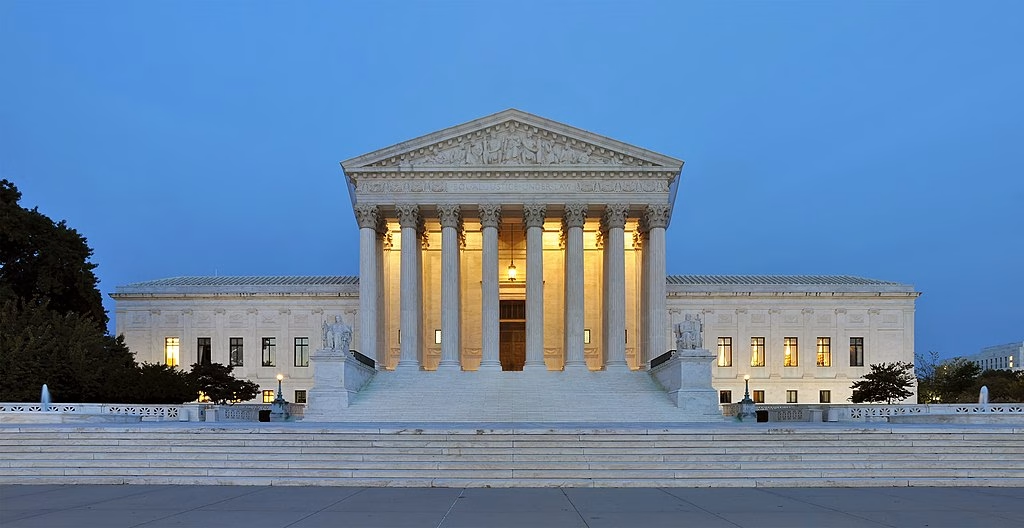

President Donald Trump appointed two-thirds of the justices on the United States Supreme Court. They all summarily rejected the outrageous bid by the indicted Texas attorney general—signed off by 17 other Republican states and Trump himself—to subvert the election. The press reaction is unusually blunt.
Adam Liptak, New York Times (“Supreme Court Rejects Texas Suit Seeking to Subvert Election“):
The Supreme Court on Friday rejected a lawsuit by Texas that had asked the court to throw out the election results in four battleground states that President Trump lost in November, ending any prospect that a brazen attempt to use the courts to reverse his defeat at the polls would succeed.
The court, in a brief unsigned order, said Texas lacked standing to pursue the case, saying it “has not demonstrated a judicially cognizable interest in the manner in which another state conducts its elections.”
[…]
Texas’ lawsuit, filed directly in the Supreme Court, challenged election procedures in four states: Georgia, Michigan, Pennsylvania and Wisconsin. It asked the court to bar those states from casting their electoral votes for Mr. Biden and to shift the selection of electors to the states’ legislatures. That would have required the justices to throw out millions of votes.
[…]
Mr. Trump’s campaign did not immediately issue a statement. In an appearance on the conservative network Newsmax soon after the decision was announced, Rudolph W. Giuliani, Mr. Trump’s personal lawyer, said that the campaign’s legal effort would continue, insisting that his team had originally planned for “four or five separate cases.”
“We’re not finished, believe me,” he said with a laugh at the end of the interview.
The president, who at a White House Hanukkah party earlier in the week eagerly mentioned the pending court case in his remarks, was scheduled to attend another holiday party around the time the ruling came down. But around 8:30 p.m., guests were informed that Mr. Trump would not be coming down from the residence to speak.
Mr. Trump weighed in later on Twitter. “The Supreme Court really let us down,” he said. “No Wisdom, No Courage!”
Robert Barnes, Washington Post (“Supreme Court dismisses bid led by Texas attorney general to overturn the presidential election results, blocking Trump’s legal path to a reversal of his loss”):
The Supreme Court on Friday dismissed a long-shot bid by President Trump and the state of Texas to overturn the results in four states won by Democrat Joe Biden, blocking the president’s legal path to reverse his reelection loss.
[…]
Justices Samuel A. Alito Jr. and Clarence Thomas said they did not think the court had the authority to simply reject a state’s filing, a position they have taken in past cases. But they said they would not have granted Texas the remedy it sought, which was to disallow the electors from those four states.
Legal experts from the beginning had derided Texas’s unprecedented action as implausible, and the court’s rejection was fast and emphatic — the order came just hours after briefing was completed. The justices seemed to have bypassed a lengthy explanation in favor of a unified outcome.
Taking into account an earlier request from Republicans in Pennsylvania, it means that in two cases to reach the court — where conservatives hold a 6-to-3 majority — no justice has expressed support for the drastic idea of throwing out election results.
Nina Totenberg, NPR (“Supreme Court Shuts Door On Texas Suit Seeking To Overturn Election“):
The U.S. Supreme Court on Friday night rejected an eleventh hour challenge to Joe Biden’s election as president.
The court’s action came in a one-page order, which said the complaint was denied “for lack of standing.”
The Guardian (“Supreme court rejects Trump-backed Texas lawsuit aiming to overturn election results“) and CNN (“Supreme Court rejects Texas’ and Trump’s bid to overturn election“) apparently got the memo as well.
SCOTUSblog’s Tom Goldstein, writing before the announcement, was hoping for more:
The easy thing for the Supreme Court to do is simply deny Texas permission to file the complaint (and deny the motions to intervene as moot) and be done with it. No fuss, no muss.
But the court should do more. It is perfectly ordinary and appropriate for the justices to write an opinion explaining the various reasons why they are rejecting Texas’ request. Indeed, the minority of justices who think that the court is required to accept original actions like Texas’ may well write short opinions of their own or note that they think the case was properly filed. So there is nothing overreaching if a majority of the court explains why the case is meritless.
The justices’ decision whether to do that needs to account for this extraordinary, dangerous moment for our democracy. President Donald Trump, other supportive Republicans, and aligned commentators have firmly convinced many tens of millions of people that the 2020 presidential election was stolen. If that view continues to take hold, it threatens not only our national politics for the next four years but the public’s basic faith in elections of all types that are the foundations of our society.
A simple five-page per curiam opinion genuinely could end up in the pantheon of all-time most significant rulings in American history. Every once in a long while, the court needs to invest some of its accumulated capital in issuing judgments that are not only legally right but also respond to imminent, tangible threats to the nation. That is particularly appropriate when, as here, the court finds itself being used as a tool to actively undermine faith in our democratic institutions — including by the members of the court’s bar on whom the justices depend to act much more responsibly.
In a time that is so very deeply polarized, I cannot think of a person, group or institution other than the Supreme Court that could do better for the country right now. Supporters of the president who have been gaslighted into believing that there has been a multi-state conspiracy to steal the election recognize that the court is not a liberal institution. If the court will tell the truth, the country will listen.
Volokh Conspiracy’s Jonathan Adler argues that the opinion is actually much more of a smackdown than the reporting would have us believe:
This result was not a surprise. As I indicated in my prior posts on AG Paxton’s initial filing, the intervening briefs, amici, state defendants’ responses, and Paxton’s feeble replies, this case never had merit. As the Court concluded, Texas could not satisfy the requirements of Article III standing to challenge the election procedures utilized by other states to select presidential electors. What is more, even the two justices who believed the Court was obligated to hear the case-arguably the Court’s two most conservative justices-did not believe Texas was entitled to the extraordinary relief it sought, relief which would have been necessary for AG Paxton’s last-ditch effort to have any result on the electoral college. AG Paxton’s office submitted transparently weak arguments, and the Court summarily dispatched them.
It is important to underscore that the Supreme Court’s decision is, for all practical purposes, unanimous. Justices Alito and Thomas have long held the view that when a state seeks to invoke the Court’s original and exclusive jurisdiction, the Court is obligated to hear the case. (See, e.g., their dissent from the Court’s refusal to hear Arizona v. California.) This is a serious argument, which Ilya Somin discussed here and which I suspect may be correct. So while the vote on Texas’ Motion for Leave was technically 7-2 on this basis, the Court was 9-0 in rejecting AG Paxton’s attempt to get any sort of actual relief, such as an injunction preventing states from appointing presidential electors. Not a single justice was willing to express any sympathy for any aspect of Texas’s legal claims.
As for the rest of Justice Alito’s statement, what “other issue” might he be referring to? I suspect this is a reference to the Pennsylvania litigation that is still pending, about which Justice Alito previously issued a statement.
On the rest of the Court’s order, it is significant that the Court did not merely note the lack of standing, but also specified that Texas had not “demonstrated a judicially cognizable interest in the manner in which another State conducts its elections.” In other words, one state cannot invoke the jurisdiction of the federal courts to challenge another states election processes, even when it concerns the selection of presidential electors. This should discourage other states from trying such things in the future, whether to raise Electors Clause claims, Equal Protection claims, or anything else.
As I have already noted, this should not have been a surprise to anyone who was paying attention. The briefs submitted by AG Paxton’s office were weak on the facts and weak on the law. In some respects, as I noted in prior posts, they were downright embarrassing. The briefs filed in support of Paxton’s claims were, on the whole, not much better. Those attorneys who were willing to file briefs that actually embraced the substance of Paxton’s claims should be particularly embarrassed. If Paxton’s own Solicitor General would not sign on to these briefs, why would the SG of Missouri or Utah?
[…]
The #Kraken may have been released. Tonight’s Supreme Court order should also have put it out of its misery.
Emphases all mine.
The Trump legal team is now something like 0-55 in the courts. Despite outrageous statements from Republican officials from the President to the House Minority Leader to numerous Senators, Governors, and lower state office-holders, the wishes of the voters in every state were ultimately upheld.
One hopes that there is a reckoning for those who so brazenly tried to steal this election. Alas, judging from my Facebook feed, the “stop the steal” nonsense had the desired effect of poisoning the well. People I know to be intelligent and otherwise decent and patriotic folks honestly think—or are at least willing to publicly proclaim in what they think are semi-private conversations among friends and comrades—that the Democrats somehow stole the election and that we’re living in a banana republic.
Indeed, Adler’s colleague Ilya Somin fears the Supremes didn’t do enough to dispel that notion.
I do worry that the Court’s decision to reject the case on procedural grounds will give more fuel to Trumpist claims that the plaintiffs were actually right on the merits, and that Texas would have won if only the justices had been willing to take up its claims. Texas’ position had numerous substantive flaws, as well. But committed partisans are likely to ignore that or be unaware of it.
More generally, I fear that tonight’s ruling won’t stem the dangerous tide of conspiracy-mongering about the election by Trump and many of his allies, and it won’t prevent a good many of his supporters from continuing to believe such claims. That said, the Supreme Court cannot be expected to solve all the flaws of our screwed-up political discourse. The justices’ job is much narrower than that. And tonight they did it well.
Indeed, they did. A unanimous verdict here is likely as powerful a message as we could have expected.








