
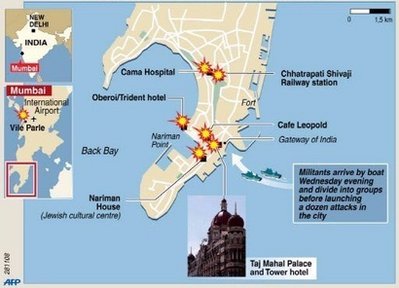
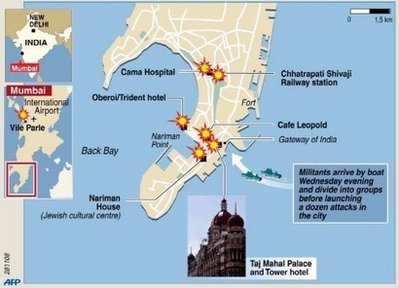
 After nearly three days the terrorist rampage that has rocked India’s financial capital, Mumbai, has ended in a hail of bullets as Indian forces killed the last three gunmen who had barricaded themselves within a luxury hotel:
MUMBAI, India — A 60-hour terror rampage that killed at least 195 people across India’s financial capital ended Saturday when commandos killed the last three gunmen inside a luxury hotel while it was engulfed in flames.
Authorities searched for any remaining captives hiding in their rooms and began to shift their focus to who was behind the attacks, which killed 18 foreigners including six Americans.
A previously unknown Muslim group with a name suggesting origins inside India claimed responsibility for the attack, but Indian officials said the sole surviving gunman was from Pakistan and pointed a finger of blame at their neighbor and rival.
Islamabad denied involvement and promised to help in the investigation. A team of FBI agents also was on its way to India to lend assistance.
Some 295 people also were wounded in the violence that started when heavily armed assailants attacked 10 sites across Mumbai on Wednesday night. At least 20 soldiers and police were among the dead.
Orange flames and black smoke engulfed the landmark 565-room Taj Mahal hotel after dawn Saturday as Indian forces ended the siege there in a hail of gunfire, just hours after elite commandos stormed a Jewish center and found at least eight hostages dead.
“There were three terrorists, we have killed them,” said J.K. Dutt, director general of India’s elite National Security Guard commando unit.
Many are now trying to understand why and how the attacks happened. Suketu Mehta, a journalist writing in an op-ed in the New York Times, points to Mumbai’s openness and that the city is a “soft target”:
Mumbai is a “soft target,” the terrorism analysts say. Anybody can walk into the hotels, the hospitals, the train stations, and start spraying with a machine gun. Where are the metal detectors, the random bag checks? In Mumbai, it’s impossible to control the crowd. In other cities, if there’s an explosion, people run away from it. In Mumbai, people run toward it — to help. Greater Mumbai takes in a million new residents a year. This is the problem, say the nativists. The city is just too hospitable. You let them in, and they break your heart.
In the Bombay I grew up in, your religion was a personal eccentricity, like a hairstyle. In my school, you were denominated by which cricketer or Bollywood star you worshiped, not which prophet. In today’s Mumbai, things have changed. Hindu and Muslim demagogues want the mobs to come out again in the streets, and slaughter one another in the name of God. They want India and Pakistan to go to war. They want Indian Muslims to be expelled. They want India to get out of Kashmir. They want mosques torn down. They want temples bombed.
And now it looks as if the latest terrorists were our neighbors, young men dressed not in Afghan tunics but in blue jeans and designer T-shirts. Being South Asian, they would have grown up watching the painted lady that is Mumbai in the movies: a city of flashy cars and flashier women. A pleasure-loving city, a sensual city. Everything that preachers of every religion thunder against. It is, as a monk of the pacifist Jain religion explained to me, “paap-ni-bhoomi”: the sinful land.
Al Jazeera notes the intelligence failure:
The attacks were not simply about spreading terror and creating chaos, but also served to humiliate the government as they proved that a handful of men could paralyse a city and frustrate highly-trained security forces.
People were left wondering how the Indian intelligence agencies failed to anticipate an attack of this proportion.
The scale and execution of the foray points to acute planning for a sustained period of time. It was the first time that the sea route was exploited for access – the assailants used boats to reach the urban peninsula.
That’s what baffled me about the attacks. This wasn’t the same as a suicide bomber blowing him- or herself up in a crowded marketplace. That could have been achieved at a fraction of the cost of this particular set of attacks. These attacks had planning and coordination; the young men who forced their way into some of Mumbai’s fanciest hotels and restaurants had received a level of training and preparation. That incurs a cost; such resources are too valuable just to throw away.
I have no more explanation than anybody else and can only offer a handful of guesses. It may have been a probing attack. If that’s the case Mumbai can expect more such attacks and soon, indeed, I would have already expected a followup.
It may have been intended to discredit the government or provoke an over-response. If that’s the case, the attacks would seem to have failed. At this point the “rally ’round” effect seems to be outweighing the questions and there hasn’t been an overreaction. Yet.
This attack was distinctive in that Westerners seem to have been the targets. If we’re the audience for whatever message was being sent, it’s misfired. There just doesn’t seem to be enough coverage of the events here.
UPDATE
Here’s an excerpt from a commentary on the attacks from David Cid, director of the Memorial Institute for the Prevention of Terrorism:
In the past three years nearly 4000 were killed in India by terrorists, but our attention is captured only by the spectacular, and so our adversary engages in an increasing spiral of barbarity, and the world watches. Targeting the West, they killed or captured Americans and British nationals, the captives likely to be killed later at leisure.
There is both practicality and symbolism in the choice of targets; modernity, plurality and the influence of the Western World were transformed from symbols of hope to symbols of horror. Mumbai is a world away, and 12 hours by air from San Francisco.
Apparently, I’m not the only one thinking along those lines.









