

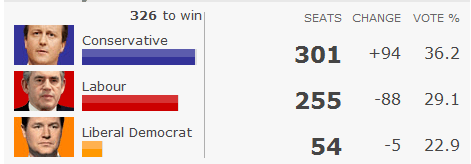
The preliminary results from the elections in the UK underscore the need for electoral reform in that country. Now, the UK uses the same system as the United States to elect the House of Commons, i.e., single-member districts with plurality winners. However, because of the presence of a number of third parties (as Chris Lawrence did a good job of describing yesterday), the results of the elections (and this is not a new phenomenon) are such that the overall preferences of the voters are not reflected in the actual results. Specifically, one can see from the graphic from the BBC that the Liberal Democrats have the support of 22.9% of the voters (less than 7% less than does Labour) and yet they are projected to have 201 less seats than Labour in the new parliament. This is a rather substantial amount of disproportionally. Indeed, the gap between the Conservatives and Labour in terms of the percentage of the vote is almost the same, and yet the difference in seats is rather dramatic.
And yes, I fully understand that the reason for the disparities is that Labour won more constituencies (i.e., districts) than did the Liberal Democrats. However, any electoral system that so poorly translates popular preferences into elected office is problematic from the point of view of basic democratic theory. For what it is worth, US elections actually does not suffer from the same problem, given that there is a fairly close fit between party vote shares and party seat shares which is due to the lack of seriously viable third parties. Indeed, disproportionality in the US is more comparable to many proportional representation systems than it is to other single-member district systems (source: unpublished manuscript). Our two party system is one of the most solidly two party in the world, in fact (almost uniquely so).
Meanwhile, the Conservatives in the UK are going to try and form a government (via the BBC: Election 2010: Cameron to try to form government). Labour may try as well.
If anything, the LibDems and their supporters have to be a bit depressed today, as the polling had them, at times, in second place, and all indications seemed to be pointing to a potentially historic day for them. Instead, they appear to have actually lost seats.
See also, Matthew Shugart: What if they held an election and everyone lost?
UPDATE (James Joyner): I’m blogging this at New Atlanticist: “Britain’s Hung Parliament: What Now?” and “Britain 2010 and America 2000.”









