
 A while back, I explored “Why College Tuition is Growing So Fast” through the lens of MIT artificial intelligence guru Patrick Henry Winston‘s writings. He argued that administrative costs are skyrocketing and that higher education was one of the few industries not taking advantage of the advances in technology, particularly computers, to increase efficiency.
My reaction was a fascinated skepticism:
On his homepage, Winston asserts, “I believe technology will take university education through a period of instability—what Andy Grove would call a 10X period—as new educational technology is introduced for the first time since the invention of movable type. This period of instability coincides with a window of global scientific opportunity and engineering challenge.” This is fascinating and he’s certainly better positioned to project this than I am.
While I’ve seen extraordinary technology-driven progress in the ability of faculty to do research, I’ve seen very little impact on teaching. True, there’s increased ability to deliver lectures and interact with students across space and time. But little advancement seems possible in the ability of professors to increase their bandwidth. The number of papers one can grade, students one can advise, and so forth at a level of high quality remains bounded by time and energy. So, I’m not sure how teaching will get less labor intensive.
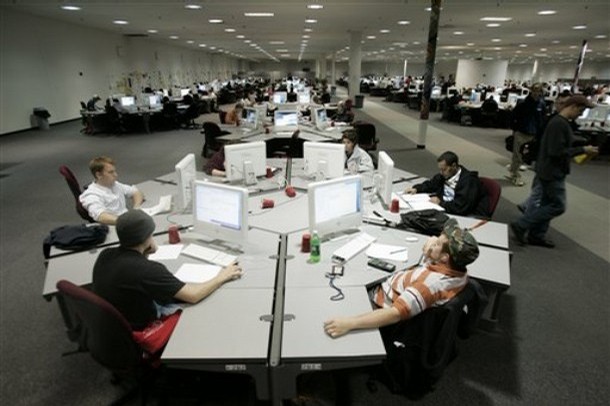
Jim Henley points me to an August 2008 essay by Kevin Carey in Washington Monthly that answers part of that question. It focuses on the Virginia Tech Math Emporium, a facility in cheap rented space in an abandoned shopping mall.
Undergraduate education, particularly at big state universities, is often passive and regimented. Students sit and receive information in the form of lectures that occur at a time and place of someone else’s choosing. The Math Emporium courses that Williams designed—there are currently nine—work in a very different way. Each course is broken up into a series of “modules,” available on Emporium computers or the Internet, that students are required to complete within a certain amount of time. Each module outlines a specific set of mathematic principles and concepts. These are translated into specific examples to review and problems to solve.
Once the module materials are completed, students can take randomly generated practice tests that draw on a central bank of thousands of potential questions. If they get questions wrong, the computer refers them back to the appropriate materials, and there’s no limit to the number of practice tests they can take. When they decide they’re ready, students come to the Emporium to take an official, proctored test that’s generated in exactly the same way as the practice quizzes. Then they move to the next module. Instead of marking progress by time—the number of hours spent in proximity to a lecturer—Emporium courses measure advancement by evidence of learning.
[…]
Some institutions, like the University of Alabama, have replicated the Virginia Tech Math Emporium model. Others have adopted a hybrid approach, reducing but not eliminating lectures while moving selected course materials, problem sets, and class discussions online. Arizona State, for example, recently used this method to transform an introductory women and gender studies course. Florida Gulf Coast University put its “Understanding the Visual and Performing Arts” course completely online. Portland State University focused on introductory Spanish, freeing up professors to teach more sections by using computers to grade language worksheets. Biology, psychology, chemistry, economics—the whole range of undergraduate courses [are being taught using this method at institutions across the country.]
[…]
It’s tempting to see the automation of college teaching as educational malpractice, a ploy to water down instruction and put professors out of work just to save a few bucks. But there’s persuasive evidence that the opposite is true—properly used, technology can make higher education better, not worse. NCAT has been spreading the gospel of course transformation since the late 1990s, when it secured an $8.8 million grant from the Pew Charitable Trusts to pilot the process with thirty colleges. The results were unequivocal: twenty-five colleges saw learning results improve while the other five saw no change. All thirty reduced costs, some by over 70 percent. As the number of NCAT institutions has expanded, they’ve found similar—or even greater—success.
The results at some institutions have been dramatic. In the late 1990s, students at the University of Alabama were washing out of freshman math courses in large numbers, and the failure rates for minority students were particularly high. After building a smaller version of the Emporium in 2000, Alabama boosted pass rates from 40 percent to nearly 80 percent—and erased the previously large gap between white and black students.
The key is letting computers do what they do best—grading multiple-choice tests, providing 24/7 access to text, audio, and video, connecting people to one another at a distance—while retaining the human element when only real people will suffice. The Virginia Tech Math Emporium is staffed twelve hours a day with a combination of upper-division math majors, graduate students, and faculty, each of whom is prepared to help students with any of the Emporium-based courses.
I don’t see how this could be applied to upper division political science courses without transforming education completely into training. Nor have computers advanced far enough, at least not that I’m aware, that they can provide effective feedback on English Composition essays. But if a course is nothing but lecture, reading, and multiple choice exams, I don’t see why this model can’t be applied.
What I fear is that the incentives will be to turn more and more courses into nothing but lecture, reading, and multiple choice exams.
When I first began teaching, I strongly resisted using that format, insisting on essay exams and term papers or other original writing exercises even in introductory courses. After all, college is supposed to be about teaching critical thinking and effective communication. But the incentives beat that notion out of me after two or three years. Survey courses have too many students in them, since they’re filled with the expectation that they’ll be taught in the lecture-regurgitate-Scantron format. Grading that many essays just takes too much time away from professional activities that are rewarded: research and writing, institutional service, and community service. Not to mention the ability to have a life outside work.
Further, the students resented it. They were used to Mickey Mouse exams in their survey courses, easy enough that all they had to do was skim the readings and attend most of the lectures to recognize plausibly correct answers and shade the appropriate oval with their trusty Number 2 pencil. And, if the answer was supposed to be “C” and they marked “B,” they intuitively understood why their grade was reduced. Conversely, if they wrote down some stuff they’d heard in class, they couldn’t understand why they were marked down for not writing down some other stuff, too. Or, worse, they got a “B” rather than an “A” because they didn’t quite connect the dots.
So, I gave in and started giving multiple choice tests that could be graded in a flash using a Mark Sense reader in the American Government survey course. I mostly made up my own questions, trying to craft them to test true understanding of the material, but sometimes took the easy way out and used questions provided by the textbook provider. It was easier on me and made the students happier. But I’m pretty sure that the end result was a diluted experience, furthering the conversion of freshman year into “the 13th Grade.”
Given that reality, though, the Math Emporium model makes good sense. And I could see where it would indeed allow students to learn the basics better. Unfortunately, a calendar-based course means that students who don’t understand the material tested in the first block are essentially screwed, since the class will move on without them. Sure, they can come to the professor for additional instruction or get outside tutoring, but there are practical limitations.
But what’s to prevent turning an increasing number of courses into spoon fed, computer gradable modules? And at what point does this produce something unrecognizable as a university education?









