
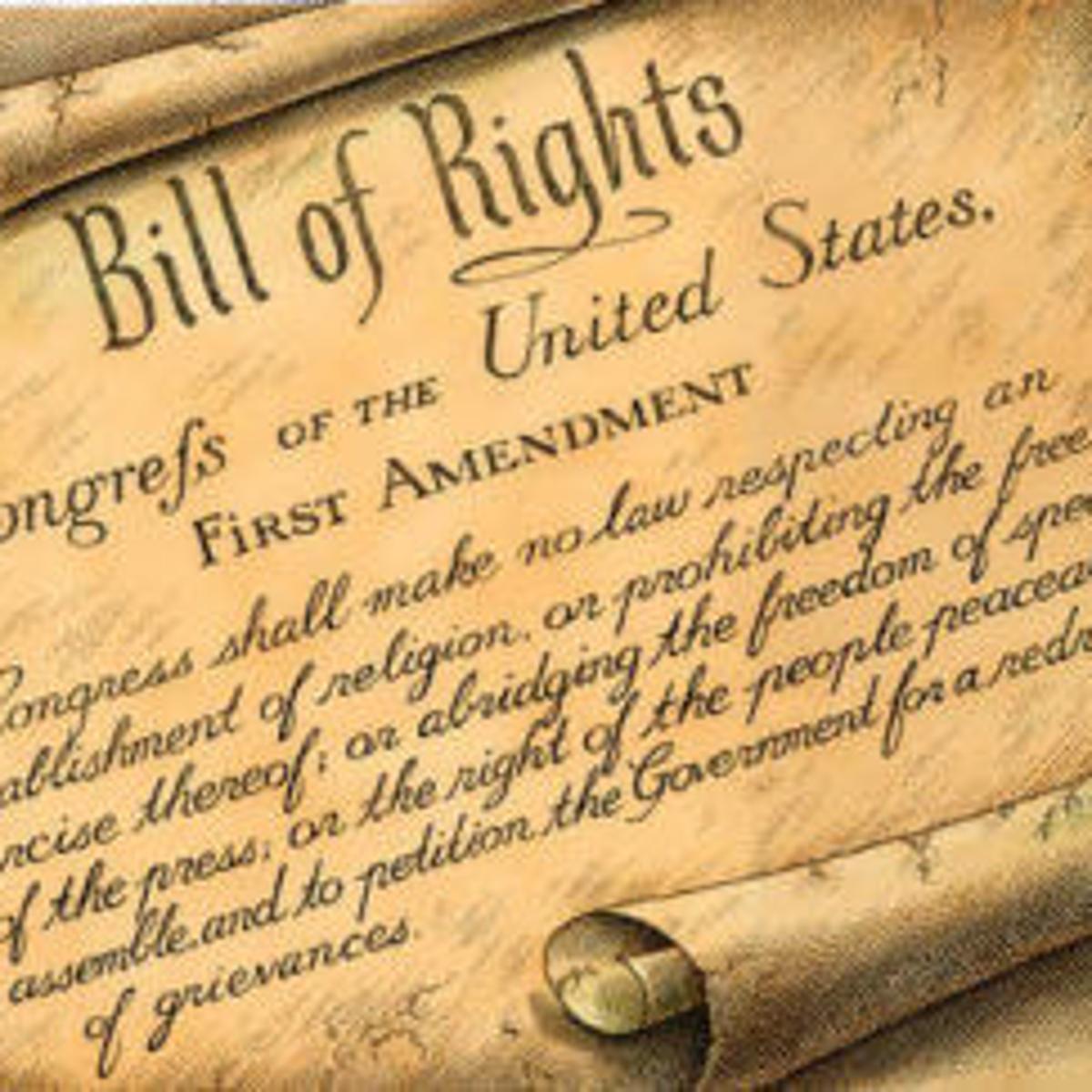

When I saw the headline “Trump Judge: Professor Has a First Amendment Right to Misgender a Trans Student in the Classroom” on Mark Joseph Stern‘s latest for Slate, I was a wee bit skeptical. The inflammatory write-up did little to change that.
Public university professors have a constitutional right to intentionally misgender trans students in the classroom, a federal appeals court ruled on Friday in a perverse decision that wields the First Amendment as a weapon against LGBTQ students’ access to equal treatment in education.
So, first off, deciding one citizen’s free speech rights outweighs another’s right to be treated with common decency is not “wield[ing] the First Amendment as a weapon” but rather the sort of balancing courts exist to perform.
The ruling in Meriwether v. Hartop comes as no surprise: It was heard by a panel of the 6th U.S. Circuit Court of Appeals made up of two Donald Trump nominees, Amul Thapar and Joan Larsen, plus a George W. Bush nominee, David McKeague. Trump’s judges were selected, in part, to curtail LGBTQ equality by legalizing discrimination against gender minorities in the name of free speech and religious liberty. Thapar, a Mitch McConnell protege, signaled his enthusiastic support for this agenda during oral arguments when he compared a policy requiring professors to use students’ preferred pronouns to a hypothetical rule compelling a Jewish professor to call a student “my Fuhrer.”
I think the analogy is poor but, as noted this morning, starting from a point of agreement is a common line and often productive form of inquiry. He wasn’t signaling that he personally believes the two to be the same but rather seeing if the attorney agreed that there was a limit to what the university could compel a professor to do to comply with a student’s preferred address.
The plaintiff, Nicholas Meriwether, is a philosophy professor at Shawnee State University in Ohio. In 2016, the school implemented a new policy requiring professors to use students’ preferred pronouns; Meriwether objected, citing his refusal to “recognize transgenderism.” Two years later, he misgendered a trans woman during class—inadvertently, he claimed, asserting that “no one would have assumed” she “was female.” The student, Alena Bruening, later “demanded” that he refer to her as a woman. When Meriwether refused, Bruening responded: “Then I guess this means I can call you a cunt.”
Meriwether reported the incident, and his dean sought a compromise: eliminate all gendered language from the classroom. He rejected this solution. Instead, he chose to call all other students “Mr.” or “Ms.” while referring to Bruening by her last name only. Bruening complained, and the dean asked him to recognize her as a woman. Meriwether said he might comply if he could add a disclaimer in his syllabus stating that he used preferred pronouns “under compulsion” and describing his personal objections to transgender identity. The dean rejected his terms, so Meriwether continued to call Bruening by her last name while addressing all other students in gendered language. The university launched a Title IX investigation, which found that Meriwether had violated the school’s nondiscrimination policy. The investigation concluded with “a written warning” placed in Meriwether’s file.
Presuming this is a fair summary of the facts, I would conclude Meriwether to be a bigoted asshole. Further, given that the school made its policy, made on entirely firm anti-discrimination grounds, clear, it strikes me as perfectly reasonable to punish Meriwether for being an asshole in this particular manner, given the trauma it inflicted on Bruening and the bizarre effect could reasonably be anticipated to have had on the overall atmosphere of the classroom.
Aided by the anti-LGBTQ legal organization Alliance Defending Freedom—which has also tried to disqualify a judge because he would not allow its lawyers to misgender trans students in another case—Meriwether sued.
So, Meriwether is an asshole. But the fact that his legal representatives have taken other cases of this sort and, indeed, are part of an organization that supports “traditional Christian values” is a distraction. It’s not unusual to seek out lawyers who are sympathetic to your cause and have experience in similar cases.
He alleged a violation of rights to free speech and free exercise under the First Amendment. A federal judge tossed his suit, but Thapar revived it on Friday. He insisted that Meriwether’s refusal to use trans students’ preferred pronouns qualifies for constitutional protection because it involves “a hotly contested matter of public concern.”
“The university,” Thapar wrote in the court’s unanimous decision, “wants its professors to use pronouns to communicate a message: People can have a gender identity inconsistent with their sex at birth. But Meriwether does not agree with that message, and he does not want to communicate it to his students. … Through his continued refusal to address Doe as a woman, he advanced a viewpoint on gender identity.”
This is, for example, the rationale behind why the state can’t require students to recite the Pledge of Allegiance. While I think it a bit of a stretch, the school—a public one, at that—is essentially requiring him to endorse a viewpoint. Now, I think that the interest in doing so here—creating a climate of inclusion and tolerance—is large enough to outweigh this. Especially since Meriwether had the option of not using gendered terminology at all (although, as we’ll get back to later, it’s more challenging than one might think) and he was just insisting on being a jerk about it.
With this framing, Thapar transformed Meriwether’s violation of a nondiscrimination policy into political speech at the heart of the First Amendment. The “point of his speech,” Thapar wrote, “was to convey a message”—that Bruening is not a woman—and “his mode of address was the message.” Reading this opinion, which depicts Meriwether as a persecuted folk hero, it is easy to forget what the professor actually sought to do: use his position of authority to out Bruening as transgender in front of her classmates, then continually degrade her by denying her identity for an entire semester.
Meriweather didn’t have secret insider knowledge of Bruening’s status. Presumably, her state of transition was such that she presented as male to his eyes and, presumably, also to theirs. He wasn’t “outing” her; he was being an asshole in ostracizing her.
Thapar then went further: Meriwether, he wrote, had “plausibly alleged” a case of religious discrimination in violation of free exercise. This conclusion rests on a handful of comments made by various university officials that, according to Thapar, reflect “religious hostility.” One department chair told him that religion “oppresses students”; a provost laughed “at some point” during a meeting with Meriweather, which he took as mockery of his beliefs. And the school’s director of labor relations compared Meriweather’s views to “religiously motivated racism or sexism.” In Thapar’s view, these statements lead to an “inference of religious hostility.” If that is true, then the Supreme Court was also guilty of “religious hostility” when it compared anti-gay discrimination to race discrimination three years ago.
Quite a number of Supreme Court cases have used this basis as well, so Thapar is on firm ground. If public institutions are going to transgress religious expression, they really need to do it in a way that appears purely motivated by secular interest, without conveying contempt for the religious views of those being suppressed. Again: I think Meriwether was absolutely wrong here and the school’s interests in promoting an atmosphere of inclusion, tolerance, and safety outweigh his right to be a bigot in the classroom. (To use Thapar’s technique against him, would it be okay if his preferred form of address for Black students were “nigger”?) But school officials didn’t help their case here.
What is especially bizarre about Thapar’s opinion is that it values anti-trans speech over other speech in the academic context: Meriwether’s defiance of the school’s nondiscrimination policy warrants utmost constitutional protections; meanwhile, university officials’ rebuttal of Meriwether’s views is not. Why? Because this expression allegedly reflects hostility toward religion (which is unacceptable even in its mildest form) rather than hostility toward transgender people (which is perfectly acceptable even when used to demean a specific student in class). Thapar’s First Amendment protects all anti-trans speech as a matter of public concern while condemning the slightest anti-religious speech as an impermissible assault on the Constitution itself.
Well . . . no. That’s just silly. The First Amendment (as incorporated against states via the Fourteenth Amendment) has many provisions, all of which work in Meriwether’s favor and against the state-run school. He has a right of free speech and a separate right to freely exercise his religion; in this case, those rights are complementary and reinforcing. The state, meanwhile, has no right of religious expression and is enjoined from discrimination on religious grounds. So, while they have considerable interest in preventing gender-based discrimination and promoting a healthy academic climate, they can’t do so in a way that even smacks of being prejudicial. That’s not new news.
Eugene Volokh summarizes the case, mainly by quoting Thapar’s actual opinion. In these excerpts, at least, Thapar seems much more reasonable than Stern makes him out to be.
For one thing, it turns out that the precedential case law is quite sympathetic to academic freedom, treating Meriwether differently than ordinary government workers. Thapar writes,
If professors lacked free-speech protections when teaching, a university would wield alarming power to compel ideological conformity. A university president could require a pacifist to declare that war is just, a civil rights icon to condemn the Freedom Riders, a believer to deny the existence of God, or a Soviet émigré to address his students as “comrades.” That cannot be. “If there is any fixed star in our constitutional constellation, it is that no official, high or petty, can prescribe” such orthodoxy….
Remember, too, that the university’s position on titles and pronouns goes both ways. By defendants’ logic, a university could likewise prohibit professors from addressing university students by their preferred gender pronouns—no matter the professors’ own views. And it could even impose such a restriction while denying professors the ability to explain to students why they were doing so. But that’s simply not the case. Without sufficient justification, the state cannot wield its authority to categorically silence dissenting viewpoints.
[T]he academic-freedom exception to Garcetti covers all classroom speech related to matters of public concern, whether that speech is germane to the contents of the lecture or not. The need for the free exchange of ideas in the college classroom is unlike that in other public workplace settings. And a professor’s in-class speech to his students is anything but speech by an ordinary government employee.
Indeed, in the college classroom there are three critical interests at stake (all supporting robust speech protection): (1) the students’ interest in receiving informed opinion, (2) the professor’s right to disseminate his own opinion, and (3) the public’s interest in exposing our future leaders to different viewpoints. Because the First Amendment “must always be applied ‘in light of the special characteristics of the … environment’ in the particular case,” public universities do not have a license to act as classroom thought police. They cannot force professors to avoid controversial viewpoints altogether in deference to a state-mandated orthodoxy. Otherwise, our public universities could transform the next generation of leaders into “closed-circuit recipients of only that which the State chooses to communicate.” Thus, “what constitutes a matter of public concern and what raises academic freedom concerns is of essentially the same character.”
Of course, some classroom speech falls outside the exception: A university might, for example, require teachers to call roll at the start of class, and that type of non-ideological ministerial task would not be protected by the First Amendment. Shawnee State says that the rule at issue is similarly ministerial.
But as we discuss below, titles and pronouns carry a message. The university recognizes that and wants its professors to use pronouns to communicate a message: People can have a gender identity inconsistent with their sex at birth. But Meriwether does not agree with that message, and he does not want to communicate it to his students. That’s not a matter of classroom management; that’s a matter of academic speech….
Further,
When speech relates “to any matter of political, social, or other concern to the community,” it addresses a matter of public concern. Thus, a teacher’s in-class speech about “race, gender, and power conflicts” addresses matters of public concern. A basketball coach using racial epithets to motivate his players does not. “The linchpin of the inquiry is, thus, for both public concern and academic freedom, the extent to which the speech advances an idea transcending personal interest or opinion which impacts our social and/or political lives.”
Meriwether did just that in refusing to use gender-identity-based pronouns. And the “point of his speech” (or his refusal to speak in a particular manner) was to convey a message. Taken in context, his speech “concerns a struggle over the social control of language in a crucial debate about the nature and foundation, or indeed real existence, of the sexes. That is, his mode of address was the message. It reflected his conviction that one’s sex cannot be changed, a topic which has been in the news on many occasions and “has become an issue of contentious political … debate.” …
Never before have titles and pronouns been scrutinized as closely as they are today for their power to validate—or invalidate—someone’s perceived sex or gender identity. Meriwether took a side in that debate. Through his continued refusal to address Doe as a woman, he advanced a viewpoint on gender identity. Meriwether’s speech manifested his belief that “sex is fixed in each person from the moment of conception, and that it cannot be changed, regardless of an individual’s feelings or desires.” The “focus,” “point,” “intent,” and “communicative purpose” of the speech in question was a matter of public concern.
And even the university appears to think this pronoun debate is a hot issue. Otherwise, why would it forbid Meriwether from explaining his “personal and religious beliefs about gender identity” in his syllabus? No one contests that what Meriwether proposed to put in his syllabus involved a matter of public concern….
So, I agree with all of that. While his faculty page doesn’t link his CV, Meriwether is a full professor of Philosophy. He is well qualified to hold a Socratic discussion over the ontological and epistemological issues surrounds gender identity and, if doing so makes some students uncomfortable, that’s too damn bad. Having one’s ideas challenged is an integral part of a college education. That’s doubly true for a philosophy class.
My really, really, really big caveat, though, is that there is a vast difference between discussing an abstract idea in the classroom in a controversial manner and singling out a particular, vulnerable student for abuse. There is all manner of case law out there, going back decades, on hostile workplaces. All of the related restrictions inherently conflict with free expression and, there, the courts have pretty consistently balanced in the direction of inclusion.
Here, I think the panel fell short:
On the other side of the ledger, Shawnee State argues that it has a compelling interest in stopping discrimination against transgender students. It relies on EEOC v. R.G. & G.R. Harris Funeral Homes, Inc. (6th Cir. 2018) in support of this proposition. But Harris does not resolve this case. There, a panel of our court held that an employer violates Title VII when it takes an adverse employment action based on an employee’s transgender status.
The panel did not hold—and indeed, consistent with the First Amendment, could not have held—that the government always has a compelling interest in regulating employees’ speech on matters of public concern. Doing so would reduce Pickering to a shell. And it would allow universities to discipline professors, students, and staff any time their speech might cause offense. That is not the law. See Street v. New York (1969) (“[T]he public expression of ideas may not be prohibited merely because the ideas are themselves offensive to some of their hearers.”). Purportedly neutral non-discrimination policies cannot be used to transform institutions of higher learning into “enclaves of totalitarianism.”
Turning to the facts, the university’s interest in punishing Meriwether’s speech is comparatively weak. When the university demanded that Meriwether refer to Doe using female pronouns, Meriwether proposed a compromise: He would call on Doe using Doe’s last name alone. That seemed like a win-win. Meriwether would not have to violate his religious beliefs, and Doe would not be referred to using pronouns Doe finds offensive. Thus, on the allegations in this complaint, it is hard to see how this would have “create[d] a hostile learning environment that ultimately thwarts the academic process.”
It is telling that Dean Milliken at first approved this proposal. And when Meriwether employed this accommodation throughout the semester, Doe was an active participant in class and ultimately received a high grade.
As we stated in Hardy, “a school’s interest in limiting a teacher’s speech is not great when those public statements ‘are neither shown nor can be presumed to have in any way either impeded the teacher’s proper performance of his daily duties in the classroom or to have interfered with the regular operation of the schools generally.’” The mere “fear or apprehension of disturbance is not enough to overcome the right to freedom of expression.” At this stage of the litigation, there is no suggestion that Meriwether’s speech inhibited his duties in the classroom, hampered the operation of the school, or denied Doe any educational benefits. Without such a showing, the school’s actions “mandate[] orthodoxy, not anti-discrimination,” and ignore the fact that “[t]olerance is a two-way street.” Thus, the Pickering balance strongly favors Meriwether.
Finally, Shawnee State and the intervenors argue that Title IX compels a contrary result. We disagree. Title IX prohibits “discrimination under any education program or activity” based on sex. The requirement “that the discrimination occur ‘under any education program or activity’ suggests that the behavior [must] be serious enough to have the systemic effect of denying the victim equal access to an educational program or activity.”
But Meriwether’s decision not to refer to Doe using feminine pronouns did not have any such effect. As we have already explained, there is no indication at this stage of the litigation that Meriwether’s speech inhibited Doe’s education or ability to succeed in the classroom. Bauer even admitted that Meriwether’s conduct “was not so severe and pervasive that it created a hostile educational environment.” Thus, Shawnee State’s purported interest in complying with Title IX is not implicated by Meriwether’s decision to refer to Doe by name rather than Doe’s preferred pronouns. [emphases mine – jhj]
That strikes me as weak tea. It was perfectly reasonable for the school administration to think the misgendering created a hostile environment. Do they really have to wait until after the fact to make a damage assessment? At which point, if there is damage, they’ve exposed the school to an expensive lawsuit? That’s absurd.
Still, Thapar makes a perfectly reasonable point:
[T]he university argues that Meriwether simply could have complied with the alternative it offered him: Don’t use any pronouns or sex-based terms at all. This offer, the university says, would not violate Meriwether’s religious beliefs. But such an offer has two problems. First, it would prohibit Meriwether from speaking in accordance with his belief that sex and gender are conclusively linked. And second, such a system would be impossible to comply with, especially in a class heavy on discussion and debate. No “Mr.” or “Ms.” No “yes sir” or “no ma’am.” No “he said” or “she said.” And when Meriwether slipped up, which he inevitably would (especially after using these titles for twenty-five years), he could face discipline. Our rights do not hinge on such a precarious balance.
In my first year or so teaching college, I did the “Mr.” and “Ms.” thing because it had been the norm when I was an undergraduate and for time immemorial before that. It’s one of the things that distinguished the university and high school experience. I soon decided that it was simply stilted in our less formal age (and this would have been more than twenty years ago). Still, it’s true that, if that was Meriwether’s longstanding habit, he would almost surely have slipped up at some point.
Volokh is uncharacteristically stingy with his own opinion in the matter, simply summarizing the likely impacts:
1. The case provides further support for the view that the First Amendment potentially protects public university professors’ teaching decisions (at least in some situations).
2. Under the court’s reasoning, the First Amendment would even more clearly protect against liability imposed by the government as sovereign (e.g., through the civil liability system or through administrative fines)—for instance, in the New York City rules I discussed here—rather than just as employer.
3. Much of the language in the opinion will also be used to support other kinds of academic freedom claims, for instance based on faculty research, faculty outside writing (from Tweets to blog posts to op-eds), and university student speech.
4. But whether a university may forbid faculty members from referring to students using the pronoun that the student rejects remains an open question. This case only deals with faculty members declining to use the pronoun the student prefers, and using the student’s name instead.
To the extent this case is precedential, 4 would seem to be an obvious No.
The third point, though, is most interesting. There have been instances (although only a handful that I’m aware of) of professors being fired or forced to resign for inflammatory social media posts. If this ruling stands up, I don’t see how that continues to be the case. Under my—admittedly non-expert—understanding, any public sign of racial or gender-based bigotry could be used as evidence for a hostile climate. And it’s not unreasonable. If a Black student reads tweets from a professor professing sympathy with the Proud Boys or the Ku Klux Klan, they will surely believe that professor will treat them unfairly. But it’s quite possible that this is simply protected speech.








