
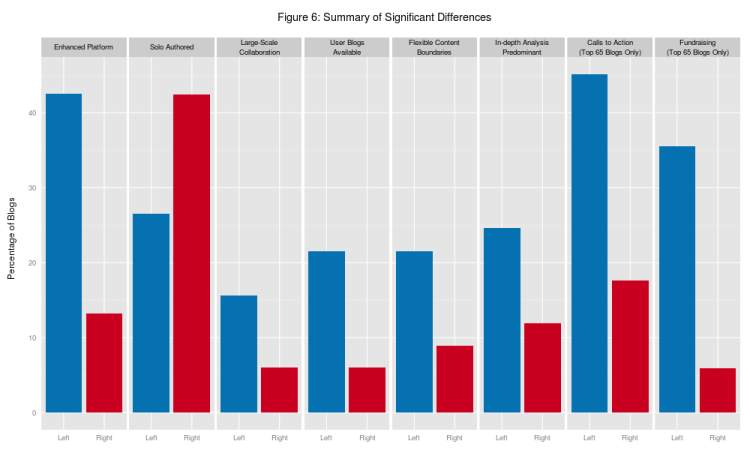
It has long been an article of faith that — in terms of authorship, comment policy, other user interaction, and linking policies — Left-leaning bloggers are more communitarian and Right-leaning bloggers more individualistic. At the same time, however, several studies have found that neither side does a very good job of linking to and discussing arguments from the opposite side of the blogosphere.
Yochai Benkler, Aaron Shaw and Victoria Stodden have re-examined these conclusions using a broader methodology that looks beyond URLs:
Based on qualitative coding of the top 155 political blogs, our results reveal significant cross-ideological variations along several important dimensions. Notably, we find evidence of an association between ideological affiliation and the technologies, institutions, and practices of participation across political blogs. Sites on the left adopt more participatory technical platforms; are comprised of significantly fewer sole-authored sites; include user blogs; maintain more fluid boundaries between secondary and primary content; include longer narrative and discussion posts; and (among the top half of the blogs in our sample) more often use blogs as platforms for mobilization as well as discursive production.
Our findings speak to two major theoretical debates on the political effects of the Internet and networked discourse. First, the variations we observe between the left and right wings of the U.S. political blogosphere provide insights into how varied patterns of technological adoption and use within a single society may produce distinct effects on democracy and the public sphere.
In terms of “participatory technical platforms,” they’re talking about the use of Scoop and other diary-based platforms that allow dozens or even hundreds of users to create their own subblogs, often with a chance of being bumped to the main page by a group of editors, and commenting systems like Disqus that are hosted off-site and allow integration with other social media sites, sharing with the commenter’s own community, and so forth.
Conservatives tend to be less likely to experiment with such models because they necessarily mean giving up control. I’m intrigued with the cross-discussion and traffic-generating potential of hosting dozens of OTB Diaries, for example, but am uncomfortable with having the commentary on said sub-sites associated with my name.
I’m more likely to experiment with something like Disqus — which my friend Steven Taylor (interestingly, included in the study above as a Center blog while OTB was included on the Right) is doing right now. I am, however, a bit leery of having an outside entity control my content and being at their mercy.
In both cases, then, I’m conforming to type.
Secondly, our study suggests that the prevailing techniques of domain-based link analysis used to study the political blogosphere to date may have fundamental limitations. The fact that we find evidence of significant cross-ideological variation when we compare intra-domain attributes of political blogs demonstrates that link analysis studies have obscured both the diversity of participatory affordances online as well as the primary mechanisms by which the networked public sphere alters democratic participation relative to the mass mediated public sphere.
Here, they’re talking about the fact that not all sites are really one site. They give the example of Glenn Reynolds’ InstaPundit vice Markos Moulitsas Zúniga’s Daily Kos. The former is a single site run by a single individual. The latter, by contrast, is really hundreds upon hundreds of sub-sites under the rubric of one brand, including one site that’s a major standalone blog in its own right. The authors are right that treating them identically is problematic.
Aside from RedState, which was specifically conceived as an answer to Daily Kos, and, recently, Hot Air (with its Green Room), I can’t off the top of my head think of significant community blogs on the right. I suppose Town Hall qualifies as do the suite of blogs under the National Review masthead, but they’re both corporate creations rather than grassroots blogs of the sort that Talking Points Memo, FireDogLake, and a plethora of others represent.









