
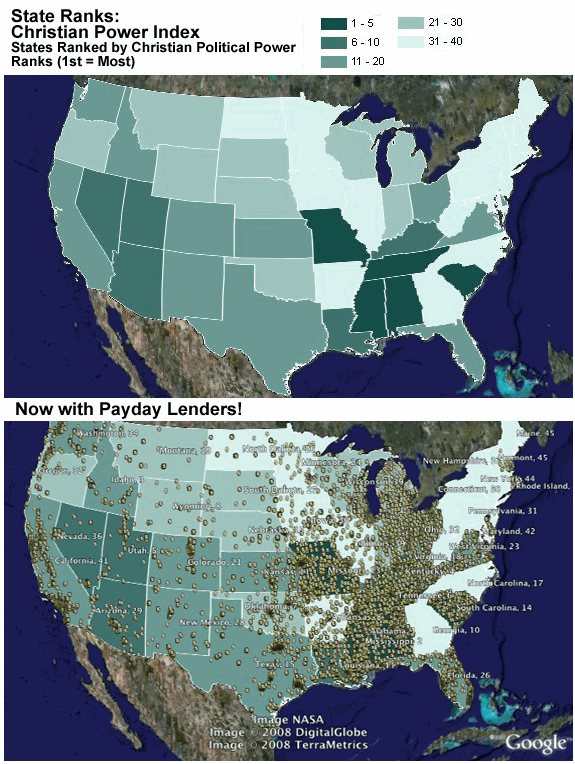
 A study (or, rather, a report on said study) by two law professors on the relationship between the availability of high-interest payday loans and representation by Christian conservative legislators is generating some blogospheric commentary.
The study’s abstract:
The culture war has become a national moniker describing a variety of policy debates between social conservatives and secular liberal Americans. Hotly contested battle grounds in this metaphorical war have included abortion policy, affirmative action, the right to bear arms, and gay marriage. Frequently these debates have divided secular Americans from people of faith. This article explores this cultural divide in the context of consumer financial services. In the past fifteen to twenty years America has witnessed a stunning transformation in financial services offered to lower and lower-middle classes. A new breed of fringe creditors charging prices far in excess of the old mafia loan sharking syndicates have spread throughout much of the country. The archetype of fringe creditors commonly referred to as payday lenders, charges average simple nominal annual interest rates of around 450 percent. This Article presents empirical research based on the largest, most comprehensive database of payday loan locations yet created. Payday lender locations are compared to an index measuring the political power of conservative Christian Americans in all fifty states. We conclude that there is a strong correlation between the density of payday lending industry and the political power of conservative Christians, suggesting that conservative Christians have become a prime demographic target of payday lenders. These findings are further discussed in light of Biblical injunctions against usury.
HuffPo‘s Russell Shaw weighs in with “‘Usury Maps’ Show Hypocrisy of Many ‘Christian Conservative’ Pols.”
It seems as though the states with the weakest, or non-existent laws against the type of usury often offered by predatory payday loan lenders are also among the most traditionally- and let’s call a “spade a spade” Christian conservative/Mormon conservative, church attending, conservative-voting pious. In fact, if you look at these two maps, you will see a high degree of correlation between piety and states where payday loan usury is statutorily tolerated.
In my mind, when a family in an economic rough patch has to pay 500% interest on a payday loan, or gets foreclosed upon, that creates threats to marriage far, far more than any two guys getting hitched at the county courthouse does. In fact the latter presents no threat at all.
Why is this? Is it because so many conservative politicians are really more motivated by corporate donors than the Bible they profess adherence to?
FireDogLake‘s Marcy Wheeler piles on with “Time to Throw the Payday Moneylenders out of the Christian Conservative Temples.”
The people preying on the financial insecurity of working people are also some of the people bank-rolling the preachers who give Republicans moral cover for their immoral ways.
Unbossed‘s smintheus muses,
You’d have thought that usury would be little practiced in areas of the country where large numbers of conservative Christians go so far as to declare that the Bible is the received word of the Almighty, reflecting His will, His interests, and even His grammatical tendencies. But in fact the opposite is true. The worst and most shameless form of legalized usury, the payday lender, is most prevelant in the Bible belt and least common in the liberal Northeast.
It turns out, though, that the study demonstrates very little. Relying on simple correlation, it finds that there are a lot of payday loan facilities per capita in areas that are represented by legislators whose voting record shows them to be strong social conservatives. That’s it. Everything else is inference and snide suggestion.
Where are the control variables? I don’t know a lot about payday loans but I’m guessing they’re more popular with people living paycheck-to-paycheck than among the relatively affluent. But there are no controls for that — or anything else — to ensure that social conservatism isn’t spurious.
Using simple correlation as a means of analyzing complex social phenomena is, quite literally, a joke. Or, should I say, an endless series of them. Drowning deaths and ice cream sales. Ministers’ salaries and the price of vodka. The number of doctors, fire trucks, and cops and deaths by disease, property damage from fire, and crimes.
 Indeed, the study authors found that there was an incredible correlation between the recent rise of payday loan facilities and that of Starbucks Coffee franchises. They dismiss this by saying, “There is, of course, no relationship between the Starbucks and payday lending.” Yet they offer no more evidence that the correlation between legislative representation and payday lending is meaningful. Maybe people are spending too much on coffee and need to borrow some money?
Further, the authors didn’t even measure the actual issuance of payday loans or the amount of said loans — just the number of facilities offering them. And, while they insinuate that legislators are being silent on the issue because they’re getting massive campaign contributions from the industry, they provide no statistical data to back their argument.
It’s worth noting, by the way, that “Christian Right” here is not synonymous with “Republican.” Look at this chart from the study:

Twenty of the thirty representatives are Democrats while only ten are Republican.
A more useful column to look at on that table, though, is the second one: State. A whopping 23 of 30 are from Alabama, Mississippi, and South Carolina.
The distributions are somewhat different if one looks at U.S. House Districts rather than state legislature, with a more even distribution of Democrats and Republicans (17 and 13, respectively) and the inclusion of more states, with AL, MS, and SC dropping to only about half the distribution and Tennessee, Louisiana, and Missouri gaining more slots.
Again, though, I’d guess that poverty rather than religiosity is the more salient variable.
Here’s the other strange thing about the study: The tables all rank order localities by payday loan availability and then fit in the correlations with the voting records of its legislators. If the intent is to show that the latter is the dependent variable and the former independent, wouldn’t doing the reverse make more sense? For example, Georgia, one of the most socially conservative states in the country, outlaws payday lending. Yet that fact is almost hidden in the tables.
Now, none of this is to dismiss the initial premise of the study authors — that there are myriad biblical injuctions against usury and yet social conservatives seem less energized to make laws about this issue than, say, gambling, alcohol consumption, or homosexuality. But that’s a discussion that can be had without misleading statistical analyses.








