

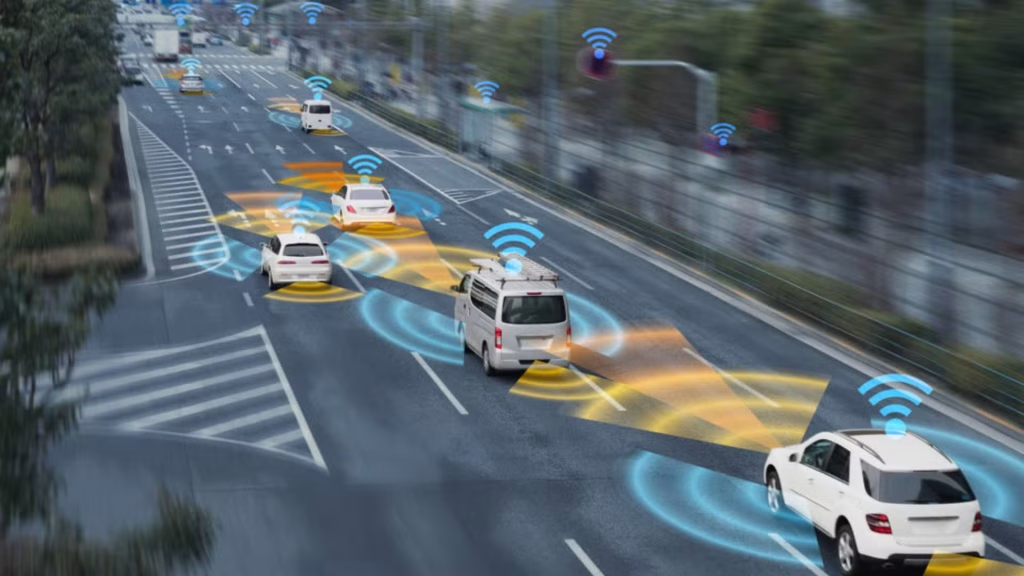
AP (“Cars collect troves of data about traffic and road hazards. Should they share it?“):
The secret to avoiding red lights during rush hour in Utah’s largest city might be as simple as following a bus.
Transportation officials have spent the past few years refining a system in which radio transmitters inside commuter buses talk directly to the traffic signals in the Salt Lake City area, requesting a few extra seconds of green when they approach.
Congestion on these so-called smart streets is already noticeably smoother, but it’s just a small preview of the high-tech upgrades that could be coming soon to roads across Utah and ultimately across the U.S.
Buoyed by a $20 million federal grant and an ambitious calling to “Connect the West,” the goal is to ensure every vehicle in Utah, as well as neighboring Colorado and Wyoming, can eventually communicate with one another and the roadside infrastructure about congestion, accidents, road hazards and weather conditions.
With that knowledge, drivers can instantly know they should take another route, bypassing the need for a human to manually send an alert to an electronic street sign or the mapping apps found on cellphones.
“A vehicle can tell us a lot about what’s going on in the roadway,” said Blaine Leonard, a transportation technology engineer at the Utah Department of Transportation. “Maybe it braked really hard, or the windshield wipers are on, or the wheels are slipping. The car anonymously broadcasts to us that blip of data 10 times a second, giving us a constant stream of information.”
So far, so good.
I have, for quite some time now, routinely used various mapping apps even for routes I know well—including if not especially my daily commute—in order to be alerted to traffic conditions and possible route alterations. Increasing the amount of data collected to that end is an unalloyed good.
A 2016 analysis by the National Highway Traffic Safety Administration concluded V2X could help. Implementing just two of the earliest vehicle-to-everything applications nationwide would prevent 439,000 to 615,000 crashes and save 987 to 1,366 lives, its research found.
Dan Langenkamp has been lobbying for road safety improvements since his wife Sarah Langenkamp, a U.S. diplomat, was killed by a truck while biking in Maryland in 2022. Joining officials at the news conference announcing the vehicle-to-everything blueprint, Langenkamp urged governments across the U.S. to roll out the technology as widely and quickly as possible.
“How can we as government officials, as manufacturers, and just as Americans not push this technology forward as fast as we possibly can, knowing that we have the power to rescue ourselves from this disaster, this crisis on our roads,” he said.
Again, this makes sense. The data is being collected; it may as well be put to good use.
Who it’s shared with and for what purposes, obviously, is the rub.
Most of the public resistance has been about privacy. Although the V2X rollout plan commits to safeguarding personal information, some privacy advocates remain skeptical.
Critics say that while the system may not track specific vehicles, it can compile enough identifying characteristics — even something as seemingly innocuous as tire pressure levels — that it wouldn’t take too much work to figure out who is behind the wheel and where they are going.
“Once you get enough unique information, you can reasonably say the car that drives down this street at this time that has this particular weight class probably belongs to the mayor,” said Cliff Braun, associate director of technology, policy and research for the Electronic Frontier Foundation, which advocates for digital privacy.
I’m honestly more concerned about this information being routinely fed to law enforcement, insurance companies, and others, which seems a more likely target for privacy concerns than one-off tracking of the mayor’s, much less my, vehicle. Indeed, some insurance companies already encourage customers to use automatic vehicle monitoring technology—ostensibly, to get better rates. It would certainly be a massive revenue stream for police departments to be able to automatically ticket any vehicle for any moving violation—which the driver would be unable to defend against since the notification would likely happen well after the event.
The federal blueprint says the nation’s top 75 metropolitan areas should aspire to have at least 25% of their signalized intersections equipped with the technology by 2028, along with higher milestones in subsequent years. With its fast start, the Salt Lake City area already has surpassed 20%.
Of course, upgrading the signals is the relatively easy part. The most important data comes from the cars themselves. While most new ones have connected features, they don’t all work the same way.
Before embarking on the “Connect the West” plan, Utah officials tested what they call the nation’s first radio-based, connected vehicle technology, using only the data supplied by fleet vehicles such as buses and snow plows. One early pilot program upgraded the bus route on a busy stretch of Redwood Road, and it isn’t just the bus riders who have noticed a difference.
“Whatever they’re doing is working,” said Jenny Duenas, assistant director of nearby Panda Child Care, where 80 children between 6 weeks and 12 years old are enrolled. “We haven’t seen traffic for a while. We have to transport our kiddos out of here, so when it’s a lot freer, it’s a lot easier to get out of the daycare.”
That simply changing the behavior of fleet vehicles would have that much impact—in Utah, no less—is counterintuitive.
Casey Brock, bus communications supervisor for the Utah Transit Authority, said most of the changes might not be noticeable to drivers. However, even shaving a few seconds off a bus route can dramatically reduce congestion while improving safety, he said.
“From a commuter standpoint it may be, ‘Oh, I had a good traffic day,’” Brock said. “They don’t have to know all the mechanisms going on behind the scenes.”
Traffic congestion is a phenomenon that I still don’t pretend to understand. Much of it is attributable to “phantom traffic jams”:
And human nature being what it is, no amount of tips about not weaving in and out of traffic, not tailgating, and the like is going to help. There are just too many moving parts. So, automating signals and the like to be attuned to real-time traffic patterns would help tremendously.
Cavnue, a Washington, D.C.-based subsidiary of Alphabet’s Sidewalk Infrastructure partners, funded the Michigan project and was awarded a contract to develop the one in Texas. The company has set a goal of becoming an industry leader in smart roads technology.
Chris Armstrong, Cavnue’s vice president of product, calls V2X “a digital seatbelt for the car” but says it only works if cars and roadside infrastructure can communicate seamlessly with one another.
“Instead of speaking 50 different languages, overnight we’d like to all speak the same language,” he said.
I haven’t the foggiest what all of this costs. But it’s the type of infrastructure investment that makes sense to federalize for standardization and economy of scale.








