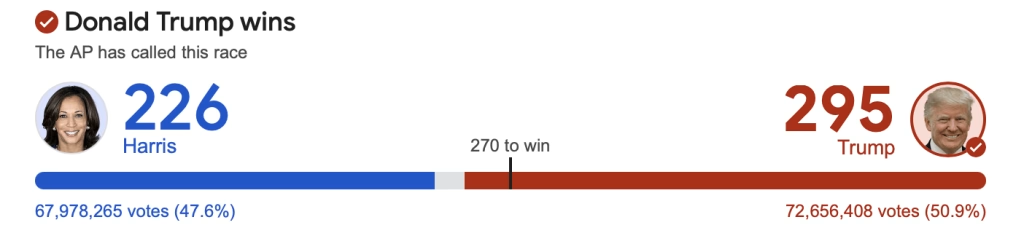
First, an obseravtion. There is currently a 3.3% gap between the candidates in the popular vote, so let’s not forget that he didn’t win an overwhelming amount of the vote. Let’s not pretend like he won an actual landslide. But the fact that he won a majority is a troubling comment on the American electorate and American society in general.
What explains this? We won’t have a firm answer for some time as the data are incomplete (and even then there will be debate as to exact answers).
Here are my initial thoughts.
A Binary Choice. He was going to win most of those votes no matter what. Most people vote based on party ID. This is just true. They rationalize their choice or they really don’t think about it as much as anyone who is reading these words. Moreover, getting them to defect to the other teams is plain hard.
The Economy. I will admit that earlier in the year when I was marveling at the fact the polls had Biden and Trump tied, if not Trump ahead, I could not fully wrap my head around it and regular commenter Andy kept pointing out that Biden was unpopular. And, of course, a major reason that Biden was unpopular was inflation. I have a family member (who is anti-Trump) who works in a blue-collar industry. A major topic of conversation from him and his colleagues continues to be the price of groceries. People don’t want to hear about macroeconomics and global effects when they look at their receipts at the grocery store. Biden, and by extension the incumbent party, was unpopular because of that. No amount of correctly noting that the pandemic was responsible for the economy, that gas prices are based on a global market, and that the US did far better on inflation and other indicators than did similar economies.
None of that matters.
We live in a world (and always have) wherein things like this are actually effective:

I am reminded of an exchange I had with a co-worker in 2018 about Trump. She stated that all she cared about was the gas was cheaper than it had been, so Trump was great! This was a person who worked with statistics and analytics. But she nonetheless reduced the presidency to gas prices (and, no doubt, this was fueled, no pun intended, by long-term partisan affiliation).
Change. The economy, plus long-term resentment over COVID restrictions, as well as other factors, have contributed to a global (not just US) political sentiment for change. There has been a clear anti-incumbent wave globally, and there has also been a surge of right-wing nationalism (see, e.g., Austria as a recent example).
I would note that if a segment of the population wants change, and there are only two viable parties, the incumbent party loses. People have nowhere else to go (or they stay home, as many millions did).
And if you combine a global nationalist movement with two parties, it stands to reason that one of those two parties would have the nationalists as part of their internal coalition. And that means the real risk that the nationalists will take over said party.
While, yes, I can conjure a fantasy in which a robust Democratic primary would have produced a miracle opponent, the reality is that this was not going to happen. Indeed, it is likely such a candidate would have had to attack the Biden administration on inflation, which would have just contributed to the general belief that the Democrats were to blame. And if even Democrats are saying the Democrats are to blame, then why vote in another Democrat?
Who would have won this election on D side? Michelle Obama is the best I can conjure. And she would have faced many of the same headwinds that Harris faced.
This is Us. Yes, this election says something about America. But it isn’t new. Can I remind us all that despite our deeply engrained national mythology about democracy and freedom, we really only had full voting rights in the United States in 1965? And that we continue to have to fight over voting rights? Many Republican states were willing to purge potentially legal voters from the rolls because of fantasies about masses of noncitizens voting.
Indeed, I am currently reading a book, Freedom’s Dominion: A Saga of White Resistance to Federal Power, which clearly clarifies that often those calling for “freedom” are calling for the freedom to dominate others. While we have come a long way down the journey toward true freedom, I can’t help but see the freedom to dominate manifesting in things like Dobbs, anti-trans actions, threats for mass deportations, and a long list of other parts of the politics of the American right.
But, let me point out that the current difference between Harris and Trumos is roughly 3.3% of the vote. And let me also note that if Harris had won by 3.3% of the vote we wouldn’t think that the country was resoundlingly Democratic or that small “d” democracy and small “l” liberalism had vanquished the threat of reactionary nationalism.
There is clearly a significant strand of illiberalism in our politics, and it is going to get its chance in office. Don’t get me wrong: I am quite concerned about it. I can’t forget the fact that serious people who worked for Trump called him a fascist. I have not forgotten his ongoing rhetoric nor that of the people he will empower. I am profoundly disappointed by so many of my fellow Americans, including people very dear to me, who were willing to ignore/rationalize all of this and stick to their partisan preferences. I will say that hold in full disdain anyone who defends it directly.
Race. I think that when the data are analyzed we will find that race is a major variable in explaining the outcomes. Certainly, that would comport with the work Liliana Mason has done. And yes, Trump’s rhetoric about “losing our country” and his xenophobic fearmongering about the border resonates with a lot of people. And the people who fear their loss of power, or who fear migrant-fueled crime don’t want to have nuanced conversations about the complexities of the border. They just want simplistic solutions. Just close it! As if the border is the garage door and Mom is worried about flies getting in.
And, as I feared when the debate about removing Biden was ongoing, Harris’ race and gender could be a problem. We don’t know yet what role that played, but I am betting it was worth some portion of that 3.3%.
Conclusions. I think that at the end of the day, the data will show that some combination of inflation and nationalism/racial resentment/nationalism will explain most of why Trump will be president again.
While, again, it is always possible to assert that a “better” candidate with “better” messaging would have won, the devil is in the details. A brutal primary would not have been good for the Democrats. I don’t, for a second, believe that some better-honed policy message would have worked.
Indeed, this election rather substantially reinforces my core view that candidates matter a whole lot less than the general public and the pundit class, in particular, think.
Trump was, objectively, a terrible candidate. The list of why is enormous. And yet, he won. People wanted change and returning the incumbent party to office is not change.
To be clear, I am not attempting to justify any vote for Trump, nor am I discounting the harm he is likely to inflict on the US and the world (that is not hyperbole).
Elections do, in fact, have consequences.