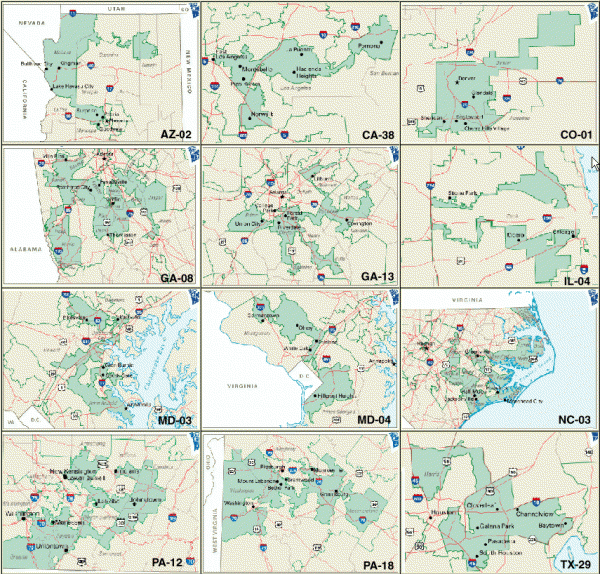

Undoubtedly one of the major themes of the upcoming book A Different Democracy, coauthored by our Outside the Beltway colleague Steven L. Taylor, is that many of the structural features of our system of government in the United States are the result of conscious choice rather than inevitability. As I regularly explain to the students who take my American government courses, we usually take for granted features of our political system and even assume they are either the one true way of doing things or the only way to do things, despite the fact we could choose very different approaches yet still accomplish our goal of having a representative national government.
A case in point is the oft-discussed issue of congressional district boundaries in the United States (and, to a lesser extent, the district boundaries in state and local representative bodies as well). As political scientists, we regularly see new proposals to somehow generate “ideal” districts that will somehow purge our system of the perceived evils of partisan or ethnic gerrymandering; recently, Vox.com discussed one of these approaches, advanced by an engineer and a mathematician (somewhat tellingly, these proposals rarely come from social scientists) which would replace the often-squiggly lines between districts with a bunch of polygons, presumably taking the politics out of redistricting much as one might like to take the pee out of a public swimming pool.
Political scientist John Sides pointed out at the time that there are plenty of good reasons why we might want our congressional districts to look, well, weird, rather than being the result of mathematical formulae:
[P]retty little districts could actually be pretty terrible. That is, they could be terrible at doing what districts are supposed to do: engender good representation.
What’s good representation? Here are some answers that people regularly defend:
- Good representation happens when representatives are beholden to specific geographical communities, who are believed to have common interests. This is a reason to draw districts that correspond to existing cities, towns, and the like.
- Good representation happens when the largest possible majority of people get to elect the representative of their choice. This is a reason to draw lopsided districts with large partisan majorities.
- Good representation happens when groups who have been historically excluded from the electoral process — like racial and ethnic minorities — get to elect the representative of their choices. This is a reason to draw majority-minority districts (like the snakey NC-12, the subject of Shaw v. Reno and subsequent Court cases).
- Good representation happens when a district is politically competitive, which means representatives work harder to represent “the people” because there is always a good chance they could be thrown out of office. This is a reason to draw districts with a partisan balance close to 50-50.
This is an area of politics where the United States is something of an outlier; in most other countries with district-based representation (in whole or in part), districts are at least nominally created in a non-partisan process with somewhat more emphasis on maintaining communities intact and less emphasis on having equally-populated districts (the latter a result of the Supreme Court’s ruling in a 1964 case known as Wesberry v. Sanders). However, even in those countries the process is fraught with politics; the most recent redistricting review in England notably collapsed after the current Coalition government disagreed over the revised boundaries as part of a broader spat over electoral reform. Closer to home, the recently-established independent redistricting commission in California has faced criticism regarding exactly how independent its decisions were of the state’s Democratic Party majority in the 2010 redistricting cycle; around the same time, Arizona Republicans attacked their state’s independent commission as well.
If we can’t get the politics out of redistricting, what can we do? Many of the objectives Sides suggests (the representation of minorities, the representation of geographic interests, and more competitive elections overall) can be accomplished by using at-large representation or multiple-member districts as part of a broader scheme of proportional representation. Although at the extremes proportional representation can lead to a proliferation of minor parties, as has been the case in the Netherlands and Israel, assuming we were to retain the constitutional requirement that districts be wholly within a state, the effective electoral threshold (essentially, the share of the vote a party would need to get at least one representative) in all but the four most populous states (California, Florida, New York, and Texas) would be over 5%, which is actually quite high by world standards.
Even a system with a mixture of district-based seats and a compensatory proportional tier (like the system used in Germany and Mexico, as well as in Scotland and Wales for their devolved lawmaking bodies, which are generally referred to in the political science literature as a “mixed-member proportional” system) would minimize the rewards to partisan gerrymandering, as virtually any partisan gains in the district seats from gerrymandering would be lost at the proportional level.
Of course, the one potential disadvantage—at least from the vantage points of the two major parties—of a move away from single-member districts with winner-takes-all elections would be some degree of erosion of the Republicans’ and Democrats’ duopoly in American politics; however, there are also plenty of other factors that help our two major parties retain power, and eliminating one of them would not necessarily displace the two dominant parties from their overwhelming supremacy within our system.