
 (I actually started this post as part of an extended example of my post Teaching Political Science and the Trump Administration, but it really was getting too long, so here we go…).
If we want to talk about an excellent example of policy that is, for me at least, impossible to teach/discuss in a detached way, it is the border wall. The reason is that the notion of a 30-foot high, 1954-mile long wall is, if one exams the topic in any detail, an absurd policy goal. It is absurd because the cost far outweighs the benefit, and, worse, it will not accomplish its policy goals. This is a recent example, insofar as I gave a talk this week to a student group entitled “Will Mexico Pay for the Border Wall.” Not to keep everyone in suspense, but the answer to the question is a bilingual one: “no.” Indeed, even the question, which derives from repeated promised by President Trump, is absurd on its face. There is absolutely no motivation (or ability) of the Mexican government to pay for a border wall. It is an utterly ridiculous promise that demonstrates an inherently flawed understanding of basic international relations.
But, like the complexity of health care, Trumps’ claims about border security do provide a pathway for teaching, although it is largely impossible to be objective about the policy itself–if, “objective” means acting like all policy options are equal or, at least, reasonable. To me, Trump’s border wall proposal is only marginally more reasonable than proposing “let’s just develop force field technology on the border” or “let’s dig a border trench.” There is a point at which it is not unreasonable to treat unreasonable policy proposals as unreasonable. And yes, a border wall is more feasible than a force field or a trench, but only barely. (If it makes anyone feel better, I have long had a similar problem about US drug war policy: an analysis of the cost/benefit suggests that it is a failed policy, and I do not pretend otherwise in class).
I can certainly note, and agree, that a 30-foot high, 1954-mile long border would lessen foot traffic across the border. My point is that it will not stop persons from entering the US undocumented, and it will most certainly not stop drug imports. It will decidedly not be worth the cost.
First, roughly half of persons without appropriate documents in the US are visa-overstayers. They entered legally. No wall, regardless of height or or length, will solve that issue. Such a situation will continue no matter whether there is a wall or not. Any real policy solution needs to demonstrate understanding of that fact.
Second, smuggling into the US will continue regardless of a wall. People can still go under the wall, for example (there have been discovered 183 tunnels under the border from 1990-2015). I would suspect if a wall were built, people would also find ways over and through as well. A wall would also just increase smuggling via legal crossings. Let’s not forget the coasts as well (the Texas coast, in particular, strikes me as a serious temptation for smugglers).
Third, the wall’s efficacy in regards to the drug trade (which the president has claimed would be part of its function) would be practically nil. Most drugs enter the US via legitimate routes or via routes that have nothing to do with walking across the Sonoran desert. While some drugs are walked across, it is far more efficient to smuggle them with legitimate products. The drugs are getting in, and a wall won’t stop them.
So, at a minimum, if a wall won’t stop drugs at all, and millions of the undocumented are visa over-stayers then these two factors alone raise the question of whether the border wall is worth the money (and all policy requires a cost/benefit calculation).
I would note, for example, that a lot of the Central Americans who cross purposefully go to legal crossing points to seek asylum. They are not going to be stopped by a wall, either. Since Central American migration is currently the main driver of border apprehensions, this pattern of behavior undercuts the wall proposal as well. It is not hyperbole to note that Mexican migrants frequently risk death crossing the Sonoran desert on foot for the privilege of getting a job cleaning bathrooms at a McDonald’s and Central Americans will undertake a ~3,000 mile journey to escape poverty and crime. Walls are unlikely to fully deter them.
So, even if one allows, as I do, that the wall will stop some people, it will not stop huge percentages of the policy problem it purports to solve. A border wall will not utterly seal the border from illegal crossings, nor will it end illegality via the border–so if anyone who supports the policy thinks that that will be outcome, they are simply mistaken. No policy will “seal the border” nor will the US government ever have 100% control of what happens along that vast a space.
Here are some numbers and images of relevance:
Let’s start with this graph, that Adam Isacson tweeted recently:

First, note that we are approaching two decades since the peak of illegal border crossing apprehensions. Also note the significant decline in Mexican nationals being caught and the increase in Central Americans. I would suggest that the decrease in Mexicans crossing is the result of a combination of factors, including improvements in the Mexican economy, the Great Recession (see 2008 onward on the chart), and improved security (including some increased pressure on employers due to the 1996 “Illegal Immigration Reform and Immigrant Responsibility Act”).
To quote a recent WaPo story on the subject:
Last year, the number of people arrested along the border with Mexico dropped to a 49-year low, and Trump has touted the decline as proof his border security strategies are working.
But illegal crossings have been falling for most of the past decade, and migration experts say tougher border security is only one of several factors. Birthrates in Mexico have plunged since the 1960s, leaving the country with far fewer unemployed young people, while the domestic labor demands of Mexican manufacturing have grown.
Today, the majority of unauthorized border crossers are from Central America, not Mexico, including many families and unaccompanied minors who turn themselves in to U.S. agents to request asylum, citing threats of chronic gang violence back home.
The increase in Central Americans is due to worsening conditions in El Salvador, Guatemala, and Honduras, much of which is linked to the drug war. As I wrote back in January:
Even the origins of one of the administration’s great boogeymen, the MS-13, has been aided by US policies (e.g., the drug war, as well as the deportation of arrested gang members back to El Salvadors in the 1990s and 2000s, which helped facilitate the transnational nature of the organization).
[…]
So, on the one hand, yes, MS-13 was a gang that grew out of Salvadoran refugee communities in Los Angeles in the 1980s (which fits the administration’s narrative about immigrants). But, why were they refugees in the first place? Partly because the US was helping fund a civil war in El Salvador (and it was also funding a counter-insurgency in Nicaragua and a drug war in the region, among other actions). From there, the drug market helped gang activity, and then the massive deportation of MS-13 members to the region helped further destabilize that region. Am I saying that the US is solely responsible? No. But, what I am saying is that uninformed, simple-minded dismissal of complicated circumstances as just the product of a place being a “shithole” is wrong and leads to terrible policy decisions, and ones that directly impact real human beings. There is also the inconvenient truth that not all Salvadoran migrants became part of MS-13 (see, e.g., the ~200,000 under TPS).
It would be nice if US policy about migrations patterns took some of this into consideration.
Some key numbers:
- $1.7 billion per day in cross-border commerce. Policies that slow cross-border trade costs real money to companies.
- Based on the 25 border crossings (out of 48 total) in the Department of Transportation database, I compiled the following numbers:
- 42,280,172 pedestrian crossings a year (or 115,836.09 per day).
- 142,961,770 personal vehicle passengers crossings per year (or 391,676.08 per day).
The notion that our border security is 100% efficient in stopping illegal crossing strains credulity. I did not compile bus traffic, nor trucks. All of this is to show that there is a lot of border activity going on a daily basis, a huge percentage of it being legal.
Note, too, that at the borders there are existing local ecosystems and shared metropolitan areas where people live on one side, but attend school or go to work on the other.
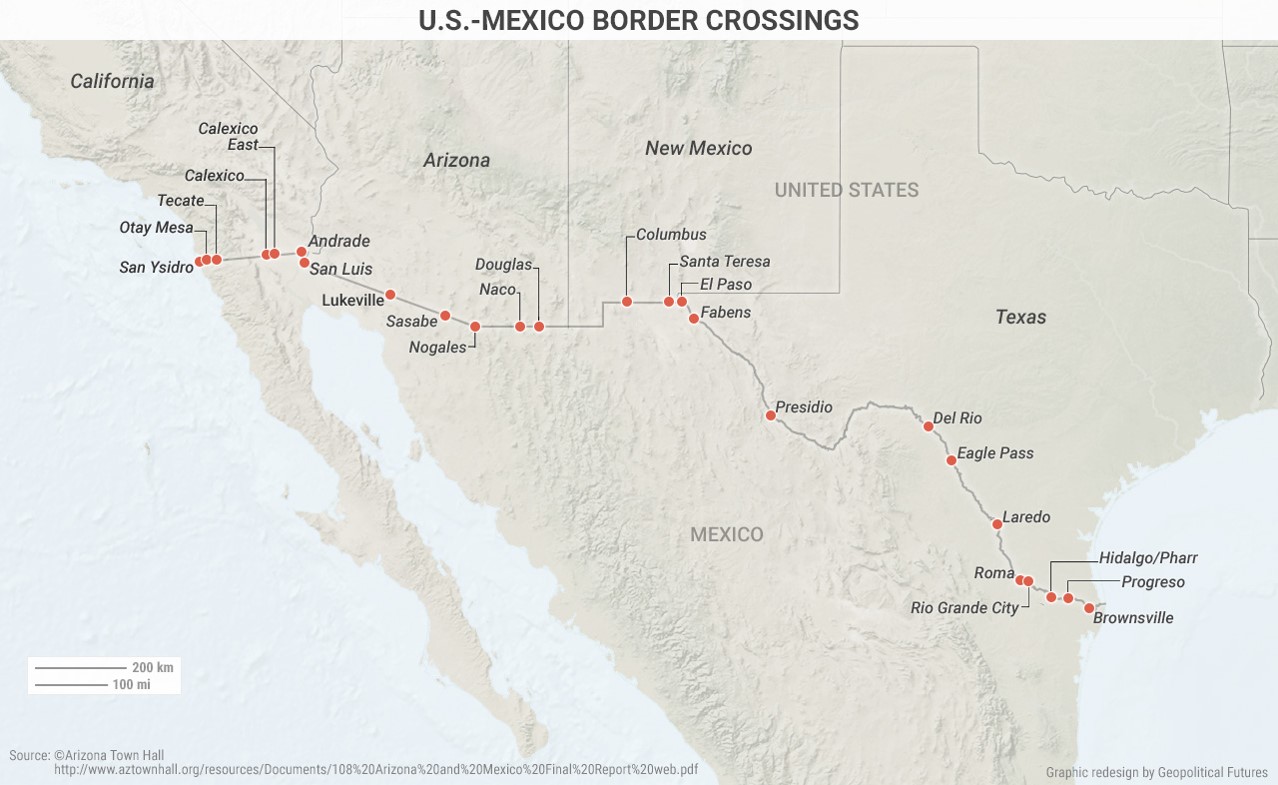
Note the paired cities on this map (and those are just the larger ones):

Tijuana, Mexico and San Ysidro, CA:

Some other numbers include ~650 miles of existing border barriers, of which 352 miles is pedestrian barrier, 299 miles is vehicle only barrier, and roughly 36 miles is double-fenced. USAT has a great inter-active feature on the border for those who are interested: We looked at every mile of the U.S.-Mexico border. Now you can, too – right here.
Here is a comparison of the current fencing and the proposal wall (via WaPo):

While I am sure it would be hard to get over the wall, I also have little doubt that a method to do so will be deployed.
In short: border security over this vast space is expensive and complicated, and just shouting about how Mexico is going to pay for it is silly. Worse: it is a policy “solution” that seems to have the 1990s in mind, and does not address the drug-trade, visa-overstayers, nor a myriad of other issues.
It is a bad policy proposal.









