So, here’s a question: would baseball, and America, be better off if Shohei Otani had stayed in Japan? I mean, isn’t he taking a job that an American could be doing? Indeed, about a quarter of MLB players were born outside the US. Will no one think of the jobs for real Americans?
Poor Ken Jennings had to wait for the Canadian who had the job before him to die before he got an opportunity to host Jeopardy!
And I am sure that the American spaceflight program would have eventually gotten its act together if Werner Von Braun had been denied a visa so that an American could have gotten that job.
Think about how many foreigners are taking acting, sports, teaching, and scientific jobs away from native born Americans! How many jobs have the Skarsgård family alone taken? Pedro Pascal stars in just about everything!
What is this silly rant about? Well, the Trump administration’s ongoing xenophobia.
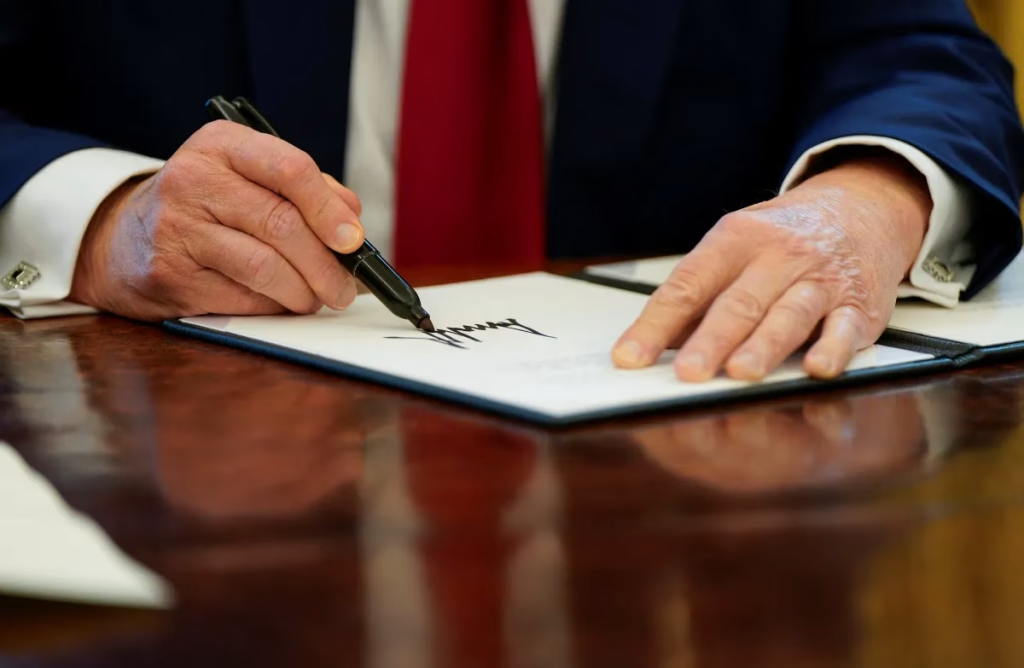
Here’s the latest from the AP: Trump signs proclamation adding $100K annual fee for H-1B visa applications.
President Donald Trump on Friday signed a proclamation that will require a $100,000 annual visa fee for highly-skilled foreign workers and rolled out a $1 million “gold card” visa as a pathway to U.S. citizenship for wealthy individuals, moves that face near-certain legal challenges amid widespread criticism he is sidestepping Congress.
If the moves survive legal muster, they will deliver staggering price increases. The visa fee for skilled workers would jump from $215.
Now, I think that the legal challenges will come, and quite frankly, this is surely Congress’s realm, but I am to the point that until SCOTUS rules, I am not convinced that the courts will stop Trump in any substantive way.
Doug Rand, a senior official at U.S. Citizenship and Immigration Services during the Biden administration, said the proposed fee increase was “ludicrously lawless.”
“This isn’t real policy — it’s fan service for immigration restrictionists,” Rand said. “Trump gets his headlines, and inflicts a jolt of panic, and doesn’t care whether this survives first contact with the courts.”
Hopefully so.
I have some direct experience in this area, as when I was a college dean, I was directly involved in the hiring process. One aspect of recruiting faculty is that there is a large number of foreign-born applicants in a given pool. In some fields (computer science comes to mind), the qualified applicants may all be foreign-born persons who need a visa to work in the United States. It was always a relief to find out if an obviously foreign-born applicant had a green card. It made hiring easier and less expensive.
(Side note: one of my first mini-crises as dean was heading into my first Fall semester and being told at the 11th hour that one of the chemistry lecturers still didn’t have their H-1B renewal and that if it didn’t come through, he wouldn’t be allowed to work. Luckily, we got the renewal in the nick of time, else there would have been some serious scrambling to cover a number of lectures and labs!)
And while, yes, STEM fields had a lot of foreign-born applicants, in my time there were applicants and hires in the social sciences who fell in the same category, in terms of visa needs.
One might respond to this by saying that the lack of native-born applicants makes the point of the nativists, i.e, that we aren’t training enough domestic folks to do these jobs. Even if one takes that point seriously, if school A needs a CS professor right now to help train domestic students who might one day pursue a doctorate in the field, then stopping school A from hiring a foreign-born professor when you have no native-borns in the pool kind of undercuts your goals.
While we can debate whether there aren’t enough domestic students in certain fields, simply blocking the ability of American institutions to hire foreign-born applicants won’t fix that problem.
Such myopia also ignores why it might be the case that relatively small, regional schools might find themselves with a number of foreign applicants. We are talking here about highly competitive fields. Computer Science, to pick the one that looms the largest in my mind, is a field in which there is a lot of draw from private industry and where pretty much every school in the country is recruiting.
Given that our university was in a small town of ~13k in a county of ~30k, about an hour from an unglamorous mid-sized city in a state that a lot of people look down on, recruiting faculty in highly competitive fields was never an easy task. As such, the fact that we were able to provide a visa pathway to non-citizens meant that we got highly qualified applicants who might otherwise not have been interested in living in rural Alabama.
A small, relatively unknown school will get a disproportionate number of often high-quality foreign applicants because of the visa. Let’s say I just earned a Ph.D. in CS from a good school, and I want to work in the US. My willingness to work even for regional schools in places I have never heard of is even higher than the normal Ph.D.’s willingness to do so (which is already high, I would note, just less so in specialized STEM fields that also have industry jobs available).
The ability to use H-1B visas to hire faculty who are neither citizens nor green card holders is a massive boon to such schools (and to universities in general, as well as industry). Taking those people will not mean that the native-born will get them. It will mean that the positions won’t be filled.
Universities like the one I worked for are not going to fork over $100k as an additional fee to hire an Assistant Professor (and the applicants aren’t going to be able to pay that fee–and if they can, they are unlikely to be applying to Directional Regional U).
I am focusing here on something I know quite well, but the logic applies to other areas and industries. Making it harder to hire the foreign-born is a self-own that makes it harder for America, writ large, to attract talent.
One of the stunningly stupid things about the MAGA approach to these things is that one of the ways that America has been great is that it attracts talent from all over the world.
If we are going to talk pure power and greatness in that sense, then surely we should want as much of the world’s talent here on our shores, working with our economy, not being shut out.
But, of course, if MAGA is really MAWA (make America whiter again), then it all makes sense.
Back to baseball, a truly great America is the Big Leagues in every area: sports, entertainment, science, industry, and education. Bringing the best of the best to the table should be the goal, but clearly, it is not for this administration.
In case anyone is missing my point: I am aware that an MLB team will gladly pay the fee to import the next Otani. What I am noting are high-profile examples where it should be obvious that attracting talent from around the world is a net good. If it is true about baseball, which it is, it is true about industry and higher ed.
This is just an example of ideological preferences leading to shooting ourselves in the collective foot.