
Sparked by the Ralph Northam controversy, USA Today‘s Brett Murphy conducted a wide-ranging survey of yearbooks and discovered that racism abounded–and not just in the Old South. Shocking, I know.
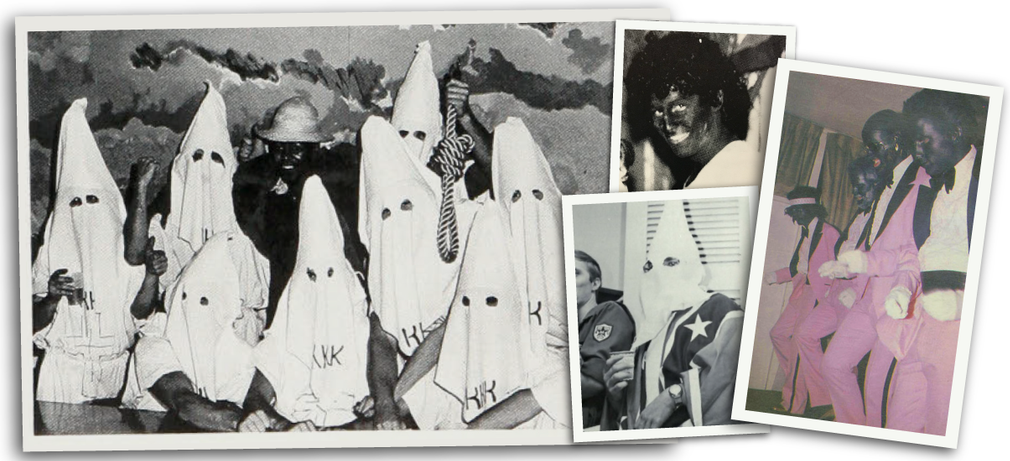
“Blackface, KKK hoods and mock lynchings: Review of 900 yearbooks finds blatant racism”
[…]
Throughout the 1970s and 1980s, a stunning number of colleges and university yearbooks published images of blatant racism on campus, the USA TODAY Network found in a review of 900 publications at 120 schools across the country.
At Cornell University in New York, three fraternity members are listed in the 1980 yearbook as “Ku,” “Klux” and “Klan.” For their 1971 yearbook picture, a dozen University of Virginia fraternity members, some armed, wore dark cloaks and hoods while peering up at a lynched mannequin in blackface. In one of the most striking images – from the 1981 University of Illinois at Urbana-Champaign yearbook – a black man is smiling and holding a beer while posing with three people in full KKK regalia.
The yearbook photos reflect campus communities that tolerated open displays of racism at the parties they attended, parades they marched in and posters they hung – despite the hard-learned lessons of the civil rights movement they grew up with. In almost every picture, people appear happy.
Minority students from that era say the comfort with public behavior that would likely meet swift condemnation today further marginalized minorities on campus. And the choice to publish the images for posterity cut even deeper.
[…]
The volume of shocking imagery found in the examination, which was not comprehensive, suggests that there are likely more yearbooks that recorded racism on campuses nationwide – and countless more acts never captured on camera or submitted for publication.
The review also gives new perspective to an array of cases that have emerged since reports showed that Virginia Gov. Ralph Northam’s 1984 medical school yearbook page features a person wearing blackface and another in a KKK hood. The image, uncovered in early February, has endangered Northam’s career and galvanized student newspapers and local outlets around the country to dig up other cases of politicians in racist situations.
No politicians were identified by USA TODAY Network’s review, which focused on the same time period as Northam’s yearbook, in the era after sweeping civil rights reform. Few images had captions to provide names or context and people’s faces were often hidden behind hoods or blackface.
In one yearbook, from Arizona State University, reporters discovered that USA TODAY Editor Nicole Carroll had designed a page that included a photo of two people, at a fraternity’s Halloween party, in black makeup as actress Robin Givens and boxer Mike Tyson. Carroll, who was editor of the yearbook in 1989 when the photo ran, expressed regret after learning of the photo.
“I was shocked when a colleague told me of my role in publishing a racist and hurtful photo in my college yearbook,” Carroll said in a statement. “I am truly sorry for the harm my ignorance caused then, and the hurt it will cause now, 30 years later.”
Experts say that even if school officials don’t have direct oversight over the yearbooks, responsibility rests with the entire institution: A campus culture that fostered racist behavior; yearbook staffs that chose to memorialize it; and administrations that failed to condemn the images when they were published for the world to see.
Andre M. Perry, a David M. Rubenstein Fellow in the Metropolitan Policy Program at the Brookings Institution, has studied his alma mater’s yearbooks at the University of Maryland. He said racism in higher education has a way of involving everyone on campus, so he wasn’t surprised to see it documented so regularly.
“The way to fit in, sadly, is to make fun of black people,” Perry said. “It’s a unifying act. It’s sad but racism pulls people, particularly white people, together.”
The yearbooks in the USA TODAY Network examination also show students saluting in Nazi uniforms on Halloween or wearing orange paint and a headdress to depict a stereotype of a Native American on game day. There are “slave sale” fundraisers that auctioned off young women, “plantation parties” and a “sharecroppers ball.” One picture shows a swastika banner hung up on what appears to be a dormitory wall.
But the vast majority of the offensive material show racist imagery, such as students in blackface or KKK robes, sometimes just pages away or even alongside images of minority students and university leaders.
As noted in several posts after the Northam controversy broke, I’m simply not that surprised. Things that are seen as clearly racist now—and even some things that were at least controversial at the time—were routinely taking place even in the late 1980s. Granting that I was going to school in the Deep South, where this sort of thing was conducted openly later than it may have been elsewhere, it certainly doesn’t shock me that it was happening in elite schools in other parts of the country in the 1970s and early 1980s.
While it doesn’t seem like it to those of us who are old enough to remember them, the 1970s and 1980s were a long time ago. 1989 is as far in the past now as 1959 was then—and that period was already seen as the Olden Days, the subject of romantic movie and television portrayals and fond retrospectives when I was a kid.
One can easily imagine people of the not-that-distant future going back through our own cultural history and judging us harshly based on their evolved understanding.
As I believe I’ve noted before, I’m often surprised when I go back to the entertainment of my youth at the casual misogyny of the song lyrics and movies. (And it’s even worse going back to what was popular slightly before, including such things as “The Honeymooners” or the early “James Bond” flicks.)
Partly because we brought different television viewing habits into the relationship and partly because we don’t start watching until we’ve gotten the kids to bed and don’t have the mental energy to dive into serial programming by then, my fiance and I have been watching a lot of stand-up comedians on Netflix of late. More than me, she’s often shocked at the casual racism and misogyny of many of the routines—mostly coming from middle-aged black comics—even though they’re almost all from the last five-six years.
Also peculiar to that demographic—and, again, these are men roughly my age—is a penchant for jokes about beating children with extension cords and other weapons. That’s cringe-worthy to me now, even if it has the live audience laughing hysterically.
Recently, the comedian Kevin Hart was forced to step down as host of the Academy Awards after some gay slurs were found in some old tweets. At 39, Hart is considerably younger than me. He’s been in the spotlight for nearly two decades with a relatively “clean” act. One would think he would have known better than to use such language in a public forum, let alone in written form. But anti-gay jokes are routine among black and Hispanic comics. The anti-trans bits are flat-out toxic. But, rather clearly, they’re not considered taboo within some subcultures.
Our broader attitudes toward the LGBTQ community are rapidly evolving. Much more quickly, in fact, than our attitudes toward African Americans. It won’t take 35 years, as it did in Northam’s case, for this to come back and haunt many of these comics. Perhaps, like Northam, they will have erased that part of their past from their self-identity. But we should also cut them some slack, judging them based on the social norms of their community and not just the most evolved attitudes of elite society.