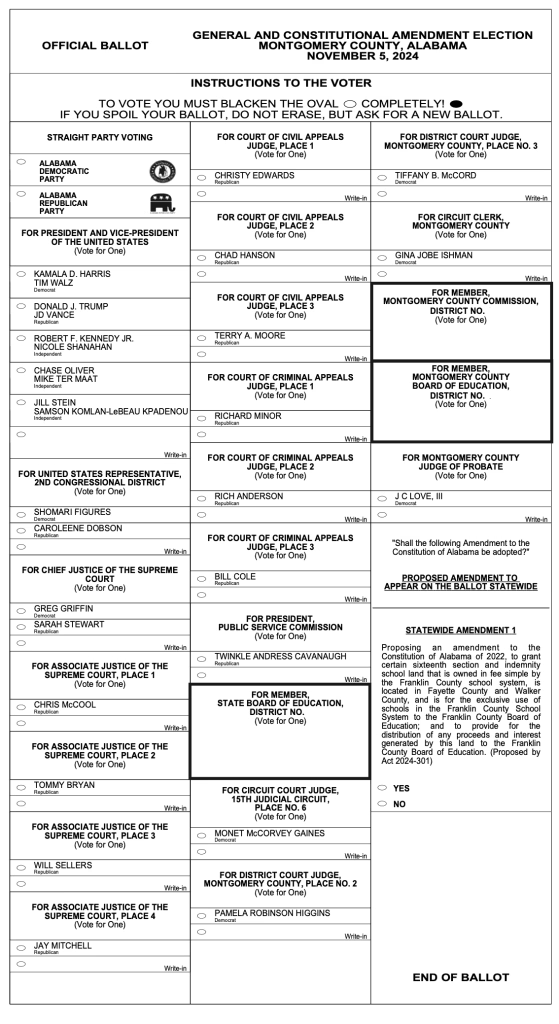
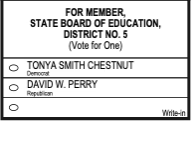
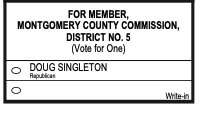
So, in looking at my sample ballot I note that I can vote for 21 offices and one constitutional amendment. However, only four of the races have more than one candidate. And, really, only the US House is competitive (and that’s because the state was forced to redraw House districts), and even then, it is a likely D win. The State Board of Education race is maybe quasi-competitive (but also in relative terms with the D the likely winner because of district lines).
The amendment reflects the super-weird Alabama state constitution that often asks the whole state to vote on hyper-local, and very specific, policy issues.
This isn’t exactly a ballot that reflects a healthy democracy, as most of it is just a pro forma exercise. We already know that the winners of the primary won office.
Part of it is that there are a number of offices that I would argue simply shouldn’t be elected (e.g., judges) or for whom a hearty debate over whether they should be elected (school boards, public service commission). My general view is that policy-specific boards should be appointed, but that’s not the point of this post.
Part of what I see before me is part of a very long history of poor competition at the state and local levels in Alabama. That is part of a general democratic deficit that is long-standing. Part of it, too, is that the way lines are drawn walls off voters and there is little reason for both parties to be healthy enough to compete.
Montgomery County is majority Black, and hence Democrats do better than in the state overall. But most of the judicial races are statewide, and hence the GOP dominates. When I moved to the state in the late 90s, Democrats were still one-party dominant at the state and local level, with the full switch not hitting until roughly 2010ish.
I will note that the state is majority Republican, so it is fully democratic for them to dominate statewide offices. But having so many uncontested elections speaks to a broader, unhealthy democratic environment. While I know that this can be blamed, in part, on the state Democratic Party, the reality is, as I have noted before, individual candidates, more than party apparatuses, drive elections in the United States. When there is little hope of access to office, parties wither and individuals choose not to run. Money does not flow to certain losers.
Part of the problem is that the state House and Senate districts are gerrymandering to help the GOP, meaning that the State Legislature is overly dominated by one party. This diminishes the legislature as an incubator for statewide candidates for the Democrats. While statewide, the ratio of Republicans to Democrats is close to 60:40, the State House of Representatives and State Senate are something like 75:25. In 2018, which I have handy, the specifics were as follows. The State Senate was 77.14% to 22.86% and the State House of 73.33% to 26.67%.