
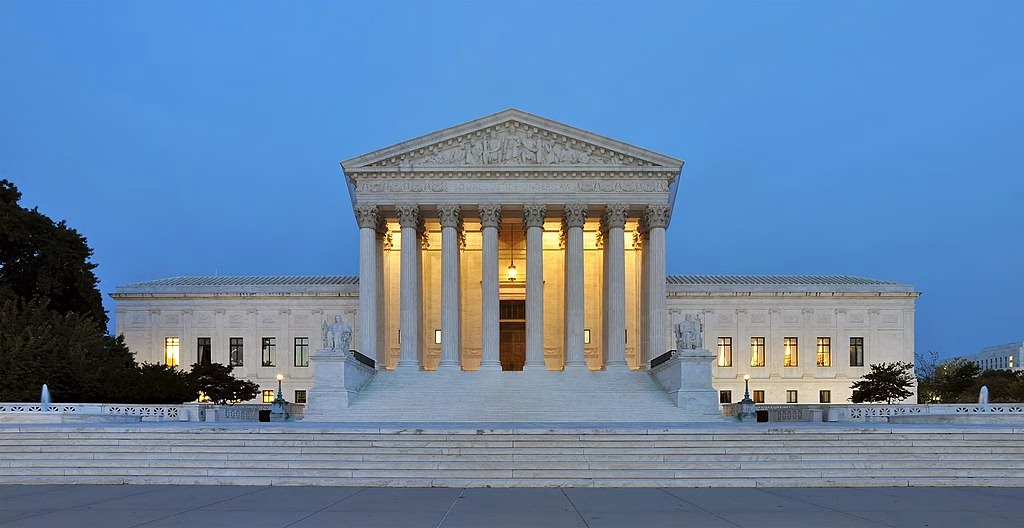
Back in March, I asked, “Should Sonia Sotomayor retire?” It was based on a demand coming from many Democrats and expressed specifically in a Josh Barro piece in The Atlantic. I was largely noncommittal, taking the position, “While Supreme Court appointments are for life and Sotomayor has every right to stay in what is, after all, a dream job so long as she’s fit to do it, it’s perfectly fair for her co-partisans and others who share her judicial philosophy urge her to step aside for a younger replacement” and noting, “Balancing an individual Justice’s desire to fulfill that awesome role with the realities of American politics is a strange and dangerous game of roulette.”
My co-blogger, Steven Taylor, was a bit more direct:
If SCOTUS is just a really cool job that goes to deserving persons, then they should never resign unless they want to.
If Justices are political leaders of the country, then they have an obligation to make some calculation as to how their retirements might have implications for the country (which one would expect to be guided, at least in part, by their own political POV).
Given their vast power, I think that they have some responsibility to consider how staying or going could matter.
Well, here we are eight months later, and the Democrats have lost a bid to keep the White House for another term and lost their Senate majority to boot. In between, Sotomayor celebrated her 70th birthday. Naturally, some argue that Sotomayor should hurry up and resign so that Biden and the lame-duck Democratic-majority Senate can confirm a replacement. A handful have even suggested that Elena Kagan, appointed just a year later but only 64, should join her.
There has been zero indication that Sotomayor herself is interested in retiring, and it’s not at all clear whether a lame duck nominee could clear the Senate.
WaPo (“With Trump win, focus turns to older Supreme Court justices“):
Democrats hoping to find a way to allow Biden to replace Sotomayor face major hurdles. Sotomayor has served on the court for 15 years, not especially long by modern standards. She has also been the senior liberal justice, a status that allows her to write significant dissents, for only two terms. She has not commented on the calls for her to consider retiring and did not respond to a request for comment Wednesday.
Even if Sotomayor did step down, “it’s far from clear that Senate Democrats would have the votes to confirm a replacement,” said Alex Aronson, executive director of Court Accountability and former Senate Judiciary Committee staffer.
Democrats have a slim 51-49 edge in the Senate until the newly elected lawmakers take office in January. Sen. Joe Manchin III, a Democrat turned independent from West Virginia who caucuses with his old party, said in March that he wouldn’t vote for any judicial nominee who lacked Republican support. He then softened his position and agreed to move forward on judicial nominees without Republican support in some instances.
“This is my own little filibuster,” Manchin told Politico at that time.
A spokesperson for Senate Majority Whip Dick Durbin (D-Illinois), chair of the Senate Judiciary Committee, said in a statement that the committee plans to continue working to confirm lower-court judges for the next two months. The spokesperson declined to comment on the prospect of moving a Supreme Court nominee if Sotomayor stepped down.
POLITICO (“Playbook: Dems agonize over Sotomayor“) adds:
This isn’t simply some flight of fancy happening among progressive activists online. It’s a conversation members of the Senate are actively engaged in.
One senator Playbook spoke with last night told us that the topic has come up repeatedly this week in talks with their colleagues. Inevitably, those conversations end up with a recognition of two realities: (1) It’d be a risky play with the party already trying to figure out how to handle a crowded lame-duck session, and (2) no senator seems to be offering to be the person to put his or her neck on their line publicly (or even privately) by pushing for Sotomayor to step aside.
[…]
If Sotomayor were to resign, “she can sort of resign conditionally on someone being appointed to replace her,” the Democratic senator told Playbook. “But she can’t resign conditioned on a specific person. What happens if she resigns and the nominee to replace her isn’t confirmed and the next president fills the vacancy?”
Then there’s the abbreviated timeline. Democrats would have to convince her to retire immediately, Biden would have to nominate a successor, they would have to figure out how to bring enough senators on board, dodge whatever obstructions Republicans throw in their way and get a whole floor vote before the new Congress is sworn in. There would be no room for error or delay.
“We would have to have assurances from any shaky senator that they would back a nominee in the lame duck, because what do you do if she announces she’s going to step down and then [independent West Virginia Sen. JOE] MANCHIN doesn’t support her and then [Republican Sens.] SUSAN COLLINS and LISA MURKOWSKI back off and say they’re not going to support a new nominee?” one senior Democratic source told us. “Do you just rescind that letter?”
The logistics, the senator suggested to us, may be insurmountable. (The phrase they used was “Beltway speculative conversation.”) Better, perhaps then, to focus on confirming lower-court judges, filling vacancies Trump can’t later fill himself.
lt’s odd that Kyrsten Sinema isn’t even mentioned; it’s not clear whether she’d go along.
Logistics aside, there was a time not long ago when this would have been unthinkable. While it’s become routine for Justices (even moderates like Sandra Day O’Connor and Anthony Kennedy) to time their retirements so that a same-party President can appoint their replacement, there hasn’t been a lame-duck session appointment in modern history, if ever. While Trump’s rush appointment of Amy Coney Barrett in the immediate aftermath of Ruth Bader Ginsburg sparked outrage, she was confirmed by the Senate and sworn in before the 2020 election.
But, of course, the Republican-controlled Senate’s refusal to even consider President Obama’s nomination of Merrick Garland to fill the seat created by the passing of Justice Antonin Scalia, despite it being made eight months before the 2016 election, changed everything. While my late co-blogger Doug Mataconis was right that this was simply hardball politics and well within the rights of Senate Republicans under Article III, it was a gross violation of our Constitutional norms.
Arguably, a lame-duck appointment and confirmation of a new Justice after the voters have signaled that they want Republican governance would be a more egregious move. But that’s the nature of thumbing one’s nose at the rules to gain temporary advantage: the opponent will almost certainly do the same when they get the chance. Indeed, allowing the other side to change the rules as they see fit while being a stickler for them yourself is to play with a permanent handicap.








