
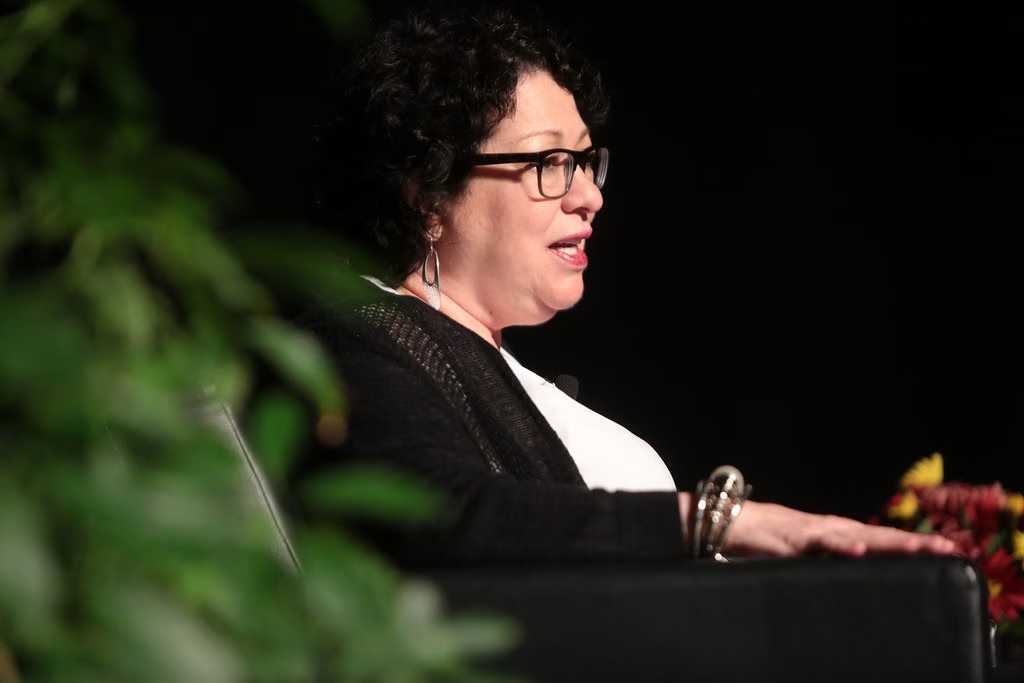
Josh Barro takes to The Atlantic to argue “Sonia Sotomayor Should Retire Now.” He bases his appeal on counterfactuals:
On Election Day in 2006, Justice Antonin Scalia was 70 years old and had been serving on the Supreme Court for 20 years. That year would have been an opportune time for him to retire—Republicans held the White House and the Senate, and they could have confirmed a young conservative justice who likely would have held the seat for decades to come. Instead, he tried to stay on the Court until the next time a Republican president would have a clear shot to nominate and confirm a conservative successor.
He didn’t make it—he died unexpectedly in February 2016, at the age of 79, while Barack Obama was president. Conservatives nevertheless engineered some good fortune: There was divided control of government, and then–Senate Majority Leader Mitch McConnell refused to even hold confirmation hearings for Merrick Garland, Obama’s nominee to the seat. Donald Trump won that fall’s election and named Neil Gorsuch to the seat that McConnell had held open.
But imagine for a moment that Hillary Clinton had won the 2016 election, as many expected. By running a few points stronger, she might have taken Democratic candidates across the finish line in close races in Pennsylvania and Missouri, resulting in Democratic control of the Senate. In that scenario, Clinton would have named a liberal successor to Scalia—more liberal than Garland—and conservatives would have lost control of the Court, all because of Scalia’s failure to retire at the opportune moment.
You see where this is going:
Justice Sonia Sotomayor will turn 70 in June. If she retires this year, President Joe Biden will nominate a young and reliably liberal judge to replace her. Republicans do not control the Senate floor and cannot force the seat to be held open like they did when Scalia died. Confirmation of the new justice will be a slam dunk, and liberals will have successfully shored up one of their seats on the Court—playing the kind of defense that is smart and prudent when your only hope of controlling the Court again relies on both the timing of the death or retirement of conservative judges and not losing your grip on the three seats you already hold.
But if Sotomayor does not retire this year, we don’t know when she will next be able to retire with a likely liberal replacement. It’s possible that Democrats will retain the presidency and the Senate in this year’s elections, in which case the insurance created by a Sotomayor retirement won’t have been necessary. But if Democrats lose the presidency or the Senate this fall—or both—she’ll need to stay on the bench until the party once again controls them. That could be just a few years, or it could be longer. Democrats have previously had to wait as long as 14 years (1995 to 2009). In other words, if Sotomayor doesn’t retire this year, she’ll be making a bet that she will remain fit to serve until possibly age 78 or even 82 or 84—and she’ll be forcing the whole Democratic Party to make that high-stakes bet with her.
In a theoretical world, of course, Supreme Court Justices are impartial arbiters, not partisan actors. Alas, we do not live in that world. While it’s doubtful that Trump wins and is followed by a Republican successor—Republicans haven’t won back-to-back elections since George W. Bush in 2000 and 2004 and have only won the popular vote once since 1988—anything is possible, I guess.
If Democrats lose the bet, the Court’s 6–3 conservative majority will turn into a 7–2 majority at some point within the next decade. If they win the bet, what do they win? They win the opportunity to read dissents written by Sotomayor instead of some other liberal justice. This is obviously an insane trade. Democrats talk a lot about the importance of the Court and the damage that has been done since it has swung in a more conservative direction, most obviously including the end of constitutional protections for abortion rights. So why aren’t Democrats demanding Sotomayor’s retirement?
Well, they are whispering about it. Politico reported in January:
Some Democrats close to the Biden administration and high-profile lawyers with past White House experience spoke to West Wing Playbook on condition of anonymity about their support for Sotomayor’s retirement. But none would go on the record about it. They worried that publicly calling for the first Latina justice to step down would appear gauche or insensitive. Privately, they say Sotomayor has provided an important liberal voice on the court, even as they concede that it would be smart for the party if she stepped down before the 2024 election.
This is incredibly gutless. You’re worried about putting control of the Court completely out of reach for more than a generation, but because she is Latina, you can’t hurry along an official who’s putting your entire policy project at risk? If this is how the Democratic Party operates, it deserves to lose.
Again, in a theoretical world, this is crass and bizarre. Sotomayor is not a Democratic Party operative and has no duty to listen to those who are. In that world, the very suggestion is offensive. But, again, that’s not the world we live in and, indeed, speculation about the retirement of Justices who hit a certain age has become routine.
The cowardice in speaking up about Sotomayor—a diabetic who has in some instances traveled with a medic—is part of a broader insanity in the way that the Democratic Party thinks about diversity and representation. Representation is supposed to be important because the presence of different sorts of people in positions of power helps ensure that the interests and preferences of various communities are taken into account when making policy. But in practice, Democratic Party actions regarding diversity tend to be taken for the benefit of officials rather than demographic groups. What’s more important for ordinary Latina women who support Democrats—that there not be one more vote against abortion rights on the Supreme Court, or that Sotomayor is personally there to write dissenting opinions? The answer is obvious, unless you work in Democratic politics for a living, in which case it apparently becomes a difficult call.
While I am admittedly not party to the conversations deep inside the bowels of the Democratic establishment, I would be shocked if Sotomayor’s status as The First Latina Justice was really that big a factor whether to approach her to urge her to step aside. If anything, it would simply increase the pressure (as was the case when Thurgood Marshall retired) to replace her with another Latina.
I thought Democrats had learned a lesson from the Ruth Bader Ginsburg episode about the importance of playing defense on a Court where you don’t hold the majority. Building a cult of personality around one particular justice served to reinforce the idea that it was reasonable for her to stay on the bench far into old age, and her unfortunate choice to do so ultimately led to Amy Coney Barrett’s appointment and a string of conservative policy victories. All liberals have to show for this stubbornness is a bunch of dissents and kitsch home decor. In 2021, it seemed that liberals had indeed learned their lesson—not only was there a well-organized effort to hound the elderly Stephen Breyer out of office, but the effort was quite rude. (I’m not sure screaming “Retire, bitch” at Stephen Breyer was strictly necessary, but I wasn’t bothered by it either—he was a big boy, and he could take it.) But I guess maybe the lesson was learned only for instances where the justice in question is a white man.
Again, I think Barro overstates the identity politics issue here. While there was certainly a bit of hero worship around The Notorious RBG, there was plenty of talk about her retirement. The earliest indicator I can find in the OTB archives is from February 2011. She was a month shy of 78 at the time— eight years older than Sotomayor is now. There are multiple posts on the idea in the years after that, with an increasing sense of urgency. In July 2014, the late Doug Mataconis lamented that “Liberals Still Think They Can Guilt Trip Ruth Bader Ginsburg Into Retirement.” By November 2018, he was begging Democrats to just “Leave Notorious RBG Alone.”
Regardless, in terms of pure party politics—and the consequences of having a Trump-appointed replacement rather than one appointed by Obama—the critics were certainly right. Most notably, of course, Roe was finally overturned. (Then again, Dobbs was 6-3, so it arguably would have happened regardless.)
Barro concludes,
One obvious response to this argument is that the president is also old—much older, indeed, than Sonia Sotomayor. I am aware, and I consider this to be a serious problem. But Democrats are unlikely to find a way to replace Biden with a younger candidate who enhances their odds of winning the election. The Sotomayor situation is different. Her age problem can be dealt with very simply by her retiring and the president picking a candidate to replace her who is young and broadly acceptable (maybe even exciting) to Democratic Party insiders. And if Democrats want to increase the odds of getting there, they should be saying in public that she should step down. In order to do that, they’ll have to get over their fear of being called racist or sexist or ageist.
Of course, a 69-year-old Justice retiring would actually lead to yet another round of questioning as to why the 81-year-old President doesn’t do the same.
I’m less doctrinaire than my late co-blogger Doug on this matter. While Supreme Court appointments are for life and Sotomayor has every right to stay in what is, after all, a dream job so long as she’s fit to do it, it’s perfectly fair for her co-partisans and others who share her judicial philosophy urge her to step aside for a younger replacement.
I’m roughly 12 years younger than Sotomayor and am unlikely to retire anytime soon. A colleague who turned 80 in December has announced his retirement at the end of this academic year but we wouldn’t have pushed him out had he not done so. But I’m old enough to remember when it was routine—even mandatory—to retire at 65, or even 62. In particular, all three of the Big Three network news anchors retired in rapid succession in the early 1980s.
Of course, college professors and news readers don’t have the final say on the law of the land. Balancing an individual Justice’s desire to fulfill that awesome role with the realities of American politics is a strange and dangerous game of roulette.








