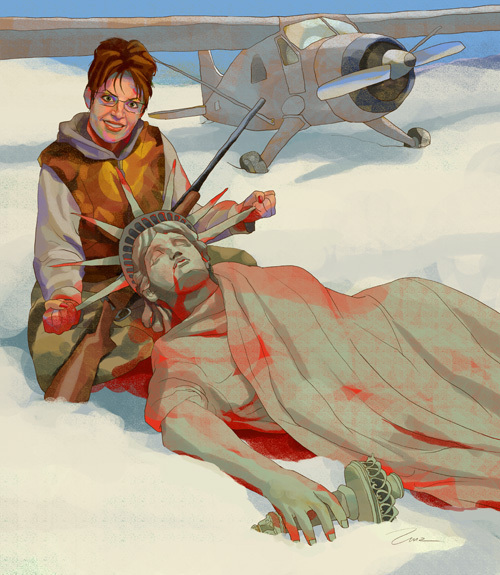
In a posting titled “The Lie of the Liberal Arts Education,” Jeff Goldstein recounts at length an emailed plea from a former professor to remove his name from the About page list of those under whom Goldstein studied. After a rather uncomfortable follow-up confrontation by telephone, Jeff discovered that this cartoon created and published on his blog by Darleen Click was the proximate cause of the controversy.
 Writes Jeff,
His position seems to be that allowing Darleen’s comic to stand — the President raping lady liberty “is not a political cartoon and you know it,” he told me — was sick and irresponsible, the abetting of a civil evil that is far worse than, say, drawing Bush as Hitler, or insinuating an American President manufactured a war and sent men and woman off to die so he could expand his portfolio.
[…]
Let me now say this: when [the professor] first wrote me, I was hurt. Now, I’m just angry. And indignant. This idea — coming from a fiction writer, a creative writing program director, and a university professor who instructs on creative endeavors — that a political cartoon or comic he found distasteful should have been removed by me as potentially incendiary and harmful, flies in the face of everything we have ever been taught about free expression, art, political speech, and the exchange of ideas (often heated) in the public square. It is the reverse of tolerance masquerading as a claim to the moral high ground.
It is an Orwellian world in which we live when f*****g novelists want to distance themselves from those who criticize the government. Were [the professor]’s disgust over the comic purely aesthetic, I could at least entertain his point. But that isn’t the case: instead, [the professor] objects to the content, and sees Darleen’s cartoon as the online equivalent of shouting fire in a crowded movie theater.
[…]
This is our modern academy, distilled to this singular objective correlative. And make no mistake: the university where [the professor] teaches is NOT on the far left, by university standards.
Now, I happen to find Click’s cartoon both amateurish and distasteful. Further, I disagree with its hamhanded message, both literally and philosophically. (That is, while I voted against Obama and oppose his health care plan, the process by which he got it passed into law was legitimate. Further, I tend to be Burkean when it comes to matters of representative government, so the election of November 2008 is indeed all the mandate Obama needs until the election of November 2010.)
That said, I’m in full agreement with Jeff about university professors — much less professors of English — having this reaction to the expression of ideas. Neither he nor Darleen Click are political leaders, who have some tangential responsibility to think about the impact of their words on their followers. Rather, they’re public intellectuals applying their creative talents to expressing their frustrations as best they can.
It’s debatable whether blogs constitute “the modern academy.” But it’s indisputable that it’s possible to live the “life of the mind” via blogging and I would argue that, in the main, Jeff is an outstanding case study.
Beyond that, professors rightly go to great lengths to protect academic freedom. As outlined over the years by the American Association of University Professionals, it “comprises three elements: freedom of inquiry and research; freedom of teaching within the university or college; and freedom of extramural utterance and action.” So it’s bizarre, indeed, for an English professor to argue so passionately for the suppression of speech.
It would, frankly, never occur to me to contact a former student and, in a huff over some cartoon, demand that they remove my name from their biography page. If I were, however, of a mind to criticize, I would engage the specific idea or utterance rather than try to hide our former relationship. There is, after all, plenty of history of teachers engaging former students (and vice versa) in rigorous intellectual debate. Indeed, it’s in the finest tradition of the academy. Calls for removing offensive speech? Not so much.
UPDATE: There appears to be some confusion among the commentariat. I’m not charging the professor in question with “censorship;” he is in no position to censor. Rather, I’m arguing that professors, and perhaps particularly those in the humanities and political science, have an affirmative duty to defend speech. Criticizing the content of the speech is not only fair game but sometimes approaches a duty. But calls for its suppression violate the core ethic of the profession.