
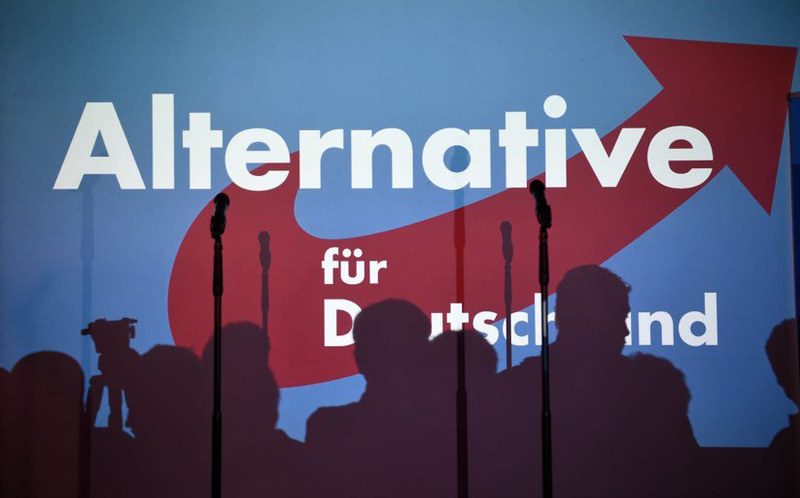
The Guardian (“Europe facing ‘grave moment’ as far-right AfD wins German poll and pledges to work with Elon Musk“):
Mainstream politicians around Europe have expressed alarm after the far-right Alternative für Deutschland (AfD) swept to a historic state election victory in Germany, while nationalist figures cheered the result as a mandate for change.
While falling just short of an absolute majority, the AfD surged into first place in the Saxony-Anhalt state election on Sunday, exit polls showed, putting the far right within reach of power at the state level for the first time since the second world war.
“It clearly sends out a very, very worrying signal,” France’s finance minister, Roland Lescure, said on Monday. “This shows that we face a major challenge in the face of a populist wave which is spreading around the world today and which we must resist.”
Lescure’s comments echoed similar remarks on Sunday evening by France’s European affairs minister, Benjamin Haddad, who posted on social media: “To see the far-right prevail in the German regional election marks a very grave moment for Europe.”
Haddad added: “We must listen with humility to the anger, fears and worries and duly respond to these concerns. But nationalism and xenophobia will never be the answer. We cannot forget our history.”
Poland’s foreign minister, Radosław Sikorski, said on Monday the AfD’s win was “a very worrying sign”. Poland’s prime minister, Donald Tusk, said on Sunday night in Poland, “only idiots or traitors can rejoice at the triumph of the AfD in Germany”.
Italy’s foreign minister, Antonio Tajani, described the election result as “terrible news … because it concerns a political force that is antithetical to liberal and western values”.
The reaction was not limited to Europe. Elon Musk congratulated the far-right party on its election victory with a “Well done!” on his social media platform X, prompting Ulrich Siegmund, the AfD’s lead candidate in Saxony-Anhalt, to thank the nativist US tech billionaire for his support.
“If we take on responsibility here, I would very much welcome the opportunity for strong and constructive cooperation,” Siegmund wrote. “Germany would then once again be a place worth investing in. Best regards from Saxony-Anhalt!”
The US president, Donald Trump, whose White House has made no secret of its support for Europe’s nationalist far-right parties, posted a screenshot of the projected election result on his Truth Social platform without any comment.
Kirill Dmitriev, Russia’s presidential envoy, took a screen grab of Trump’s post and praised a “historic win for the pragmatic AfD”. The AfD is pro-Kremlin, has called for an end to aid for Ukraine and and refugee status for Ukrainians.
The former Hungarian prime minister Viktor Orbán, who was heavily defeated in elections earlier this year, celebrated AfD’s win, describing it as “a huge night for Germany and Europe” and adding: “Buckle up. This is just the beginning!”
It’s a strange world, indeed, where Italy’s own far-right government is expressing alarm while the US President is siding with Russian and Hungarian autocrats.
Mark Landler, NYT (“Far-Right Victory in German State Sends a Signal to Europe“):
When a far-right party won a landslide victory on Sunday in a small state in eastern Germany, its reverberations could be felt from Downing Street in London to the Élysée Palace in Paris. Rarely has the result of a regional election been viewed with such portent for the fate of democracy in Europe.
This wasn’t just any European country; it was Germany, a country that has relentlessly isolated far-right political parties since the calamity of Nazism. And it wasn’t just a strange outlier, but rather the latest step in a steady, decade-long march that has brought the far right ever closer to the fulcrum of power in Europe.
With elections scheduled across Europe next year, the striking success of the party, Alternative for Germany, could be a harbinger of further far-right victories, according to analysts, as well as a template for how they can be engineered. Its populist, anti-immigrant message echoes those of nationalist leaders in Britain, France, Italy and Spain, all countries where voters harbor many of the same grievances as those in Germany.
French voters will elect a new president next spring. An election is due in Spain by August, and in Italy by the end of next year. Far-right candidates are surging in all of them, threatening incumbents blamed for systemic problems with their countries’ economies.
“Developed Europe is going through a version of sophisticated state failure,” said Mujtaba Rahman, an analyst who specializes in Europe at Eurasia Group, a political risk consultancy. “Governments are unable to address cost-of-living concerns. They are not able to deliver for their voters.”
In Germany, rising prices and high unemployment helped win the far-right party, known by its German initials, AfD, more than twice the number of votes as Chancellor Friedrich Merz’s center-right incumbent party.
The result laid bare a divide between Europeans who see the far right as a threat to democracy, and a growing number who see it as democracy’s savior. The former warn that the far right will dismantle checks and balances, while treating minorities as second-class citizens. The latter see it as a bulwark against an out-of-touch elite that has eroded their national identity and endangered their livelihoods.
We’ve seen this trend since at least 2016, when Brits voted to leave the EU and Americans elected Donald Trump. Working class voters across the West are angry about, well, everything. On issues ranging from immigration to globalization to social issues, they feel that mainstream parties have not served them well.
Still, this is a local race, not one to govern Germany. Further, it’s a state that was part of the former East Germany for decades, so less steeped in the backlash against Nazism than their western countrymen. And, as noted when I previewed this a few days ago, unlike America’s first-past-the-post method, the German electoral system does not necessarily give the plurality winner control.
Because the AfD appeared to fall just short of an outright majority, according to near-final results, it may not end up governing Saxony-Anhalt, the state where the election was held. Rival parties have vowed that they would not form a coalition government with the AfD, whose leaders have used Nazi slogans and minimized the Holocaust. The AfD is designated as a “suspected” extremist group by German intelligence, partly because the group portrays Germans of immigrant backgrounds as second-class citizens.
Al Jazeera produced this chart from the official results:

That AfD fell just shy of a majority, winning 39 of the 42 seats needed to form a government outright, is astounding. That it dwarfed the combined total (26.5%) of the two traditional parties—indeed, the delta between that total and theirs is exactly CDU’s vote—even more so. Indeed, it requires combining the five parties that finished behind AfD to surpass them.
If none of the other parties is willing to join a government with AfD—and they all claim that to be the case–it’s going to take one oddball coalition to form an alternative. Which, given the election outcome, may well backfire. AfD voters will rightly be angry to be shut out.
Regardless, who runs Saxony-Anhalt is far less interesting than what it may portend for the continent.
Still, the result could hobble Mr. Merz if members of his party blame him for the loss, at a time when Germany’s leadership in Europe was already faltering. Mr. Merz’s standing has deteriorated so badly that political analysts talk openly of his ouster, a once-far-fetched scenario in German politics.
“It’s a big concern in Europe,” said Mr. Rahman, who previously worked for the European Union’s civil service. “A weak Germany, with a chancellor who is coming unstuck and being forced to deal with domestic problems, is bad and will ultimately subtract from Europe’s ability to confront its challenges.”
Worries among centrists about France, where President Emmanuel Macron will step down next spring, are no less acute. Marine Le Pen, the candidate of France’s main far-right party, the National Rally, holds a commanding lead in first-round polls, and has even finished first in recent second-round matchups. That puts her closer to power than at any time in her 14 years of seeking the presidency.
A far-right government in Paris, Mr. Rahman said, would destabilize the European Union in a way that no other national election has, given France’s size, nuclear arsenal and founding role in the European project. It might also bring an end to the so-called cordon sanitaire, under which mainstream parties in France, as in Germany, have refused to enter governing coalitions with the far right.
“In both countries, the antifascist front that had prevailed since the end of the Second World War seems on the verge of collapse,” said Philippe Marlière, a professor of French and European politics at University College London.
In Spain, analysts said the far-right Vox Party could elbow its way into the next coalition government, with the current Socialist-led government tarnished by corruption scandals and an immigration crisis. In Britain, the governing Labour Party ousted its unpopular prime minister, Keir Starmer, in July to try to regain traction against a fast-rising far-right party, Reform U.K.
Landler does sound an optimistic note:
Still, the rise of the far right is not inexorable. Reform’s success has been rudely interrupted by a series of financial scandals involving its firebrand leader, Nigel Farage. That has given the Labour government, under a new prime minister, Andy Burnham, some unexpected breathing room.
In April, the far-right leader of Hungary, Prime Minister Viktor Orban, was swept out of power after 16 years, a casualty of widespread perceptions that his government was corrupt, inattentive to the economy, and had picked needless battles with the European Union. The defeat of his Fidesz party gave hope to mainstream politicians that the far right, too, is vulnerable.
Alternatively, it may be that the problem is incumbency. Unlike the others, Orban wasn’t an outsider railing against the unjust policies of those in power; he had to actually govern and be judged on the results.
Italy’s prime minister, Giorgia Meloni, whose populist party has neofascist roots, offers a playbook to other like-minded leaders. Having modulated her tone on issues like Ukraine and the European Union, she recently celebrated her government’s becoming the longest continuously serving in the history of the Italian Republic.
I had to stop reading there and look it up. It’s not correct by any standard that makes sense to Americans. She’s been in office 3 years, 320 days. One only has to go back to Silvio Berlusconi’s second (of three) stint as PM, from 11 June 2001 to 17 May 2006 (4 years, 340 days) to see a longer stretch. But, technically, while he never left office, he resigned, won a by-election, and put together a very different government. By Italian standards, that’s a break in government.
But I digress.
Ms. Meloni is in a decent position to extend that run when she faces voters next summer. But the rising profile of a rival even further to her right, Roberto Vannacci, has led her to harden her positions on issues like immigration. Ms. Meloni heaped criticism on Spain’s prime minister, Pedro Sánchez, after a sudden influx of migrants from Morocco into a Spanish territory in late July.
Mr. Farage risks being similarly outflanked in Britain. Rupert Lowe, a disaffected member of his party, defected to start an even more right-wing group that is siphoning votes from Mr. Farage. Given that competition, and the proliferating questions about Reform’s finances, Professor Bale said it was difficult to see how Mr. Farage could cobble together enough votes to form a government.
In France, Ms. Le Pen’s path to power is more plausible. Her poll numbers are more than double those of the leading centrist, Edouard Philippe, or the leading far-left candidate, Jean-Luc Mélenchon.
The big question in France is whether Mr. Philippe or anyone else will be able to gather enough support from the center right and left to emerge as the consensus mainstream candidate. In a second round of voting, analysts said, such a candidate would stand a chance of beating Ms. Le Pen.
But if France’s center remains fractured, as it is now, that would give Mr. Mélenchon a shot at making the second round, likely facing off against Ms. Le Pen. In that scenario — one that France’s political establishment views as a nightmare — Ms. Le Pen would be the odds-on victor.
The West does not seem to be in a centrist mood right now. Normalcy is not an appealing choice if you’re angry.
While American Democrats nominated Joe Biden in 2020 as a centrist alternative to Trump, the party is turning younger and more radical, if this year’s primary cycle is any indication. And while I’d like the Republican Party to steer in a more mainstream direction post-Trump, the likely 2028 nominees are all of the MAGA bent.
Like other far-right leaders in Europe, Ms. Le Pen has kept her distance from President Trump. But she and other populist candidates could be buffeted by him anyway, according to analysts. Mr. Trump remains deeply unpopular in Europe and is fast losing popularity in the United States as well.
At roughly 39% approval, he doesn’t have much to lose.
The lesson that Europe’s beleaguered centrists hope voters will take from America’s turmoil, Mr. Rahman said, is that “if you experiment with non-mainstream parties, you risk making mistakes.”
Alas, voters seem to have come to the conclusion that the mainstream parties don’t serve their interests. And, of course, given the nature of our system, Trump simply took over one of our two mainstream parties. And, like it or not, if AfD continues getting more votes than CDU and SPD, it’ll be hard to argue they’re not a mainstream party.









