
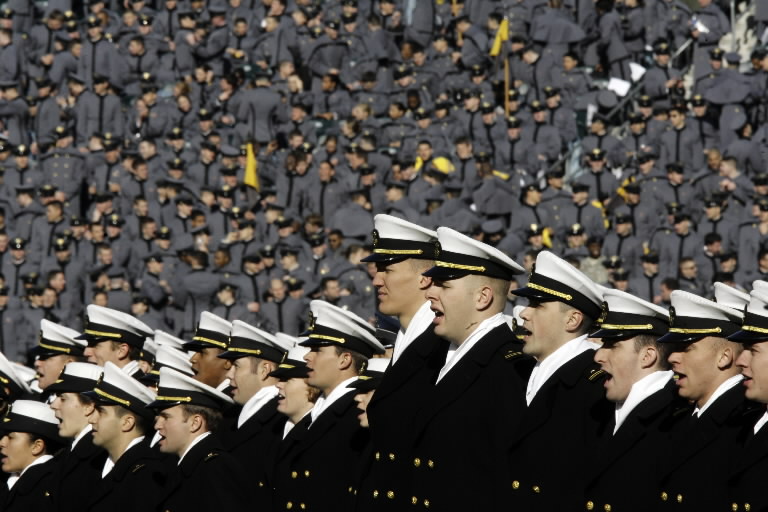
Naval Academy English prof Bruce Fleming has a scathing op-ed in the NYT titled “The Academies March Toward Mediocrity.”

First, he argues that the very idea of the Academies is dated:
[T]he Naval Academy, where I have been a professor for 23 years, has lost its way. The same is true of the other service academies. They are a net loss to the taxpayers who finance them, as well as a huge disappointment to their students, who come expecting reality to match reputation. They need to be fixed or abolished.
The service academies are holdovers from the 19th century, when they were virtually the only avenue for producing an officer corps for the nation’s military and when such top-down institutions were taken for granted. But the world has changed, which the academies don’t seem to have noticed, or to have drawn any conclusions from.
With the rise after World War II of the Reserve Officer Training Corps programs at universities around the country, the academies now produce 20 percent or less of the officers in each service, at an average cost to taxpayers of nearly half a million dollars per student, more than four times what an R.O.T.C.-trained officer costs.
The institutions are set on doing things their own way, yet I know of nobody in the Navy or other services who would argue that graduates of Annapolis or West Point are, as a group, better than those who become officers through other programs. A student can go to a civilian school like Vanderbilt, major in art history (which we don’t offer), have the usual college social experience and nightlife (which we forbid), be commissioned through R.O.T.C. — and apparently be just as good an officer as a Naval Academy product.
He makes several observations along these lines that ring true although, ironically, because they were true when I was a cadet at West Point from 1984 to 1986. Which is to say, since before Fleming was teaching at Annapolis.
Margaret Soltan, who pointed me to the piece, not surprisingly, glommed on to Fleming’s argument against Big Time Sports at the Academies.
Meanwhile, the academy’s former pursuit of excellence seems to have been pushed aside by the all-consuming desire to beat Notre Dame at football (as Navy did last year). To keep our teams in the top divisions of the National Collegiate Athletic Association, we fill officer-candidate slots with students who have been recruited primarily for their skills at big-time sports. That means we reject candidates with much higher predictors of military success (and, yes, athletic skills that are more pertinent to military service) in favor of players who, according to many midshipmen who speak candidly to me, often have little commitment to the military itself.
This is likely true, although we’re talking about a relative handful of slots, since football and basketball are the only sports where there’s much incentive to lower academic and conduct standards for recruiting. And there’s only so far one can go with that, since the 5-year service commitment tends to drive away true Blue Chip players with an eye on the pros.
This likely won’t win Fleming any friends:
Another program that is placing strain on the academies is an unofficial affirmative-action preference in admissions. While we can debate the merits of universities making diversity a priority in deciding which students to admit, how can one defend the use of race as a factor at taxpayer-financed academies — especially those whose purpose is to defend the Constitution? Yet, as I can confirm from the years I spent on the admissions board in 2002 and ’03 and from my conversations with more recent board members, if an applicant identifies himself or herself as non-white, the bar for qualification immediately drops.
But, again, to the extent this is a meaningful impact on the quality of the class, it’s a problem that predates Fleming’s tenure.
And if students struggle academically when they get to the academy, our goal is to get them to graduate at whatever cost. Thus we now offer plenty of low-track and remedial courses, and students who fail can often just retake classes until they pass: we have control over their summers and their schedules, and can simply drag them through with tutoring.
I’ve taught low-track English classes; the pace is slower and the papers shorter than in my usual seminars, but the students who complete them get the same credit. When I’ve complained about this, some administrators and midshipmen have argued that academics are irrelevant to being an officer, anyway. Really? Thinking and articulating are irrelevant to being an officer?
This was the case 25 years ago, too. At the time, the remediation tended to focus on the Rock Math class designed to get people up to snuff for what was, in its inception, an Engineering school. But that was changing even during my time there and, by the late 1980s, largely done, with West Point, at least, turning to a more standard curriculum. (I suspect Navy and, especially, Air Force have remained more math intensive given the greater technical demands of officership in those Services.)
We have two choices. One is to shut down Annapolis, West Point and the other academies, and to rely on R.O.T.C. to provide officers. Or we can embrace the level of excellence we once had and have largely abandoned. This means a single set of high standards for all students in admissions, discipline and academics. If that means downgrading our football team to Division III, so be it.
I’ve long advocated having the Academies join the Ivy League or otherwise getting out of the Big Time Sports racket. In addition to Fleming’s rationale, it just always seemed silly to face three choices at Division I-A: 1) Lower standards so as to be mediocre at best, 2) Lose a lot, 3) Rejoice in victories over patsies and I-AA schools. By joining an academic-intensive league, the competition would be among peers and every game would be more akin to the rivalry games between the Academies themselves.
As to the larger question of whether the Academies still serve a purpose, it’s hard to make a purely rational argument. There’s no statistical evidence of which I’m aware that Academy grads make better officers or even make careers at a higher rate. And, indeed, as Fleming notes, the Academies’ inability to, as a colleague of mine put it, differentiate “discipline from chickenshit” tends to produce cynics. All that remains, then, is the history, pageantry, and camaraderie that connection to the Long Gray Line and its sister equivalents brings. And I’m not sure that’s enough.









