
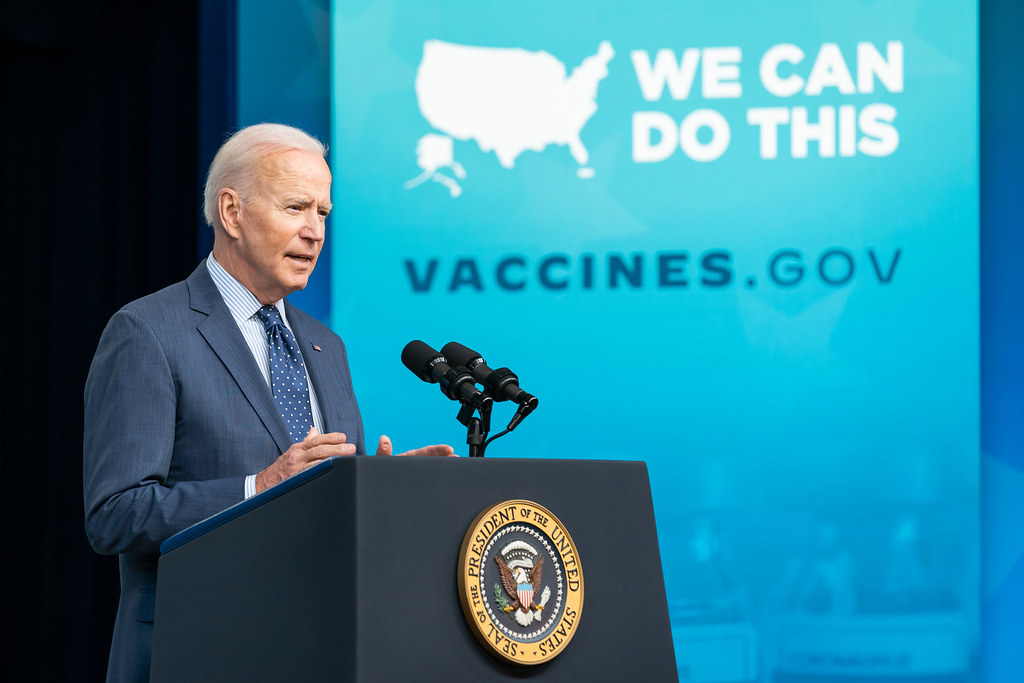

The CNBC headline “White House tells businesses to proceed with vaccine mandate despite court-ordered pause” certainly got my attention, implying as it does a defiance of judicial orders that would have been noteworthy even in the Trump era. The report itself is rather more anodyne.
The White House on Monday said businesses should move forward with President Joe Biden’s vaccine and testing requirements for private businesses, despite a federal appeals court ordering a temporary halt to the rules.
“People should not wait,” White House Deputy Press Secretary Karine Jean-Pierre told reporters during a briefing. “They should continue to move forward and make sure they’re getting their workplace vaccinated.”
As I often note, the White House, like the Pentagon, is a building. But, when used in headlines or in attribution for a news story, though, the reader will naturally assume the President, the Secretary of Defense, or another extremely-high-level policymaker is issuing the statement or order. Journalists and editors surely know this.
A spokesman for the President is not the President. Moreover, there’s nothing in the quoted statement or anywhere else in the story indicating that the administration is threatening business owners with consequences if they don’t carry out the order notwithstanding a judicial stay. Rather, they’re simply urging businesses to get their people vaccinated and follow CDC recommendations.
As to the stay itself, it strikes me as reasonable enough given both the reasonableness of the challenges to the order’s legality and the burden it places on businesses.
The U.S. Court of Appeals for the 5th Circuit, considered one of the most conservative appellate courts in the country, halted the requirements Saturday pending review, writing that “the petitions give cause to believe there are grave statutory and constitutional issues with the Mandate.”
The Republican attorneys general in Texas, Louisiana, Mississippi, South Carolina and Utah, as well as several companies, requested the pause. They argued that the requirements exceed the authority of the Occupational Safety and Health Administration, which will enforce the mandates, and amount to an unconstitutional delegation of power to the executive branch by Congress.
I have no strong sense of how this will ultimately play out, as the case law here is murky and we’ve gotten mixed indications from the Roberts Court. There’s next to no question that state governors have the power to order vaccinations; it’s much less clear that the President/OSHA does.
In its response Monday evening, the Biden administration asked the court to lift the pause, dismissing the states’ and companies’ claims of harm as “premature” given that the deadlines for vaccination and testing are not until January. The administration claimed that pausing the requirements “would likely cost dozens or even hundreds of lives per day” as the virus spreads. The Labor and Justice Departments also argued that OSHA acted within its authority as established by Congress.
The court-ordered pause came a day after the requirements went into effect, starting the countdown for businesses with 100 or more employees to ensure their staff have received the shots required for full vaccination by Jan. 4. After that date, unvaccinated workers must submit a negative Covid-19 test weekly to enter the workplace. All unvaccinated workers must start wearing face masks indoors at their workplaces starting Dec. 5.
Republican attorneys general in at least 26 states have challenged Biden’s vaccine and testing requirements in five different U.S. appeals courts since last Friday. The Republican National Committee said it has also challenged the requirements in the D.C. Court of Appeals.
It’s unclear which court will ultimately decide the case. When multiple petitions are filed in at least two courts, the cases are consolidated in one of those courts through a lottery system. The Justice Department said in a filing Monday that the lottery is expected take place on or around Nov. 16. The Biden administration, in its response Monday, said the courts should not rule until the jurisdiction for the consolidated case has been selected.
David Vladeck, a professor of law at Georgetown University, said there’s a “high probability” that the case will end up before the Supreme Court.
“There are justices on the court who want to rein in the administrative state and this is a case in which those concerns are likely to come to the fore,” Vladeck told CNBC.
Given the stakes here, this seems like a case that the Supreme Court should expedite. Given that multiple states have filed suit against the US Government, it would seem to fall within SCOTUS’ purview to hear the cases under original jurisdiction rather than waiting for multiple circuits to rule on the matter.
OSHA, which polices workplace safety for the Labor Department, developed the vaccine and testing requirements under emergency authority established by Congress. That authority allows the agency to shortcut the process to issue workplace safety standards, which normally takes years.
The Labor Department’s top lawyer, Seema Nanda, said on Friday that the Biden administration is “fully prepared to defend this standard in court.”
Nanda said the law “explicitly gives OSHA the authority to act quickly in an emergency where the agency finds that workers are subjected to a grave danger and a new standard is necessary to protect them.”
Nanda also said the vaccine and testing requirements supersede “any state or local requirements that ban or limit an employer’s authority to require vaccination, face-covering, or testing.” Texas Gov. Greg Abbott issued an executive order last month banning vaccine mandates in the Lone Star State.
OSHA emergency workplace safety standards have a mixed track record in court. Prior to the vaccine requirements, the agency had issued 10 such standards in its 50-year history. Courts halted or overturned four of those standards, and a fifth was partially vacated.
More than 750,000 people have died in the U.S. from Covid since the pandemic began, according to data from the Centers for Disease Control and Prevention. More than 1,100 people a day die from Covid, and more than 71,000 people a day are newly infected, according to data from Johns Hopkins University.
“If that’s not a grave danger, I don’t know what else is,” Jean-Pierre told reporters Monday.
As a matter of policy, I favor the mandates. They strike me as eminently sensible in the face of a pandemic that has killed more Americans than all our wars combined. The vaccines are incredibly effective and we’ve got an enormous amount of data at this point indicating that they are quite safe. Whether OSHA has been delegated sufficient power to issue them—or whether they are within the Constitutional limits of Federal power—is simply not something I have a strong opinion on.









